

Search this and you get the competition. The Omni Grove Park Inn in Asheville,
hundreds of entries, more than $40,000 in prizes, galleries of astonishing sugar architecture. All of it
true, and all of it written for someone who wants to go and look.
Almost nothing is written for someone who wants to enter. So this is that: what
the judging criteria actually mean when you are deciding what to build, and how to work backwards from a
date on which a finished sugar building has to be standing on a table in North Carolina.
The Deadline Is a Delivery Date
This is the thing that catches people, and it is worth understanding before
anything else. You do not submit a photograph. You drive or fly a finished, fragile, edible structure to
Asheville and put it on a table during a window of a few hours.
The published 2026 dates make the shape of it clear:
| Date | What happens |
|---|---|
| Monday, November 9 | Entry form due by 5pm EST. Your piece does not have to be finished. |
| Saturday, November 14 | Registration for Child and Youth divisions, 1pm to 5pm EST |
| Sunday, November 15 | Registration for Teen and Adult divisions, 8am to 1pm EST |
| Monday, November 16 | Judging, closed to the public, and the Awards Ceremony |
| Nov 17 to Jan 3 | Public display of every entry |
Two details in the official rules are easy to miss and both change how you
plan. You may bring three to five supplemental photographs showing your technique, and they must be
printed and handed over in person. And video submissions of any kind are not
accepted, so the time-lapse you were going to film is for your own audience, not the
judges.
The entry form deadline sitting almost a week before registration is the most
useful fact on this page. You commit while the thing is still half built. Most people who talk themselves
out of entering do it in October, on the grounds that they are not ready, when readiness was never what
the November 9 date was asking about.
Working Backwards
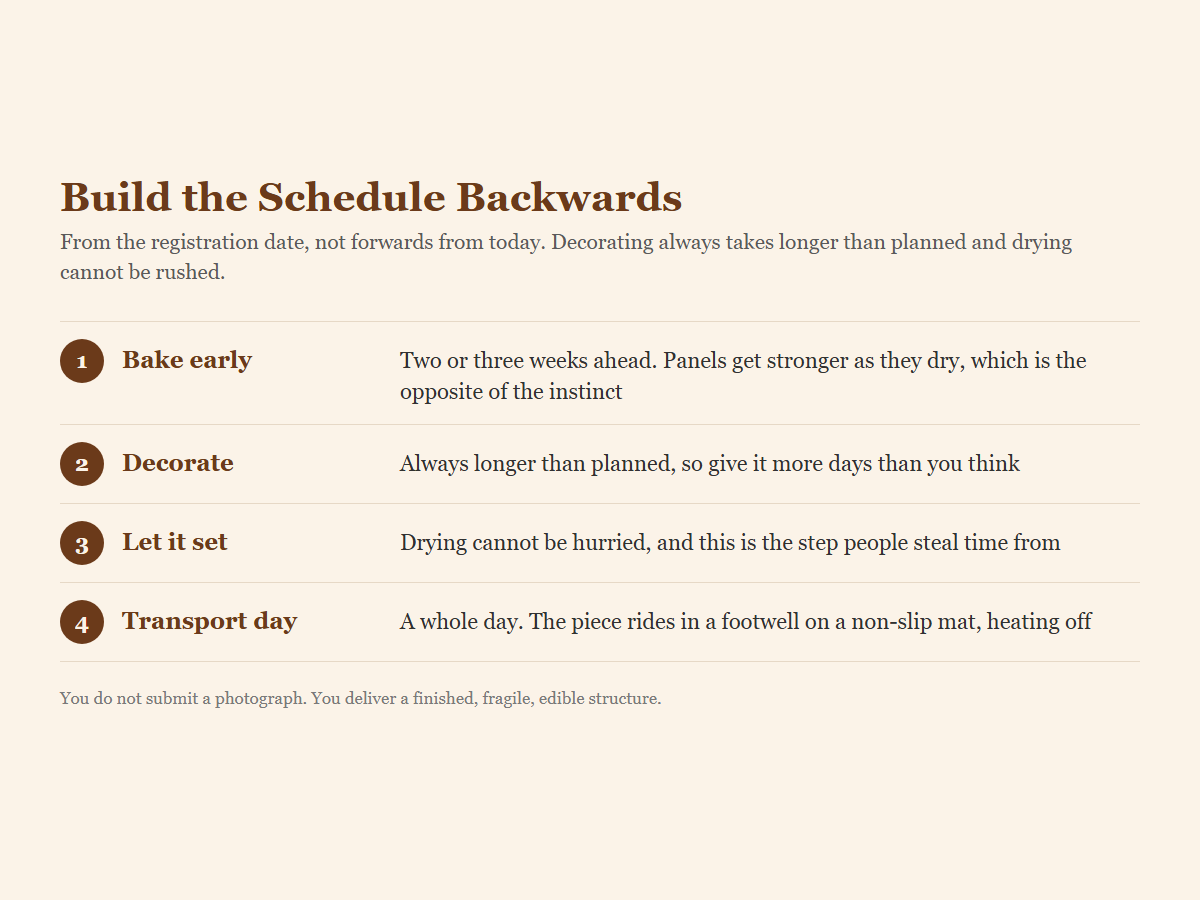
Every schedule for this should be built from the registration date, not forwards
from today. Decorating always takes longer than planned, drying cannot be rushed, and the transport day
is a whole day.
Bake early. Gingerbread panels get stronger as they dry out, so panels baked two
or three weeks ahead are better structural material than panels baked on the weekend, which is the
opposite of the instinct. Our notes on how long baked gingerbread holds
up apply directly here.
On transport: the piece rides in a footwell on a non-slip mat, not on a seat, and
the heating stays off. If you are flying or staying overnight, design the entry from day one to come
apart and go back together, and plan to finish it at the other end.
The Countdown
A competition deadline is a delivery date, not a submission date. Work backwards from the day the finished thing has to be on a table, and the schedule writes itself.
Asheville dates are the published 2026 ones: entry form due Monday November 9 by 5pm EST, Child and Youth registration Saturday November 14, Teen and Adult registration Sunday November 15, judging and awards Monday November 16. Always check the current official rules for your own year and division, because dates and divisions move. Nothing you enter here is stored or sent anywhere.
What the Judging Criteria Actually Ask For
Reported criteria across the major competitions come down to originality,
precision and difficulty, with theme consistency close behind. Allrecipes reports that judges work with
flashlights and magnifying glasses, which tells you which of the three carries the most weight in
practice.
Listing those three is where every other article stops. The useful part is that
they pull against each other, and most entries lose points by not choosing.
Difficulty and precision are a trade, not a stack
Difficulty rewards the hard thing: a domed roof, stained glass windows, a
cantilevered porch, a second storey, piped lacework. Precision rewards clean lines, even spacing and
invisible seams.
Attempt three hard elements and you will execute all three at about seventy per
cent, and the magnifying glass finds every one of the failures. One hard element executed
cleanly outscores three attempted, every time. So pick the one, and spend everything you save on
finishing.
Originality is the cheapest points on the board
A judge sees a great many suburban houses. The single least expensive way to move
your score is to build something that is not a house: a shop front, a chapel, a bus, a lighthouse, a
subway entrance, a room with one wall removed. Same skills, same techniques, completely different shelf.
Our collection of ideas that are not a house
is a reasonable place to start looking.
Precision is where home builders quietly lose
Three habits close most of the gap, and none of them is talent. Cut every panel
from a
template rather than by eye. Decorate the panels flat, on the bench, before assembly, because
piping a straight line on a vertical wall is far harder than piping one on a table. Then pipe a bead down
every seam so no joint is visible. Wobble reads as carelessness even when the idea is excellent, and
getting that right is mostly royal icing consistency and set
times.
The 75 Percent Rule Is a Design Constraint
Google's AI Overview summarizes the general rules as requiring entries to be
100 per cent edible and at least 75 per cent baked gingerbread, within a set base size, commonly around a
2 foot cube. Confirm the exact figures in the official rules for your own competition and year, because
they vary and they change.
Take that 75 per cent seriously at the design stage and it removes a lot of what
beginners plan. No internal cardboard. No wire armature. No foam core under the landscaping. A large
candy feature that reads beautifully in a photograph may push you under the gingerbread threshold on
its own.
What it means in practice is that gingerbread has to be doing the structural
work, which puts real weight on the dough. A construction dough is not a cookie dough with the sugar
reduced; it is a different recipe with a different job, and a construction dough that holds
an edge is the foundation of everything above it.
Score Your Entry Before a Judge Does
The most useful thing you can do a week out is look at your own piece the way the
panel will. Stand six feet back first, then go in close. The scorecard below runs the same criteria in
the same order, and it flags the two disqualification gates before it scores anything.
The Contest Scorecard
Score your plan against the five criteria the National Gingerbread House Competition publishes, before you bake anything. The weakest number is where your afternoon should go.
A planning aid, not an official rubric and not a prediction. The five criteria are the ones the National Gingerbread House Competition publishes; individual contests set their own rules, weightings and entry requirements, so read yours. Nothing you enter is stored or sent anywhere.
How Ambitious Should a First Entry Be
Less than you think, and this is not modesty. A clean, small, well-finished piece
with one interesting idea is a genuinely competitive entry, because precision is where the field thins
out. An ambitious piece finished in a panic is not.
If it is your first year, if you are flying, or if children are doing the
building, a smaller build is the
sensible call. Small pieces survive transport, finish on time, and let you spend your hours on the
finishing rather than on the engineering.
Finding a Competition That Is Not Asheville
Asheville is the national one, and it is not the only one. Local competitions run
at libraries, historical societies, botanical gardens, breweries, churches and town recreation
departments, and most of them are advertised for about three weeks in late October and never again.
We are not publishing a list, because a list of local holiday events is wrong
within a season and a wrong list is worse than none. What works is searching your own town or county
name with "gingerbread" in the first half of October, and checking your library and parks department
event calendars directly. Entry is usually free or nearly so, the standard is far gentler, and it is the
right place to find out whether you enjoy this before committing a November to it.
Printable Judging Sheet for a Home or Office Contest
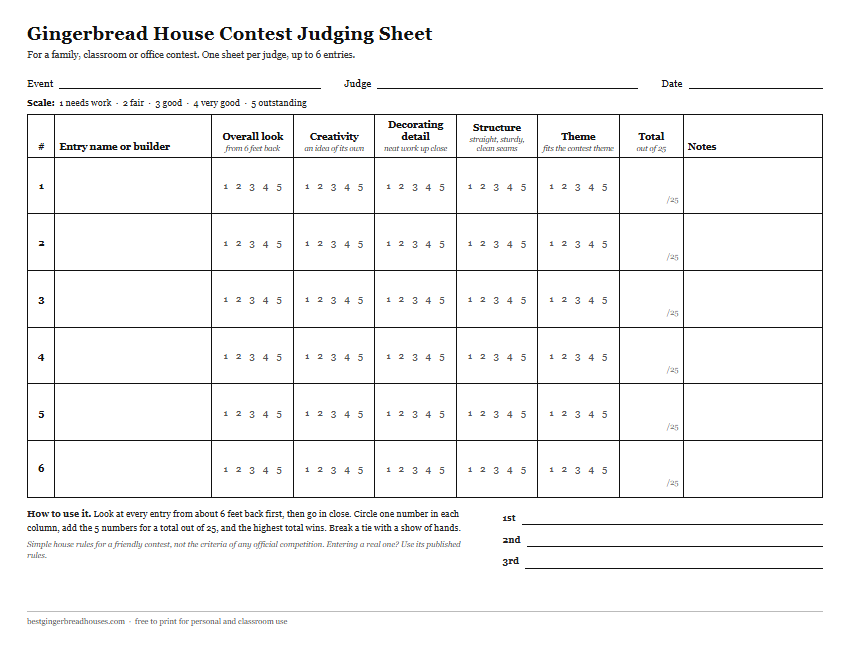
Running your own contest at home, in a classroom or at the office? This judging sheet gives each judge one page: up to 6 entries, five plain categories scored 1 to 5, and a total out of 25, with lines for first, second and third place. They are house rules for a friendly contest, not the criteria any official competition uses. Print it: US Letter PDF or A4 PDF.
Enter a Gingerbread House Competition with Best Gingerbread Houses
The competition is not really a baking problem. It is a scheduling problem, a
transport problem and a finishing problem, wearing a baking costume. Get those three right with a modest
design and you will place above a more ambitious entry that ran out of November.
Start with the construction dough
and the templates, and check
the official rules for your competition and year before you cut a single panel.