
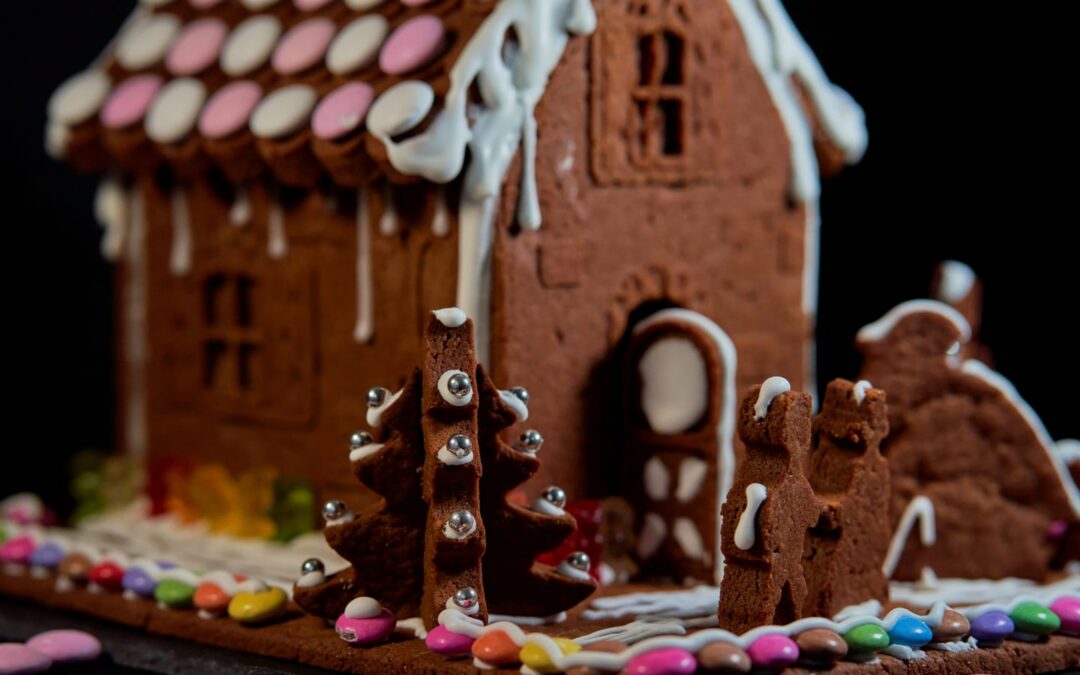
The gingerbread house in Hansel and Gretel was not made of gingerbread. In the Brothers Grimm text it is a house of bread, with a roof of cake and windows of clear sugar, and the gingerbread came later. This guide answers the story question properly, then shows you how to build a cottage that looks like the one in the tale rather than a Christmas house with a witch stuck on it.
The text we quote is D. L. Ashliman’s translation of the 1857 Grimm edition, hosted by the University of Pittsburgh, checked against his side-by-side comparison of the 1812 first edition. Where a claim rests on a secondary source, we say so.
By “the Hansel and Gretel gingerbread house” we mean both the house in the story, what it was built from and why it changed, and the house you make, whether that is a leaning witch’s hut for Halloween or a candy cottage for a December table. If you came here for a school project or a settle-the-argument answer, the first two sections are yours. If you are standing in a kitchen with a kit box and a child who wants the witch’s house, skip to the build. And if you enter a competition every year and want a themed piece with a real point of view, the crooked-wall section is where the difference lives.
By the end you will know exactly what the story says the house was made of, why nearly every picture of it is wrong in the same way, and how to cut, lean, glaze and decorate a cottage so it reads as hers at a glance. You will also have two working tools: one that does the geometry for a leaning wall, and one that plans the whole look from your version of the story.
The piece runs in three parts: the house in the story, the house on the page, and the house on your table. Start with the sentence everybody misquotes.
What the House in Hansel and Gretel Is Actually Made Of
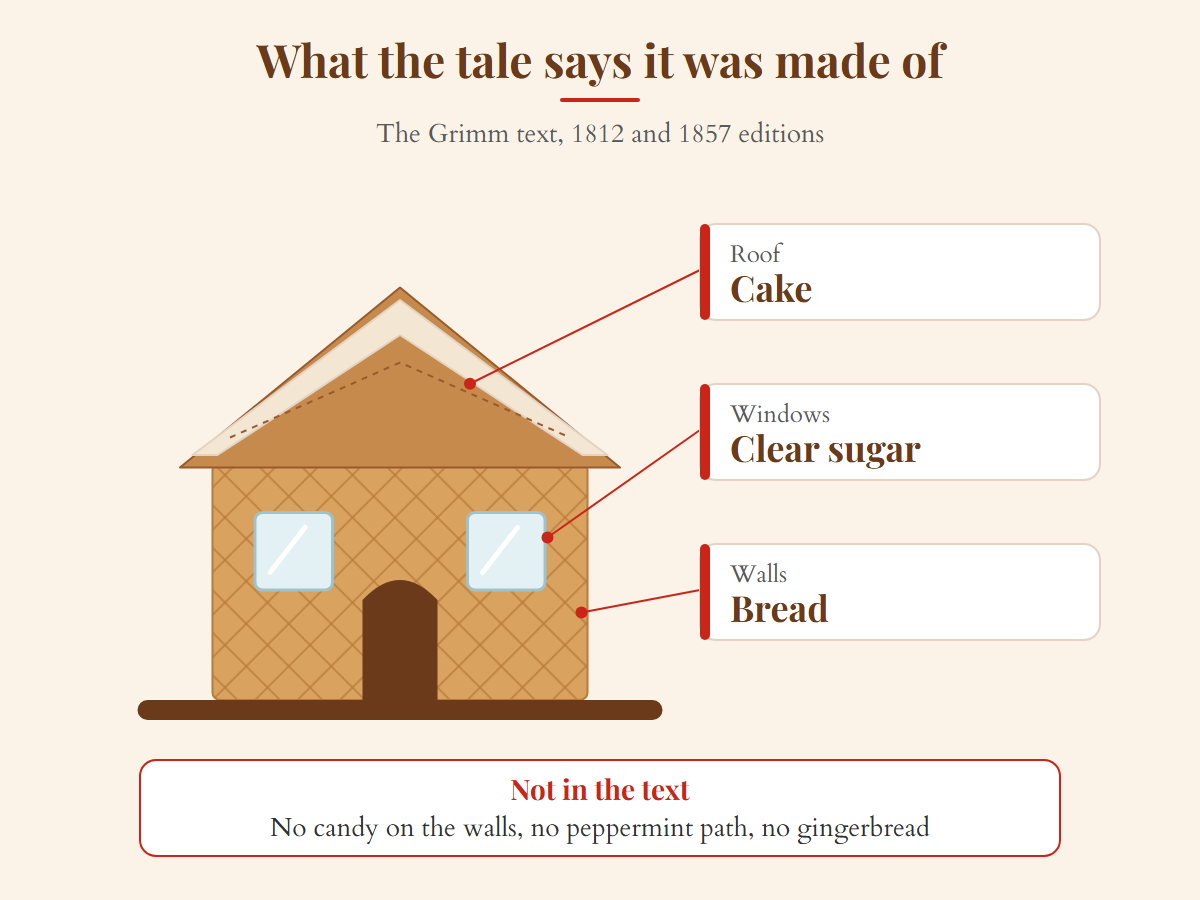
In the Grimm text, the children find “a little house built entirely from bread with a roof made of cake, and the windows were made of clear sugar.” That is the whole description. No candy on the walls, no peppermint path, no gingerbread. The wording is the same in the 1812 first edition and the 1857 final one; what changed between those editions was the parents, not the house. The woman who sends the children into the forest is their mother in 1812 and becomes a stepmother by the fourth edition of 1840, a change the side-by-side comparison of the 1812 and 1857 Grimm texts lays out edition by edition.
The witch’s rhyme is worth quoting too, because it tells you what the house is for. When the children start eating, a voice from inside calls “Nibble, nibble, little mouse, who is nibbling at my house?” The house is bait. It is edible so that hungry children will stop and eat, and the witch lets them eat because a child who is eating is a child who is not running.
Read that way, three details in the build matter more than any candy. The house has to look like food from a distance, it has to look safe up close, and it has to be somewhere nobody would find it. Everything in the build section below comes from those three lines.
Picture a fourth grader with a fairy tale project due Friday who has drawn a house covered in gumdrops and candy canes, because that is the house in every picture book. The project is not wrong, but the caption is. The tale says bread, cake and sugar. A two-line note explaining that the candy came from later versions is the kind of detail that gets a project remembered.
How a Bread House Became a Gingerbread One
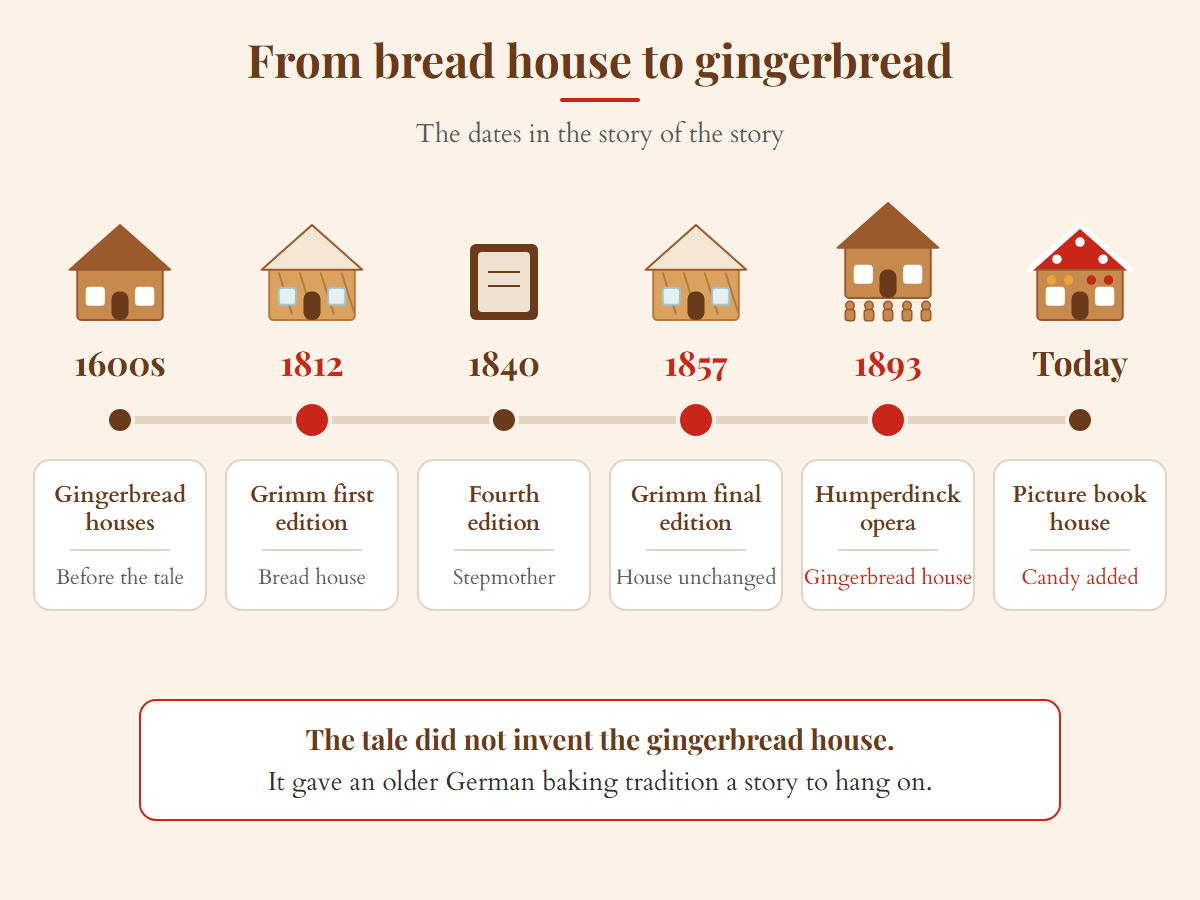
The short answer is that the story got adapted, and the adaptations were sweeter than the original. Bread became gingerbread, and gingerbread attracted candy. The version most often credited with the change is the 1893 opera by Engelbert Humperdinck, with a libretto by his sister Adelheid Wette, which put a gingerbread house on stage, usually with a fence of gingerbread children in front of it, the witch’s earlier victims. That crediting comes from the tale’s Wikipedia entry rather than a primary source, so treat it as the consensus rather than a proven cause.
What is not in doubt is the order of events. Gingerbread houses existed before the Grimms published. Smithsonian Magazine dates the first ones to the 1600s and says that by the time the Grimms wrote their version, gingerbread houses “were a long-standing tradition.” So the tale did not invent the gingerbread house. The tale, and then the opera, gave an existing German baking tradition a story to hang on, and the story is what spread. Our page on where gingerbread houses came from walks through that timeline, including why the “Grimms started it” claim has cause and effect backwards.
For a builder, the useful takeaway is that there are three different houses in this story, and you should pick one on purpose.
| Version | Walls | Roof | Windows | What sits outside |
|---|---|---|---|---|
| Grimm text, 1812 and 1857 | Bread | Cake | Clear sugar | Nothing described |
| Humperdinck opera, 1893 | Gingerbread | Gingerbread, often candy-trimmed on stage | Varies by production | A fence of gingerbread children |
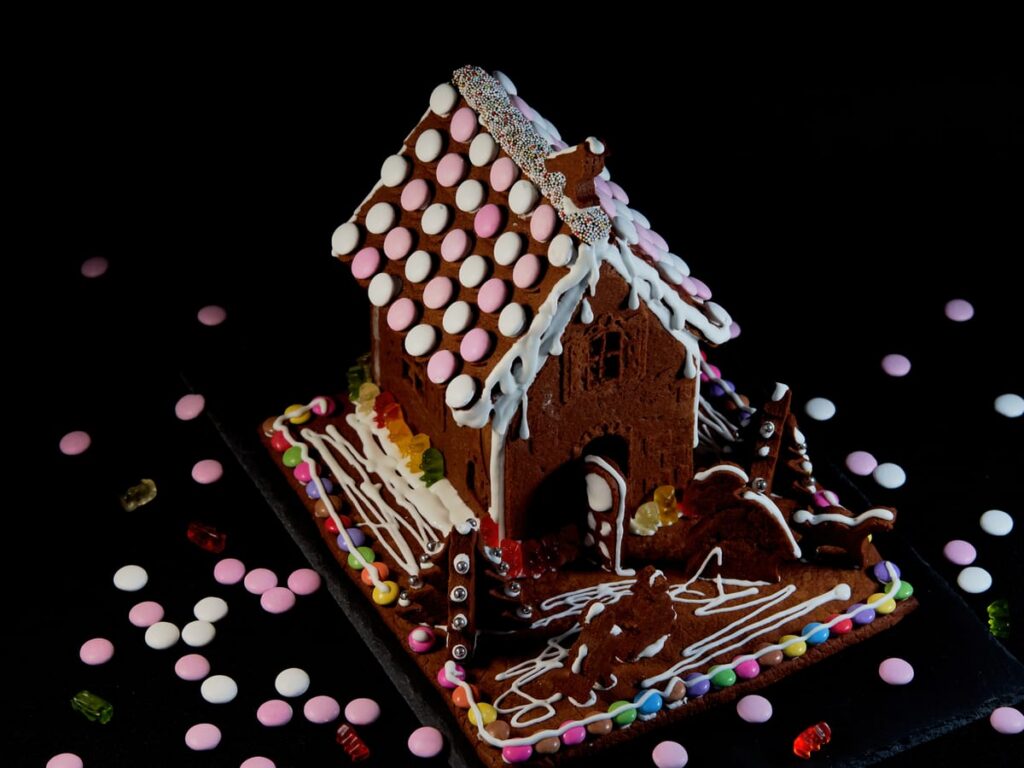
| The modern picture-book house | Gingerbread with candy | Candy shingles | Icing panes | Gumdrop bushes, candy cane posts, snow |
The third one is the house everyone builds by default. It is also the least like the story, and the least like a witch’s house. The other two are where a themed build gets interesting.
What the House Means in the Story
The house is a trap that works by looking like a gift. That is the whole point of making it edible, and it is why the story still lands: the danger is dressed as the thing you want most.
Where the idea came from is less settled than the retellings suggest. Smithsonian notes that “the tale of Hansel and Gretel may be even older than that, some historians say, perhaps dating to a 14th century famine in which parents turned children out to fend for themselves.” The folklorist Jack Zipes places the tale’s origin in late medieval Germany, and a house made of food also turns up in a 14th century text about the Land of Cockaigne, the medieval fantasy of a country where food grows on trees. Both of those last two points are reported in the tale’s Wikipedia entry and we have not traced them to the original scholarship, so read them as well-repeated rather than confirmed. What the famine reading gets right either way is the mood: this is a story about hunger, and the house is hunger’s own temptation.
There is a smaller debate that comes up every time this story is discussed online, and it is a good one to settle before you build with children. Who is the villain? One well-worn argument holds that Hansel and Gretel are trespassers who eat a woman’s house and then kill her. The story does not agree, and the rhyme is the reason: the house was built to be eaten, by children, on purpose. The witch is not a homeowner with bad luck. She set the table.
Say you are a parent doing this build with a six year old who is fine with the witch but does not want anything “too scary.” Lean on the lure, not the oven. A cottage that looks delicious and a little too welcoming is the story’s real menace, and it is one a small child understands completely. The dark part can stay in the book.
What Makes a Cottage Read as the Witch’s House
Four things, and none of them is a witch figure on the roof. A house reads as hers when it leans, when the yard is overgrown, when the candy looks like bait rather than decoration, and when there is no snow. Snow says Christmas. Bare ground, moss and a crooked fence say a forest nobody visits.
This is where the build forks, so decide which cottage you are making before you cut anything. If you are building for Halloween, take the lean, the moss, the black icing and one lit orange window, and skip the snow entirely; the haunted-house tricks on our spooky gingerbread house ideas page, especially the black icing that does not taste bitter, all apply here. If you are building for a December table and want the fairy tale without the fright, keep the walls straight, let the charm live in a gentle wobble along the roofline, and put the story in the yard with a gingerbread fence of small figures. The two versions share a dough and a mortar. They do not share a color palette, and mixing them is how a witch’s cottage ends up looking like a snow globe.
The candy question follows the same logic. A modern house wears candy as decoration, evenly, in matched colors. A lure does not. Put the sweetest, brightest things where a passing child would reach first, at the door and along the bottom edge of the walls, and let the roof be plainer. Our guide to candy sorted by house part has the full list of what sticks where; the change here is only in how you distribute it.
The Lean Rule: How Far a Wall Can Tilt and Still Hold a Roof
A leaning wall is a wall whose top edge has been shifted sideways. Cut all four walls with the same shift, so their edges still meet, and the roof panels stay the same width they always were, because a sideways lean does not change the gable. The only number you need is the shift, and it comes from the wall’s eave height and the angle you want: shift equals height times the tangent of the angle. A 5 inch wall leaned 7 degrees shifts its top edge about five eighths of an inch.
The Lean Rule is our rule of thumb for how far is too far. Keep the shift under a quarter of the wall’s width and the house behaves like a straight one with a stiff mortar and an overnight cure. Between a quarter and a third, it can stand, but it wants bracing while it cures and something solid, a chimney or a tree, leaned against the low side. Past a third of the width, the roof’s weight is sitting outside the base, and the house slides the moment the icing softens in a warm room. Those thresholds are a builder’s judgment, not a tested figure; the geometry underneath them is not in dispute.
The calculator below does the trigonometry and tells you which side of the rule your plan lands on.
The Crooked Cut Calculator
How far to shift the top edge of every wall so the cottage leans like a witch lives there and the roof still closes.
For planning only; results are not a guarantee that a house will stand. Not professional advice. Nothing you type is stored or sent anywhere; the math runs in your browser.
Two practical notes. Shear the walls, do not taper them: a wall that is narrower at the top looks like a mistake, while a wall that is the same width all the way up but shifted sideways looks like a house that settled. And because a leaning house puts more load on one seam, use the stiffest mortar you have. Our gingerbread house frosting page covers the royal icing that holds a wall up, why the pouch in a kit will not, and how long a joint takes to set before it can carry a roof.
Imagine a couple entering their office Halloween contest with a narrow cottage, walls 4 inches wide and 6 inches tall, leaned a full 13 degrees because more lean looked more haunted. That is a shift of about 1 3/8 inches, past a third of the wall’s width. The walls stand for an hour on the kitchen counter, the roof goes on, and by the time the entry reaches the office the whole thing has racked over into a parallelogram. At 7 degrees the shift drops to about three quarters of an inch, under a quarter of the width, and the same build reads as clearly crooked and stands all week. The lean that photographs best is smaller than the one that feels dramatic in the planning.
Walls Like Bread, a Roof Like Cake, Windows of Clear Sugar
If you want the cottage to match the text, the materials are the build. Each of the three is a small change to a normal house.
Bread walls
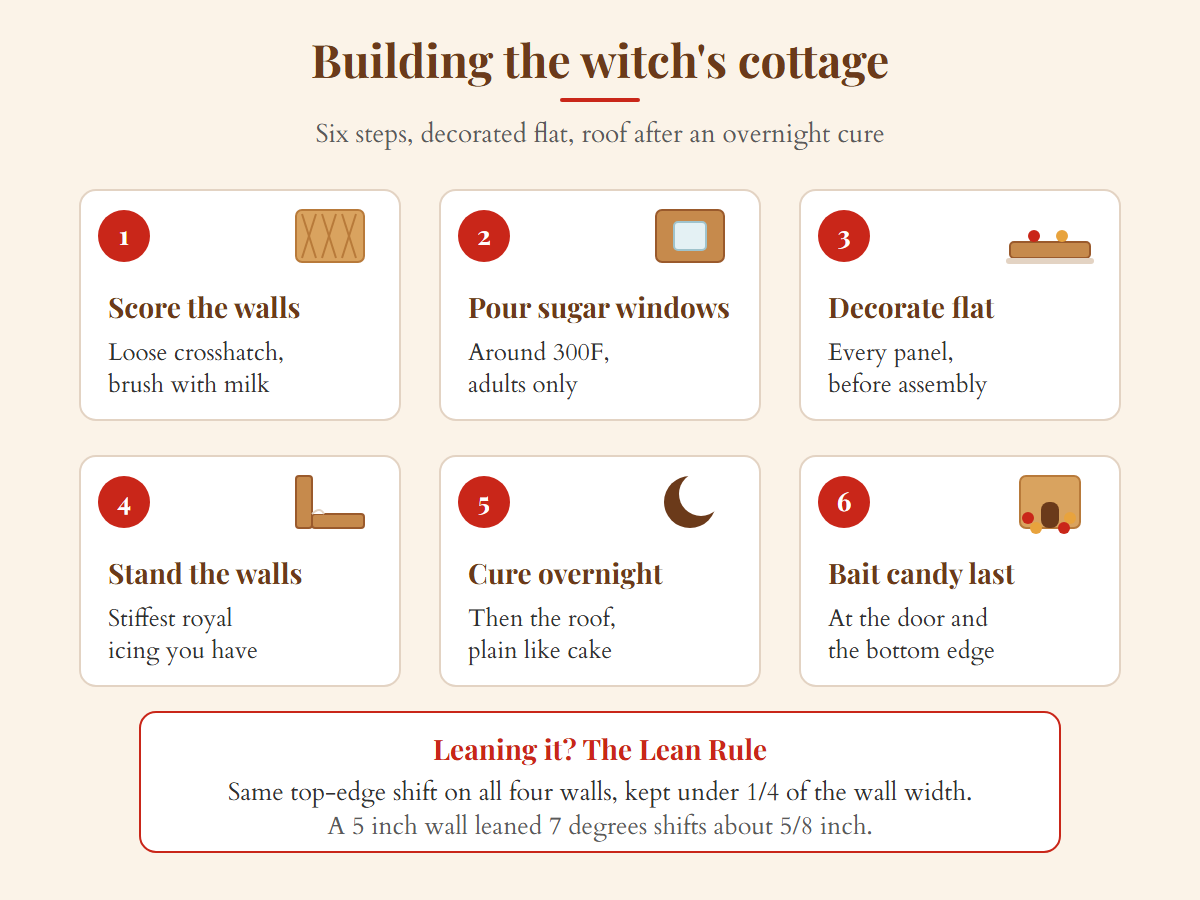
Gingerbread already bakes to a crust. To make a wall read as a loaf, score the rolled dough with a knife in a loose crosshatch before it goes in the oven, then brush the surface with milk so it browns unevenly. Leave the walls bare of candy. A wall that is scored, browned and empty reads as bread from across the room, which is exactly what the children saw.
The dough itself needs to be construction grade, because a leaning wall is a wall under load. Our gingerbread house dough recipe is built for that, and it explains the two ways a wall fails, sagging and snapping, which a crooked cottage will find faster than a straight one.
Cake roof
Do not build the roof from actual cake; it has no strength and it will not take icing. Make the roof read as cake instead. A plain gingerbread roof dusted heavily with powdered sugar looks like a frosted sheet cake. A roof shingled with thin chocolate wafers looks like a layered one. Either way, keep it plain: the text gives the roof no decoration, and a plain roof makes the sugar windows the brightest thing on the house.
Clear sugar windows
This is the one material the story specifies that most builders skip, and it is the one that makes the house look like the tale. Sugar glass is poured into the window cut-outs while the wall panel is lying flat, before assembly, and it sets clear. The method, the temperature, and the altitude adjustment are on our candy page under stained glass candy windows. For a witch’s hut, one drop of orange color in the syrup turns a clear pane into a lit one.
The syrup runs at around 300F and sticks to skin, so this step is adult-only work. Pour the windows the night before if children are decorating.
Candy That Reads as Bait
The planner below takes the version of the story you chose, who is decorating, and how much time you have, and returns the look, the candy by house part, and the one thing to leave off. Pick the 1812 bread house and it will tell you to skip the candy on the walls entirely, because the text has none. Pick the Halloween hut and it will tell you where the moss goes.
The Witch’s Cottage Planner
Pick the version of the story you are building, who is decorating, and how long you have. Get the look, the candy by house part, and the one thing to skip.
Planning guide only, not a guarantee of how any build turns out. Not professional advice. Your choices stay in your browser and are not sent anywhere.
One rule holds across every version: decorate every panel flat, before assembly. Piped windows, wafer shingles and sugar glass all go on with the wall lying on the counter, then the walls go up. This is doubly true for a leaning house, where pressing candy onto a standing wall is how a cured joint gets broken.
Building It With Children, and the Nibbling Problem
The story is about children eating a house, so a build with children ends with them eating this one. Plan for that rather than against it.
With children under eight, split the work by heat and by patience. Adults cut the dough, pour the sugar windows and stand the walls; children score the bread walls, lay the wafer shingles, and plant the yard. If the group is mostly adults, or older kids who can pipe, hand out the sugar glass and the leaning walls too, because those are the two jobs that look hard and are mostly waiting. For a classroom or a large group, a graham cracker house gives every child a witch's cottage of their own in one afternoon, and graham crackers score into bread walls with a butter knife.
On the nibbling: a gingerbread house made from real ingredients follows the same clock as any other cookie, and it stops being food long before it stops being a decoration. Our guide to how long gingerbread stays edible has the two clocks, eat-by and display-until. A witch's cottage that is going to be picked at should be built the day before it is eaten, not the week before. If the children are going to nibble the way Hansel and Gretel did, put the bait candy on last, and put it where they can reach it without touching a load-bearing wall.
Picture a second grade teacher with 22 children and a fairy tale unit ending on a Friday. Each child gets four graham crackers, a paper cup of royal icing, a fruit leather square for a window and a small pile of "bait" candy for the door. The crackers get scored into bread walls with plastic knives on Thursday, the houses go up Friday morning, and the class eats them at 2 o'clock, which is the only part of the story anybody is allowed to re-enact.
Frequently Asked Questions
Is the house in Hansel and Gretel made of gingerbread or bread?
Bread, with a roof of cake and windows of clear sugar, in both the 1812 and 1857 Grimm editions. Gingerbread belongs to later adaptations, the 1893 opera most of all.
Who wrote Hansel and Gretel?
The Brothers Grimm, Jacob and Wilhelm, published it in 1812 in the first volume of their Children's and Household Tales and revised it through the final edition of 1857. They collected the tale rather than inventing it; it circulated orally before them.
What is a witch gingerbread house?
A gingerbread house built to look like the witch's cottage from the story: leaning walls, an overgrown yard, candy placed as bait rather than as decoration, and usually a lit window. It is a Halloween build more often than a Christmas one, but the story itself has no season.
Can you make a gingerbread house lean without it falling down?
Yes, if every wall is cut with the same top-edge shift and the shift stays under about a quarter of the wall's width. Use a stiff royal icing and let the walls cure overnight before the roof goes on.
Can you eat the witch's house?
If it was built with real ingredients and has only been sitting out, it follows the same eat-by clock as any cookie, a couple of weeks at most. Build it close to the day it will be eaten, and treat anything older as decoration.
Build Your Witch's Cottage With Best Gingerbread Houses
The story gives you the plan: a house that looks like food, sits somewhere hidden, and leans a little because nobody sensible built it. The rest is dough, mortar and a few cuts made on purpose. If you would rather start from a box than from flour, our rated gingerbread house kits tell you which ones ship an icing that will actually hold a leaning wall, so you can spend the afternoon on the witch instead of the walls.