

A Bluey gingerbread house only works if it looks like the Heelers’ house, and that is not a cottage. It is a red-roofed Brisbane house up on brick piers, with a bay window, a verandah, white stairs and a tree full of red flowers on the hill.
Our house dough and royal icing recipes set every bake temperature and wait, and the free template was checked by a script so the piers, the floor, the walls and every roof piece fit. We matched the house from the show piece by piece: the striped red hip roof and chimney, the cream bay with its hooded window, the curved verandah roof, the blue arches between brick piers, and the picket fence on the hill.
You will end up with a house about 7 inches tall on a 12 inch board, from one batch of dough over two days. Start with the template, then the icing work, the plan and 16 steps.
Bluey Gingerbread House: At a Glance
- Difficulty: Medium to hard. Every cut is straight, but the house goes up in layers, the hip roof has four pieces, and the verandah roof is baked curved.
- Total time: about 1 1/2 days, in seven sessions. Most of it is icing drying.
- Active time: about 8 1/2 hours, counting the dough chill and the bake.
- Makes: a house 5 inches square and about 7 inches tall to the chimney, with stairs, a hill, a fence and two trees on a 12 inch board.
- Template: free 4-page PDF, US Letter, true size with a 1 inch test bar on every page.
Tools: printer, ruler, scissors, rolling pin with 1/4 inch guides, parchment, 2 half sheet pans, a clean food can about 3 inches across and foil, paring knife, 6 piping bags, two small round tips, toothpicks, cups for propping, offset spatula, 12 inch cake board, 1 battery LED tea light.
Materials
- 1 batch of dough that bakes flat and stays square
- 2 batches of our royal icing for flooding and piping
- Gel food coloring: red, brown, violet, sky blue, leaf green, yellow and ivory
- About 6 yellow hard candies, such as lemon drops
- 5 pretzel rods: 3 verandah posts, a poinciana trunk and a palm trunk
- Half a batch of crisp rice cereal treats for the hill and the tree, a red gumdrop for the chimney, small red candies for the flowers, white sugar pearls for the fence posts and 3 green gumdrops for bushes
Steps
- Print the template at Actual Size and measure the test bar.
- Make the dough and chill it for at least an hour.
- Roll the dough 1/4 inch thick and cut the floor plate, the main walls and the bay walls.
- Cut the roof pieces, the hood, the skirt, the rails, the stairs and the fence.
- Bake at 300 degrees F, the verandah roof over a can, then melt yellow candy into the windows.
- Trim every piece against the template while it is warm.
- Flood the verandah wall sage, the bay cream, the roofs red and the skirt pale blue.
- Pipe the arches and brick piers, the roof stripes and the bay weatherboards.
- Pipe the trim, the door and the railings, glue the stairs, and leave everything overnight.
- Stand the skirt and the bearer, set the floor plate on top, then wait 2 hours.
- Stand the main walls and the bay on the floor plate, then wait 2 hours.
- Set the hip roof and the bay roof, then add the hood and the chimney.
- Stand the posts and railings and set the curved verandah roof, then wait 4 hours.
- Stand the stairs.
- Build the hill, stand the fence and plant the two trees.
- Light the house with a battery tea light.
Notes: times are worked out from the set times on our icing page, not timed on a build. Ovens vary, so check every bake early and go by the matte surface and firm edge. Not an official Bluey product. Not approved by or associated with Ludo Studio, the ABC or BBC Studios. This is our own fan build, with no characters on it.
Free Printable Bluey Gingerbread House Template
The template is four US Letter pages with twenty shapes at true size over a faint 1/2 inch grid. Download the PDF, print it at Actual Size, and check that the red bar measures 1 inch before you cut anything.

| Piece | Cut | Size | What it does |
|---|---|---|---|
| Floor plate | 1 | 5 x 5 in | Carries the house, the bay and the verandah. |
| Main front and back walls | 1 + 1 | 5 x 2 3/4 in | Front: a window, a marked door and an opening behind the bay. Back: a light doorway. |
| Main side walls | 2 | 2 3/4 x 2 3/4 in | One window each. They tuck between front and back. |
| Bay front and bay sides | 1 + 2 | 2 in wide, 3 3/4 in to the peak; sides 1 1/4 x 2 3/4 in | The cream gable with the bay window. |
| Hip roof | 2 trapezoids, 2 triangles | 5 1/2 and 3 3/4 in at the eave, 2 2/3 in slant | The red roof, all four sides at 45 degrees. |
| Bay roof panels | 2 | 1 1/2 in at the eave, 2 3/4 in at the ridge | Their back edges follow the valley onto the hip roof. |
| Verandah roof and hood | 1 + 1 | 2 7/10 x 2 3/10 in; 1 x 1/2 in | The curved bullnose roof and the dome over the bay window. |
| Skirt and bearer | 2 + 2 + 1 | 5, 4 1/4 and 4 1/2 x 1 3/4 in | Blue arches between brick piers, plus a hidden bearer. |
| Rails, stairs, fence | 2, 2 + 3, 2 | see the piece list | The verandah railing, four even steps and the picket fence. |
The skirt is 1 3/4 inches tall, so with the 1/4 inch plate the verandah floor sits 2 inches up: exactly four stair steps of 1/2 inch. The main block takes the back 3 1/4 inches of the plate. The pieces come to about 167 square inches, so one batch covers them if you re-roll the scraps once.

For a different shape next time, the dozen more printable house patterns on our templates page fit together the same way.
Why the Heeler House
Bluey is an Australian cartoon about a family of dogs, created by Joe Brumm and made by Ludo Studio in Brisbane, and it first aired on ABC Kids in October 2018, according to Screen Queensland’s launch release. The fan wiki Blueypedia describes the family home as an old Queenslander at the end of a cul-de-sac, with cream wooden walls, white fences and accents, a red roof, brick supports and a huge poinciana tree out the back. The official Bluey’s World page calls it a classic Queenslander with a verandah out the front.

Here is what we copied from the show. The striped red roof with a bell-shaped chimney pot. The cream bay on the right with white trim and a bay window under a red dome. The verandah on the left with a curved red roof, a sage wall and a green door with a round window. White stairs in the middle. Pale blue arches between brick piers under the house. And the white picket fence, the poinciana and the palm on the hill.
Is There a Bluey Gingerbread House Kit?
We found no official Bluey gingerbread house kit this season. The closest official version of the house is a toy: LEGO sells a Bluey’s Family House building set. To get one you can eat a corner of, bake it from the template on this page, or use the kit shortcut near the end.
The Arches, the Red Roof and the Bay: The Icing Work
The piers and arches. Flood the four outer skirt pieces pale blue. Once they crust, pipe tall white arches along the dotted guides, then a column of purple brown bricks at each end: brown with a drop of violet, piped as little offset rectangles. Leave the bearer bare.
The red roof. Flood every roof piece, the hood and the verandah roof brick red. Once it crusts, pipe thin stripes from eave to ridge in red with a drop of violet. The purple stripe is what makes it the show’s roof.
The bay. Flood the bay front and sides cream, then pipe fine horizontal lines for weatherboards and a thick white line up both gable edges. Flood the main front wall sage green, with a drop of leaf green and yellow in white icing. Try other colors in the studio below before you tint a bowl.
Heeler House Color Studio
Start from the show colors, or try your own. The preview updates, and you get the icing mix for the walls and the roof.
Colors on screen are approximate, and gel colors vary by brand, so tint a spoonful and let a dot dry before you mix the whole bowl. Nothing you choose leaves your browser.
How Long It Takes, Day by Day
Plan on seven sessions over two days, about 8 1/2 hours of hands-on work. The floor plate sets on the skirt before any walls go on.
| When | What you do | Hands-on | Then wait |
|---|---|---|---|
| Day 1, morning | Print, make and chill the dough, cut, bake, melt the candy windows and trim. | About 3 hours | Until cool |
| Day 1, early afternoon | Flood the walls, the roofs, the hood and the skirt. | 50 minutes | About 1 hour |
| Day 1, afternoon | Pipe arches, bricks, stripes, weatherboards, trim and railings. Glue the stairs, pipe the palm fronds. | About 70 minutes | Overnight, pieces flat |
| Day 2, early morning | Stand the skirt and bearer and set the floor plate on top. | 40 minutes | 2 hours |
| Day 2, mid morning | Stand the main walls and the bay. | 40 minutes | 2 hours |
| Day 2, midday | Set the hip roof and bay roof, the hood, the chimney, the posts, the railings and the verandah roof. | About 1 hour | 4 hours |
| Day 2, late afternoon | Stand the stairs, build the hill, fence and trees, and light it. | About 1 hour | Overnight before you move it |
Bluey Gingerbread House Build Day Planner
Pick when you want the Heeler house finished. The planner counts back through every drying time and tells you when to start baking.
For planning only: icing sets faster or slower with the weather, so treat each wait as a minimum and check that joints feel firm before moving on. Not professional baking advice. Nothing you enter leaves your browser.
How to Make a Bluey Gingerbread House Step by Step
1. Print the template and measure the test bar
Print all four pages at Actual Size or 100 percent, never Fit to Page, and check that the red bar reads exactly 1 inch.
Why this matters: a skirt printed a little short leaves the stairs one step out.

2. Make the dough and chill it
Make one batch of house dough, split it in two, flatten each half into an inch-thick disc, wrap and chill for at least an hour, until a poked disc dents and stays dented.
Why this matters: cold dough spreads less, so the skirt pieces stay the same height and the floor sits level.
3. Roll the dough and cut the floor plate, the main walls and the bay walls
Roll a disc on parchment to an even 1/4 inch between guide strips. Cut the floor plate, the main front and back walls, the two main side walls, the bay front and the two bay sides, then cut out every window, the opening behind the bay and the light doorway. Trace the door with a toothpick instead of cutting it, and press the guide lines lightly into the floor plate.
Why this matters: the opening behind the bay lets the tea light shine through the bay window too.

4. Cut the roof pieces, the hood, the skirt, the rails, the stairs and the fence
From the second disc, cut two hip trapezoids, two hip triangles, two bay roof panels, flipping the paper for the second, the verandah roof and the hood. From the scraps, cut the skirt pieces, the bearer, two rails, two stringers, three treads and two fence strips. Snap three pretzel rods against the 2 inch post guide.
Why this matters: the bay roof panels are mirror images. Cut both the same way up and one will not fit.


5. Bake the pieces, then melt yellow candy into the windows
Bake at 300 degrees F. Flat pieces take 22 to 30 minutes, until matte with a firm edge. Bake the verandah roof draped over a foil-wrapped can on its side, so it sets in a curve, and start checking the small pieces and the curved roof at about 12 minutes. Pull the walls about 5 minutes early, fill each window two crushed candies deep, and bake again until the candy melts flat.
This is how you melt hard candy into clear windows on any house. Hard crack, where the candy flows, is 300 to 308 degrees F at sea level per Colorado State University Extension, so it melts slowly here. If it is still lumpy after about 10 minutes, raise the oven to 325 degrees F and watch closely.
Why this matters: a curve baked in stays put. Bending a cooled piece just snaps it.

6. Trim every piece while it is warm
Within two minutes of each pan coming out, trim any edge that spread past the paper piece. Check the four skirt pieces and the four hip roof pieces most carefully. Leave everything on the pan until cool.
Why this matters: uneven skirt pieces tilt the floor, and hip pieces that spread leave gaps at the corners.
7. Flood the walls, the roofs and the skirt
Thin most of the first batch of icing until a knife line closes in about 10 seconds. Flood the main front wall sage, the bay pieces and main side walls cream, every roof piece and the hood brick red, and the outer skirt pieces pale blue. Leave the plate, the bearer and the stair pieces bare.
Why this matters: the stripes, arches and weatherboards only stay crisp on a flood that has crusted.

8. Pipe the arches, the brick piers, the roof stripes and the weatherboards
Once the floods look matte, about an hour, pipe the white arches and the brick piers on the skirt pieces, the violet red stripes on every roof piece, and fine weatherboard lines on the bay pieces.

9. Pipe the trim, the door and the railings, then glue the stairs
Flood the door green with a round window piped in pale green. Pipe white frames, white trim up the bay gable and white balusters on the rails. Glue a tread across the two stringers at each step and flood the stairs white. Pipe palm fronds in green on parchment. Leave everything flat overnight.
Why this matters: the stairs and the fronds need the night to set hard.
10. Stand the skirt and the bearer, then set the floor plate on top
Spread thick white icing where the house will go, a little behind the middle of the board. Stand the skirt back, the two sides and the front, so the sides tuck between. Stand the bearer across the inside, 1 1/2 inches behind the front. Pipe icing on every top edge, lower the floor plate on flush at the back and sides, check it is level and wait 2 hours.
Why this matters: the bearer sits right under the main front wall. Without it, 1/4 inch of cookie carries the whole wall.

11. Stand the main walls and the bay on the floor plate
Stand the back wall flush with the back of the plate, then the side walls, then the main front wall on its guide line. Glue the bay front on its guide, 1/4 inch in from the plate edge, and the two bay sides between it and the main wall. Prop with cups and wait 2 hours.
Why this matters: the main front wall stands right above the hidden bearer, and the bay walls frame the opening so the light reaches the bay window.

12. Set the hip roof and the bay roof, then add the hood and the chimney
Pipe icing on the tops of all four main walls. Lean the two trapezoids on from the front and back, hold them, then slide the two triangles in at the sides and pipe every hip seam. Set the bay roof panels from the gable back onto the hip roof, pipe the valleys, and glue the hood over the bay window. Push a red gumdrop on a short piece of pretzel into the roof on the left for the chimney.
Why this matters: the bay sits 1/2 inch in from the corner so both of its roof panels land on the same flat face of the hip roof.

13. Stand the posts and railings, then set the curved verandah roof
Push a pretzel post into a blob of icing at the front left corner of the plate and one each side of the stair gap. Glue the front rail between the first two posts and the side rail back to the house. Pipe a line across the verandah wall under the main eave and a blob on each post, set the curved roof on and hold it a minute. Wait 4 hours.
Why this matters: the railings brace the posts before any roof weight lands on them.
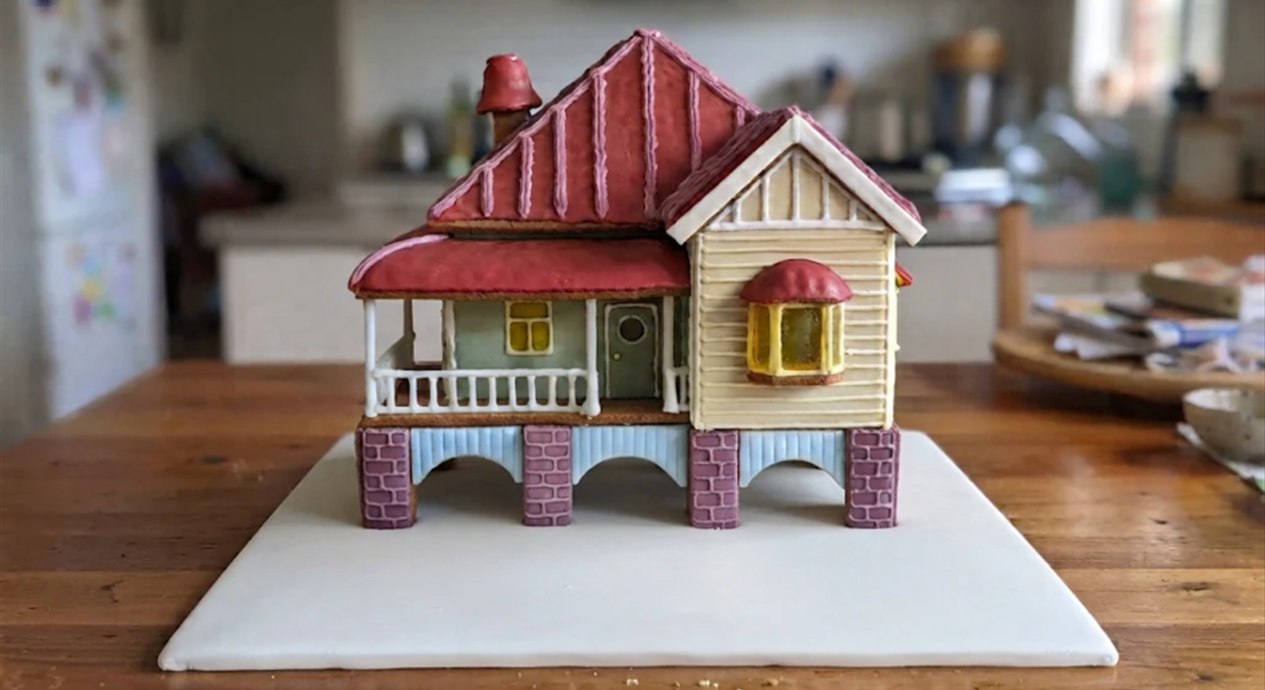
14. Stand the stairs
Pipe icing along the bottom and back edges of the stringers and push the stairs into the stair gap.
Why this matters: four even steps read as stairs. Uneven ones read as a ramp of cookies.
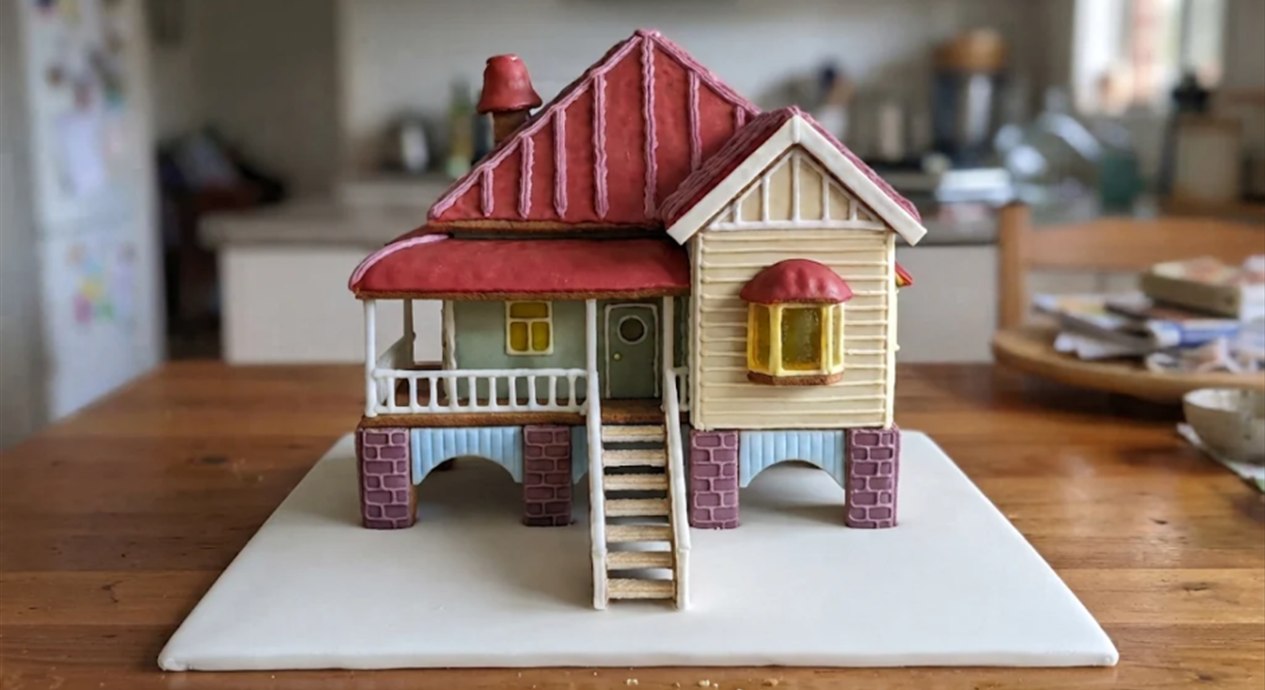
15. Build the hill, stand the fence and plant the two trees
Tint cereal treats green and press them in a mound around the piers and down to the board edge, leaving a path from the stairs. Stand the fence strips across the front with a gap for the path, top each end with a white sugar pearl, and add the gumdrop bushes. For the poinciana, shape a wide green cereal treat canopy on a pretzel trunk and press in small red candies. For the palm, stick the dried fronds to the top of a pretzel rod. Blueypedia puts the poinciana in the backyard, so we stood ours behind the house on the left, where it shows in the show’s wide shots.
Why this matters: the hill is what makes it the Heelers’ house. A flat yard makes it any house.
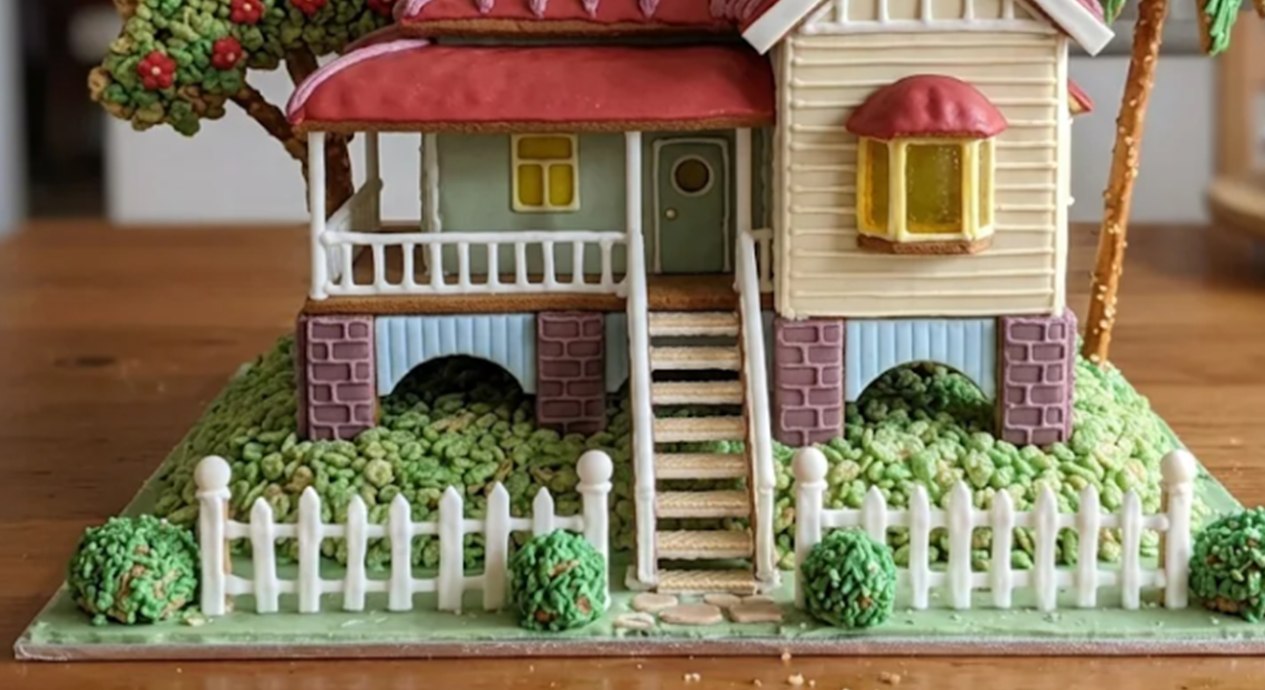
16. Light the house
Slide an LED tea light in through the back doorway onto the floor plate, and the verandah and bay windows glow. Use only battery lights, because a candle can scorch sugar walls, which is why our guide to lighting a house safely from inside sticks to them. Let it stand overnight before you move it.

Troubleshooting
| What you see | Why it happens | What to do |
|---|---|---|
| The floor plate tilts | One skirt piece came out taller | Shave it with a fine grater before you build. Trim all four warm next time. |
| The floor plate cracked | The bearer was left out or misplaced | Pipe icing into the crack from below and add the bearer under the front wall line. |
| The hip pieces slide apart | Thin icing, or the walls were still soft | Prop each trapezoid with a can, then slide the triangles in. Wait the full 2 hours first. |
| A gap at a hip corner | The pieces spread in the oven | Fill it with a thick piped seam. Trim the roof pieces warm next time. |
| The bay roof does not reach the hip roof | The panels were cut the same way up | Flip the paper and cut a mirror panel. Fill small valley gaps with icing. |
| The curved verandah roof cracked | It was bent after baking | Bake a fresh one over the can. Hide a hairline crack under a stripe. |
| A post leans | The railing went on after the roof | Lift the roof off if it has not set, glue the railing, then try again. |
| The stairs do not reach the verandah | The skirt or stair pieces spread | Add a thin wafer tread on the top step. |
| The hill slumps | The cereal treats were packed loose | Press them firmly with buttered hands and let them set before the fence goes in. |
Want Different Colors or a Bigger Yard?
The studio above starts from the show colors and swaps in cream, butter yellow, duck egg blue or white walls and other roofs. For more builds from the screen, see our movie and TV gingerbread houses, or our farmhouse pattern with its own porch for another house with a porch.
Easier Versions: No-Bake and Kit Shortcuts
A No-Bake Graham Cracker Heeler House for Small Kids
Glue four graham cracker halves into a low box for the piers and lay a whole cracker on top for the floor, then build a graham house on it with a red iced roof. A no-bake graham cracker house needs royal icing, not tub frosting, to stand.
The Kit Shortcut
Stand any plain kit on the same graham box with piped blue arches, flood the roof red with violet stripes, and add a cereal treat hill, a fence and a red-flowered tree. Our notes on which store kits are worth buying point to the boxes that stay standing.
Storage Instructions
Keep the house in a cool, dry room, away from the stove, dishwasher and sunny windows. Make the icing with meringue powder if you plan to eat any.
FAQ
Is there an official Bluey gingerbread house kit?
We found none this season. LEGO sells a Bluey’s Family House building set, but it is a toy, not something you bake.
Can I add Bluey and Bingo?
Yes, with your own figures or cookies. We left characters off so the house is the star. Small toy figures on the verandah come off again before anyone eats it.
Can I make it bigger?
Yes. Print at 125 percent for a house about 9 inches tall. The pieces come to about 260 square inches, so you need a second batch of dough and a 15 inch board.
More Gingerbread House Builds and Recipes
Our Home Alone house build and Hundred Acre Wood tree house come with templates too. Browse our themed house ideas, and when something sags, our fixes for a sagging roof work on any house.
Build Your Next House With Best Gingerbread Houses
The Heeler house proves the point we come back to on every build: a few strong details tell the whole story. Here it is a striped red roof, a hooded bay window, blue arches and a poinciana on the hill. When you want a head start, our ranked list of gingerbread house kits sorts the good boxes from the wobbly ones.