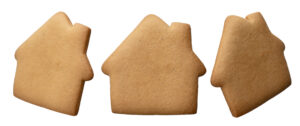

Gingerbread cookies fail in one specific, infuriating way. You cut a clean gingerbread man, slide the tray in, and pull out something with no neck, no waist and arms that have merged with the body. The internet’s word for it is blob monsters, and the standard advice is to chill the dough, which helps but does not explain anything.
Here is what is actually happening, and why the usual fix is only a third of the answer. Three things control whether a cut-out keeps its outline. Two of them cost you the tender, chewy texture you wanted in the first place. The third is free, and most recipes barely mention it.
This is the cut-out gingerbread recipe we would hand someone who cares that the shape survives: spiced properly, soft in the middle, and sharp enough at the edges to hold icing detail. It is the same problem we solve on the gingerbread house recipe, where a panel that spreads simply will not meet its neighbour at the corner.
Gingerbread Cut-Out Cookies
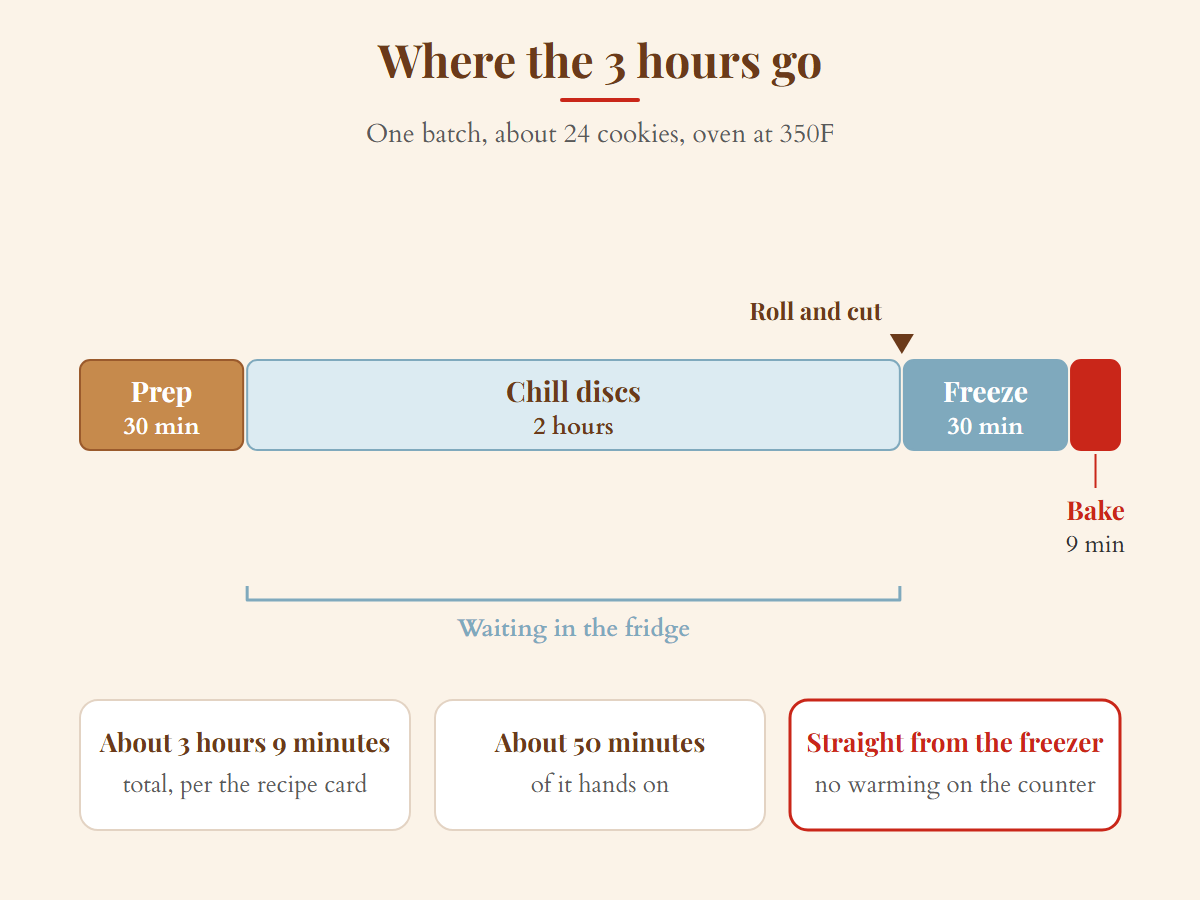
Makes about 24 cookies with a 3.5 inch cutter · Easy · Prep 30 minutes · Chill and freeze 2 hours 30 minutes · Bake 9 minutes
Total time about 3 hours 9 minutes, of which roughly 50 minutes is hands on.
Equipment: a stand or hand mixer, a rolling pin, two light-coloured half sheet pans, parchment, cookie cutters, and freezer space big enough for a sheet pan.
Ingredients
- 3 cups (360g) all-purpose flour, spooned and levelled
- 1 teaspoon baking soda
- 1/2 teaspoon salt
- 1 tablespoon ground ginger
- 1 1/2 teaspoons ground cinnamon
- 1/2 teaspoon ground cloves
- 1/4 teaspoon ground nutmeg
- 3/4 cup (170g) unsalted butter, softened but still cool
- 3/4 cup (150g) packed dark brown sugar
- 1/2 cup (170g) unsulphured molasses
- 1 large egg
- 1 teaspoon vanilla extract
Method
- Whisk the flour, baking soda, salt and spices together in a medium bowl.
- Cream the butter and brown sugar on medium until lightened, about 2 minutes.
- Beat in the molasses, egg and vanilla until smooth, scraping the bowl once.
- Work in the dry ingredients on low, mixing only until no dry flour remains.
- Chill the dough as two flattened, wrapped discs for 2 hours.
- Roll one disc at a time to a quarter inch and cut your shapes.
- Freeze the cut shapes on the sheet pan for 30 minutes.
- Bake at 350F for 9 to 11 minutes, straight from the freezer.
Notes: Adapted from King Arthur Baking’s gingerbread cut-outs, with the leavening restrained and a freezer step added for shape retention. The yield is calculated from dough weight at a quarter inch thickness rather than counted from a bake.
Ingredient Notes
Only four of these ingredients carry a real decision. The rest are doing what you expect. If you mix your own, which gingerbread spice blend to use changes the result more than the brand of flour does.
Molasses is the flavour and about a third of the moisture. Use unsulphured, which is the standard supermarket kind. Blackstrap is a different ingredient: far more bitter and mineral, and it will overwhelm the spice. If you want a darker, more grown-up cookie, swap two tablespoons of the molasses for blackstrap and leave the rest alone.
Baking soda is the one to watch. Molasses is acidic, soda is alkaline, and the two react to make carbon dioxide. That is lift, and a little is good. Too much and the cookie inflates in the oven and then falls outward as the gas escapes, which reads as spread. A teaspoon against three cups of flour is deliberately restrained.
Butter should be softened but still cool, around 65F. Butter that has gone greasy and translucent on the counter has already lost the structure you were about to whip air into.
Flour gets measured by spooning it into the cup and levelling it off. Scooping straight from the bag can pack in around 20 percent more flour per cup, and extra flour is exactly the thing that turns gingerbread into cardboard.
How to Make Gingerbread Cookies Step by Step

1.Whisk the dry ingredients
Combine the flour, baking soda, salt and all four spices in a medium bowl and whisk for a good ten seconds. You are distributing a teaspoon of soda through three cups of flour, and a pocket of it in one cookie tastes soapy.
2.Cream the butter and sugar
Beat the butter and brown sugar on medium for about 2 minutes. Stop when the mixture has lightened in colour and looks fluffy rather than grainy. If it looks wet or slumped, the butter was too warm.
3.Beat in the molasses, egg and vanilla
Add all three and beat until the mixture is uniform and glossy, scraping the bowl once. It may look curdled for a moment as the molasses goes in. Keep going and it comes back together.
4.Work in the flour
Add the dry ingredients on the lowest speed and stop the moment no dry flour is visible. The dough should be stiff and slightly tacky, not smooth. Every extra turn past this point develops gluten, and gluten is toughness.
5.Chill the dough flat
Divide the dough in two, flatten each half into a disc about an inch thick, wrap, and refrigerate for 2 hours. Flat discs chill in a fraction of the time a ball takes. The dough is ready when a pressed thumb leaves a dent that holds its edge.
6.Roll and cut
Roll one disc at a time to a quarter inch, leaving the other in the fridge. A quarter inch is the number that matters: thinner cookies heat through before their structure can set, which is why delicate shapes blur. Cut your shapes and lift them onto a parchment-lined sheet.
7.Freeze the cut shapes
Put the whole sheet pan in the freezer for 30 minutes. This is the step most recipes skip, and it is the one doing the most work. The shapes are ready when a corner feels hard and does not give under a fingertip.
8.Bake straight from the freezer
Bake at 350F for 9 to 11 minutes on the middle rack. Do not let the shapes warm up on the counter first. Pull them when the edges look set and the centres still look slightly underdone, then leave them on the sheet for 5 minutes before moving them, because warm gingerbread tears at the limbs.
The Spread Risk Scorer
Answer four questions about how you plan to bake. This scores how likely your shapes are to spread and names the one change that buys you the most edge, before you cut a single cookie.
Biggest single fix
Why Gingerbread Cookies Spread, and the Three Levers That Stop It
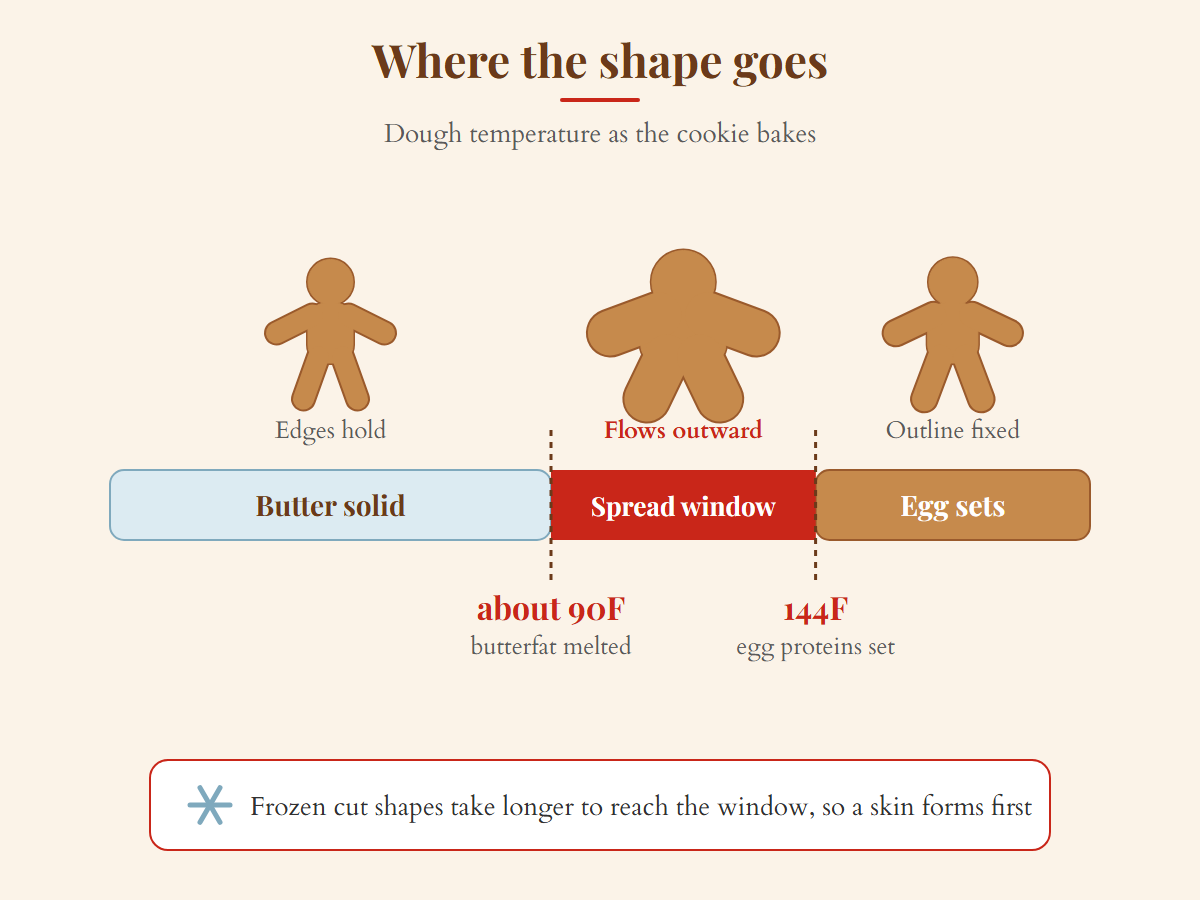
A cookie loses its shape in a window, not across the whole bake. Butterfat finishes melting in the low 90s Fahrenheit. Egg proteins do not begin to set until around 144F, according to the American Egg Board’s coagulation figures. Between those two temperatures your cookie is a warm slurry with melted fat and nothing yet holding its edges. That gap is where the shape goes.
Everything that stops spread does one of three things, and they do not cost the same.
1. Cut the leavening. Less baking soda means less gas, so less puff and less collapse. It works. It also costs you lift, and past a certain point the cookie goes dense and hard.
2. Add flour. More structure, less flow. This also works, and it is why so many no-spread recipes taste like a coaster. Flour is the lever that trades texture directly for shape, and it is the one to reach for last.
3. Send the dough in cold. A frozen cut-out takes several minutes longer to climb past the point where its butter liquefies. During those minutes the surface is drying and setting. By the time the fat is fully liquid, there is already a skin holding the outline. This costs you thirty minutes of doing nothing at all.

The reason this matters is that the baking community treats the tradeoff as a law. The usual formulation is that shape-holding doughs carry more flour and less leavening, so they are inherently less tender. That is true of levers one and two. It is not true of lever three, and lever three is the one nearly every recipe reduces to the phrase “chill your dough.”
Chilling the mixed dough and freezing the cut shapes are not the same move. Chilling makes the dough workable. Freezing is what protects the outline, because it happens after the shape exists. Picture dough that came out of the fridge at two, was rolled and cut by half past, then sat on the counter while the oven preheated. It went in at room temperature and the two hours of chilling had been spent. That failure has nothing to do with the recipe.
Structure sets late in cookies for a second reason worth knowing: the starch never fully gelatinises. Cookie dough is high in sugar and fat and low in water, and dissolved sugar ties up the free water that starch needs, so a cookie leans on protein coagulation and on sugar setting as it cools far more than bread does. There is less structural help arriving early than you would think.
Soft, Chewy or Crisp, and How to Choose Before You Bake
Decide this before you preheat, because two of the three choices change what you do at the oven. If you are cutting people rather than rounds, the gingerbread man recipe built for limbs makes two changes this one does not, and keeping them soft past day one is a separate problem again.
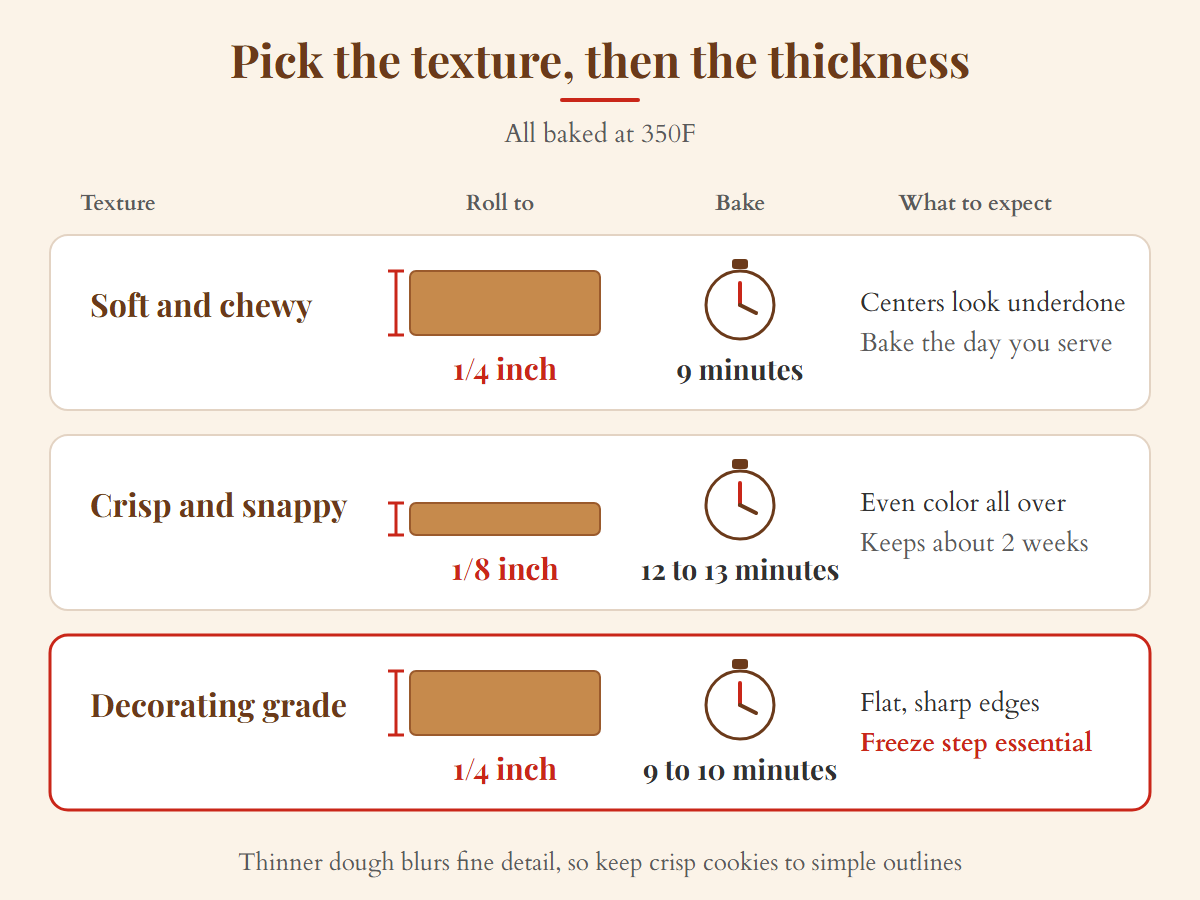
For soft and chewy, roll a full quarter inch and pull the cookies at 9 minutes, while the centres still look underdone. They finish setting on the sheet. This is the version children prefer and the version that goes stale fastest, so bake it the day you want it.
For crisp and snappy, roll thinner, closer to an eighth of an inch, and bake 12 to 13 minutes until the colour is even across the whole cookie. Accept that thin dough blurs detail, so use simple outlines rather than lace. This is the version that keeps for two weeks and posts well in a tin.
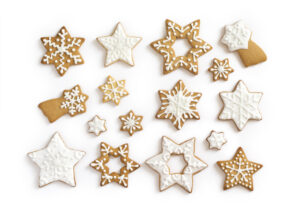
For decorating-grade, which is a different goal again, stay at a quarter inch, keep the bake at 9 to 10 minutes, and take the freezer step seriously. You are optimising for a flat, sharp-edged surface that icing can sit on without running off a domed top. A cookie that puffed in the middle is a bad canvas no matter how good the icing is.
Say you are baking with a five-year-old who wants to work the cutter and eat one warm. Soft is the right call, and the freezer step still earns its place because frozen shapes lift without stretching. Making forty for a school party and decorating them the night before is the decorating-grade path, where the schedule matters more than the recipe.
The Cookie Clock
Tell it when the cookies need to be finished and whether you are decorating. It works backwards and tells you what time to start, including the chilling and freezing most schedules forget to count.
Troubleshooting
| What happened | Why | What to do |
|---|---|---|
| Shapes spread into blobs | The dough was warm going into the oven, so the fat liquefied before anything had set | Freeze the cut shapes 30 minutes and bake straight from the freezer |
| Cookies puffed, then sank and widened | Too much baking soda against the acidic molasses | Reduce to 1 teaspoon per 3 cups of flour |
| Edges are sharp but the cookie is tough | Flour was added to stop spread, or the dough was overmixed after the flour went in | Fix spread with temperature instead, and mix only until the flour disappears |
| Arms and legs snapped off | Moved while hot, or the cutter is too fine for a quarter inch of dough | Rest 5 minutes on the sheet before lifting, and choose sturdier outlines |
| Bottoms dark, centres raw | Dark pan, or the oven runs hot | Light-coloured sheet, middle rack, check at 8 minutes |
| Dough cracked as you rolled it | Straight from a long chill, too cold to move | Rest 10 minutes at room temperature, then roll |
| Rock hard the next day | Over-baked, or stored uncovered | Pull when the centres still look underdone, and store airtight with a slice of bread |
Make-Ahead and Timeline
Every part of this recipe can be made in advance, which is the practical reason to bother with cut-outs at all.
The dough keeps wrapped in the fridge for 3 days, and the flavour deepens over the first two as the spices hydrate. It freezes 3 months as a disc; thaw overnight in the fridge before rolling.
The cut shapes freeze on the pan, then transfer to a bag for a month. Cut on a quiet evening and bake from frozen whenever you want them, adding a minute. No thawing.
The baked cookies keep 5 days at room temperature undecorated. Decorated with royal icing, give them a full 2 hours to set hard before you stack them.
Icing and Decorating Gingerbread Cookies
For cookies you are eating rather than gluing a building together, you want a thinner, softer icing than the mortar-grade royal icing on our gingerbread dough and royal icing page. That one is engineered to set like cement, which is correct for walls and unpleasant to bite.
The simple version: whisk 2 cups of sifted powdered sugar with 2 tablespoons of milk and half a teaspoon of vanilla, then add milk a quarter teaspoon at a time until a ribbon drizzled off the whisk disappears back into the surface in about 10 seconds. That is piping consistency. Thin it further for flooding, thicken it with more sugar for detail that must hold a raised line.
Two practical points. Cookies must be completely cool, because icing on a warm one turns to glaze and runs off. And tint before you thin, since gel colour adds liquid of its own.
Picture a tray iced at nine in the evening and stacked into a tin at half past, found as one fused block in the morning. Icing looks dry long before it is hard. Two hours, uncovered, in a single layer. For glazes, royal icing and cream cheese frosting compared by how long each takes to dry, see our guide to icing for gingerbread cookies.
Storage Instructions
Store undecorated cookies airtight at room temperature up to 5 days. A slice of plain bread keeps soft cookies soft, because they pull moisture from the bread instead of the air. Swap it when it hardens.
Decorated cookies keep about the same, in a single layer or with parchment between. Freeze baked cookies up to 3 months undecorated, and thaw still sealed so condensation forms on the bag rather than the surface. Gingerbread in its other forms, including a house left out as decoration, runs on a different clock, covered on how long gingerbread lasts.
Frequently Asked Questions
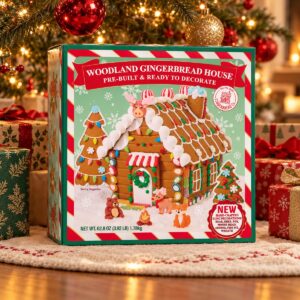
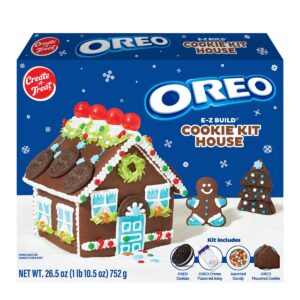
If none of this appeals and you want the shortcut, we have graded the boxed gingerbread cookie mixes on whether they can actually hold a cut shape.
Why did my gingerbread cookies spread?
Almost always because the dough was too warm when it entered the oven. Between about 90F and 144F the butter is liquid and nothing has set yet, so the cookie flows outward. Freezing the cut shapes for 30 minutes closes most of that window. Excess baking soda is the second most common cause.
Can I make gingerbread cookies without molasses?
Yes, though it stops being gingerbread in the strict sense. Dark corn syrup or honey substitutes one for one and gives you a paler, sweeter, milder cookie. Maple syrup works too and pushes the flavour somewhere else entirely. What you lose is the slight bitterness and the deep colour that molasses provides, so increase the spices by about a quarter to compensate.
How thick should I roll gingerbread cookies?
A quarter inch for shapes you want to keep their outline or decorate, an eighth of an inch if you want them crisp and are using simple shapes. Thinner dough reaches setting temperature faster at the edges than the middle, which is why fine detail blurs on a thin cookie.
Do I have to chill gingerbread dough?
Chilling the dough makes it rollable, so practically yes. But chilling the dough and freezing the cut shapes are two different steps doing two different jobs, and it is the second one that protects the shape. Skipping the freeze is the single most common reason a well-chilled dough still spreads.
Can you freeze gingerbread cookie dough?
Yes, in both forms. Wrapped discs keep 3 months and thaw overnight in the fridge. Cut shapes keep about a month in a bag and bake straight from frozen with an extra minute. The cut-shape route is the more useful of the two.
How long do gingerbread cookies last?
About 5 days airtight at room temperature, or 3 months in the freezer. Crisp versions hold their texture longer than soft ones. Softness fades before the cookie is anywhere near unsafe to eat.
Can dogs eat gingerbread cookies?
They should not. Gingerbread is not acutely toxic the way chocolate or xylitol are, but it is heavy in sugar and often contains nutmeg, which is genuinely harmful to dogs in quantity. A crumb from the floor is not an emergency. A whole cookie, or any recipe sweetened with xylitol, is a call to your vet.
More Gingerbread Recipes
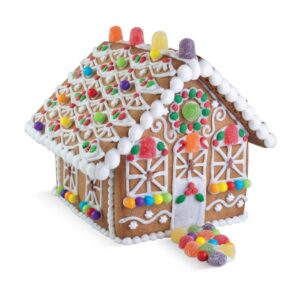
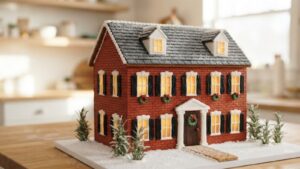
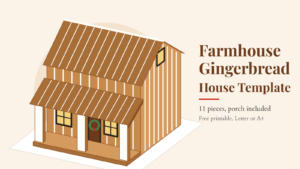
If you are baking a structure rather than a snack, the dough is different and the difference is not small. Construction dough drops the leavening almost entirely and runs stiffer, because a wall has to carry a roof. Our gingerbread house recipe covers that formula and the two ways a wall fails. For the full sweep of gingerbread baking, from loaves to lebkuchen, there is a collection of gingerbread recipes worth browsing. And when the cookies are done and you want to build something with the leftovers, start with a printable template.
Bake Better Gingerbread with Best Gingerbread Houses
We spend most of our time on gingerbread that has to stand up, which is a demanding version of the same problem you just solved on a cookie sheet. Panels that spread do not meet at the corners, so shape retention stopped being a preference for us a long time ago and became a requirement.
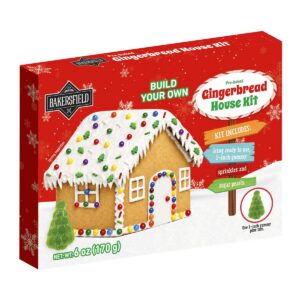
That is the perspective behind this recipe, and it is the same one behind everything else here. If the cookies went well and you are ready to build something with a roof on it, the gingerbread house kits we rate are sorted by how well they actually hold together.