
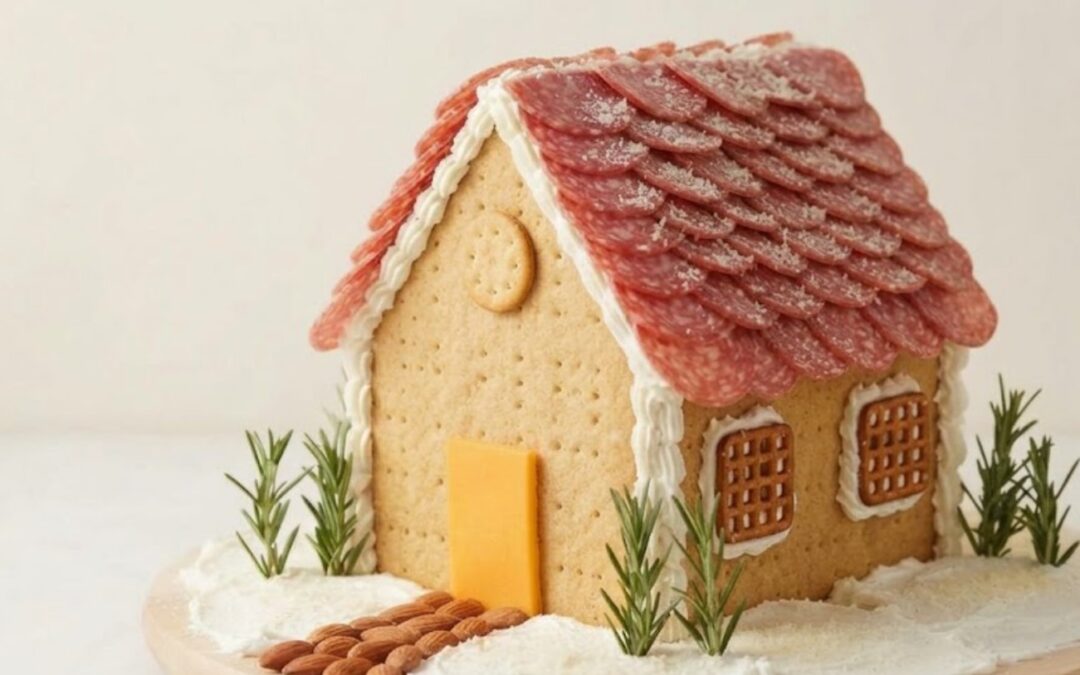
A charcuterie gingerbread house swaps candy and royal icing for crackers, cheese and salami, and it is supposed to get eaten. Most of the ones you see online are not. The top-ranking tutorial builds on a sweet gingerbread kit and admits to a hot glue gun, which, in its own words, makes the chalet inedible.
This one is built to be eaten. The walls are thin rye crackers cut from a free template, the mortar is cold cream cheese, and the roof is salami shingles. It is also the only one among the top results that says how long it can sit on the party table.
Start with the recipe card, then the template, the make-ahead plan and nine photographed steps.
Charcuterie Gingerbread House
Makes 1 house, about 8 snack servings · Medium · Prep 1 hour · Bake 20 minutes at 350F · Cool and chill about 1 hour
Total time about 2 hours 20 minutes. Bake the walls up to a day ahead to split it in two.
Equipment: printer and ruler, scissors, rolling pin, parchment, a baking sheet, a sharp knife or pizza wheel, a fork and a toothpick, a piping bag or zip bag, 4 cans for propping, a 10 inch board or platter.
Ingredients
- 2 1/2 cups whole grain rye flour
- 1 teaspoon salt
- 1 cup water
- 5 tablespoons olive oil
- 8 oz block full fat cream cheese, cold
- 6 oz thinly sliced dry salami or pepperoni
- 3 oz parmesan, finely grated
- 4 oz sharp cheddar, in a block or thick slices
- 6 square pretzel snaps
- 2 small round crackers
- 6 to 8 rosemary sprigs
- 1/4 cup almonds
Instructions
- Print the template at Actual Size, measure the 1 inch test bar and cut out the six paper pieces.
- Mix the rye flour and salt, then the water and olive oil, into one firm ball without overworking it.
- Roll the dough 1/8 inch thick on parchment, cut around the paper pieces, prick them with a fork and score the door and window marks.
- Bake on the parchment at 350F for about 20 minutes, until dry and lightly browned, and cool completely on the tray.
- Glue the four walls on the board with cold cream cheese, then chill 30 minutes.
- Set the two roof panels on cream cheese so they meet at the ridge, then chill 30 minutes more.
- Shingle the roof with salami in overlapping rows from the eave up to the ridge.
- Press on the pretzel windows, the cheddar door and the round crackers, then dust the roof with parmesan.
- Plant the yard with cream cheese snow, rosemary trees and an almond path, chill until guests arrive, and clear it away within 2 hours.
Per serving, approximate: about 470 calories, counting the whole batch of cracker dough. Calculated from USDA FoodData Central energy values divided by 8 servings. Not laboratory analysis.
Notes: Cracker dough adapted from the Use Your Noodles Holiday Cabin; topping amounts scaled from Family Fresh Meals’ charcuterie chalet, which uses about twice the roof area for 16 servings. This recipe has not been test-built by this site, so treat bake and chill times as starting points: ovens vary, and thicker crackers need longer.
What Is a Charcuterie Chalet?
A charcuterie chalet is a savory gingerbread house. The walls are crackers or baked bread dough, the glue is a soft cheese such as cream cheese, the roof is shingled with salami, and the windows, doors and yard come from the rest of a cheese board: pretzels, sliced cheese, nuts and herbs. Grated parmesan plays the snow.
The idea spread as a holiday party trend, and two retailers now sell kits with cracker panels, cheese spread and salami for about $30. You can build one from a kit, on top of a plain gingerbread kit, or from scratch. From scratch is the only way to get walls that taste savory all the way through, and with a template it is less work than it sounds.
Free Printable Charcuterie Gingerbread House Template
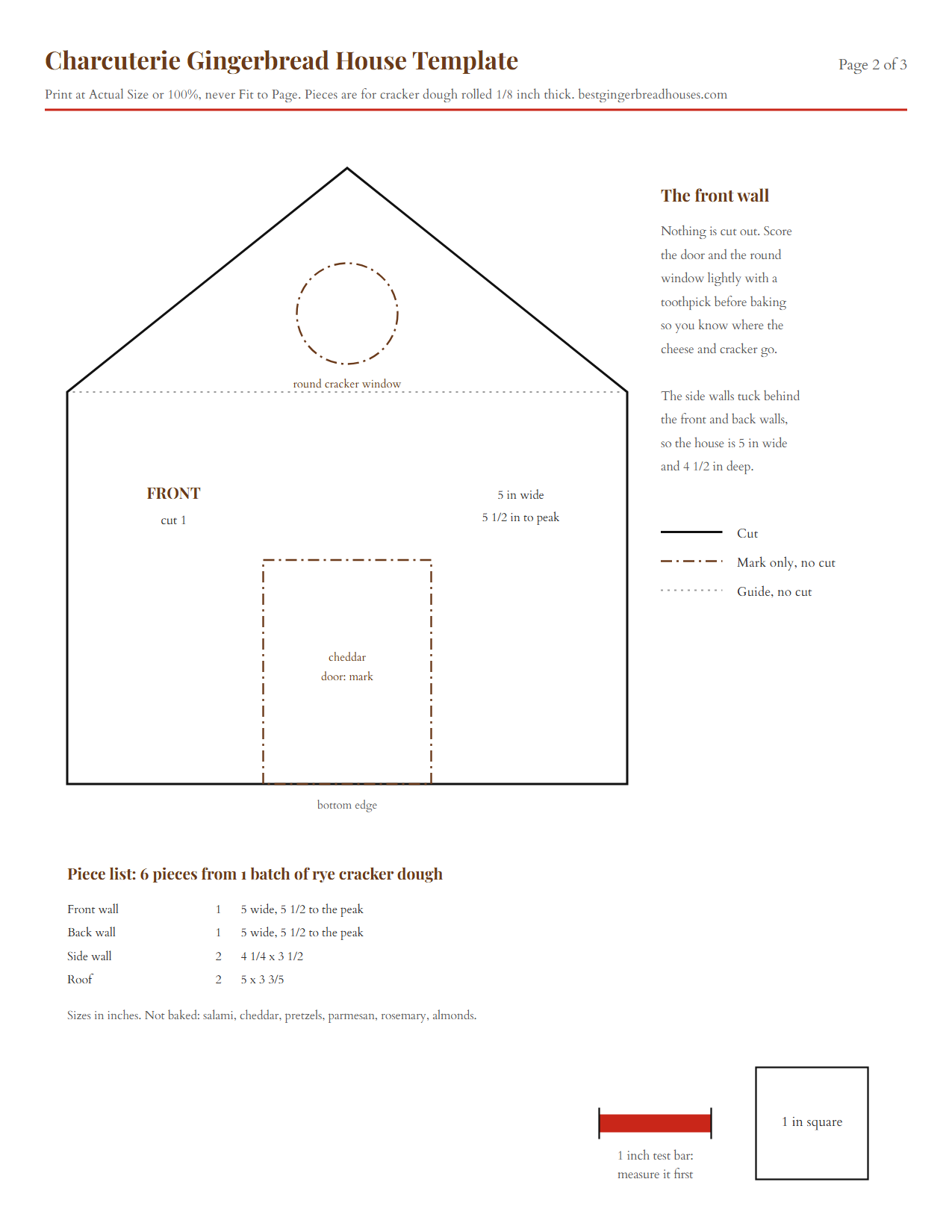
The template is three US Letter pages with six pieces, drawn at true size. Download the PDF, print it at Actual Size or 100 percent, and put a ruler on the red 1 inch bar before you cut anything. If the bar measures an inch, every piece is right.
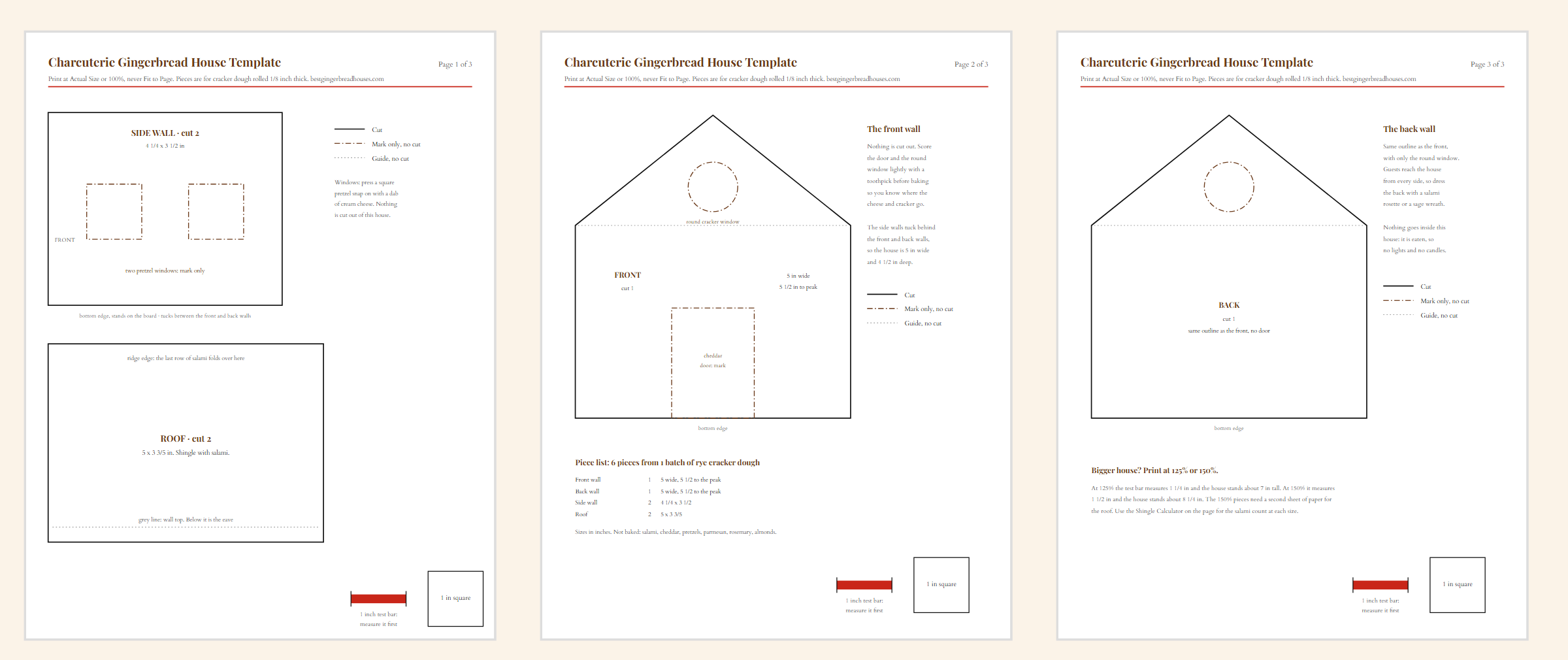
| Piece | Cut | Size | What it does |
|---|---|---|---|
| Front wall | 1 | 5 in wide, 5 1/2 in to the peak | Carries the cheddar door and a round cracker window |
| Back wall | 1 | 5 in wide, 5 1/2 in to the peak | Same outline, round window only |
| Side wall | 2 | 4 1/4 by 3 1/2 in | Two pretzel windows each; tucks between the front and back |
| Roof | 2 | 5 by 3 3/5 in | Shingled with salami |
The finished house is 5 inches wide, 4 1/2 inches deep and about 5 1/2 inches to the ridge, on a 10 inch board. That leaves room around it for a yard of rosemary trees, an almond path and extra crackers for guests to grab. Want a bigger showpiece? Print at 125 percent for a house about 7 inches tall, or 150 percent for about 8 1/4 inches. The calculator further down scales the shopping list to match.
Ingredient Notes
The walls: rye cracker dough. Four pantry ingredients: whole grain rye flour, salt, water and olive oil. Rolled thin and baked, it turns into one big crisp cracker that holds a cut edge. The recipe is adapted from the Holiday Cabin savory gingerbread house at Use Your Noodles, which bakes its walls from a paper template the same way. Rye has gluten, so for a gluten-free table see a gluten-free house dough and use your own savory swaps on top.
The mortar: cold cream cheese. Full fat, in a block, straight from the fridge. Soft tub cream cheese is looser and slides. Cream cheese holds only while it is cold: the tutorial that ended up with a glue gun says warm cream cheese “won’t hold much up.” That is why this build chills between stages. Processed cheese spread is a firmer swap; it is what the Use Your Noodles cabin glues with.
The roof: dry salami. Any thin-sliced dry salami or pepperoni works. Small rounds lay like scales. Big deli slices cut in halves or quarters lay like shingles. The calculator below tells you how many of each size cover the roof.
The details. Square pretzel snaps for windows, a slice of sharp cheddar for the door, a small round cracker for each gable window, finely grated parmesan for snow, rosemary sprigs for trees, and a handful of almonds for the path. Every one of them is something guests will happily eat.
Make-Ahead Timeline
Bake the walls a day ahead. The cracker pieces keep in an airtight container at room temperature, and they are the only part that does. Everything after that happens on party day, close to serving, because the house becomes a perishable platter the moment the cream cheese goes on.
| When | What | About how long |
|---|---|---|
| The day before | Print the template, mix, roll, cut and bake the cracker pieces; cool them hard on the tray and store airtight | 1 1/2 hours |
| 2 1/2 hours before guests | Glue the walls with cold cream cheese, then chill 30 minutes | 50 minutes |
| 1 1/2 hours before | Set the roof, then chill 30 minutes | 40 minutes |
| 1 hour before | Shingle, add windows, door, snow and yard, then back in the fridge | 40 minutes |
| Guests arrive | Fridge to table. The two hour clock starts now |
Pick your own party time and the clock does the counting for you.
Charcuterie House Party Clock
Pick when the house goes on the table. The clock counts back to when to bake and build, then tells you when to clear it away.
The 2 hour and 1 hour limits are USDA food safety guidance for perishable food left out of the fridge. Session times are planning estimates, not timed on a build. Nothing you enter leaves your browser.
How to Make a Charcuterie Gingerbread House Step by Step
1. Print the template and measure the test bar
Print all three pages at Actual Size and lay a ruler on the red bar. It should read exactly 1 inch. Cut the six paper pieces out along the solid lines.
Why this matters: printers love to shrink a page to fit, and a wall a quarter inch short leaves a gap no amount of cream cheese hides.
2. Mix the rye cracker dough
Stir the rye flour and salt in a bowl, add the water and olive oil, and bring it together with a spoon and then your hands into one firm ball. Stop as soon as it holds together; a little extra water helps if it stays crumbly.
Why this matters: overworked cracker dough bakes tough instead of crisp, so mix it like pie dough, not bread.
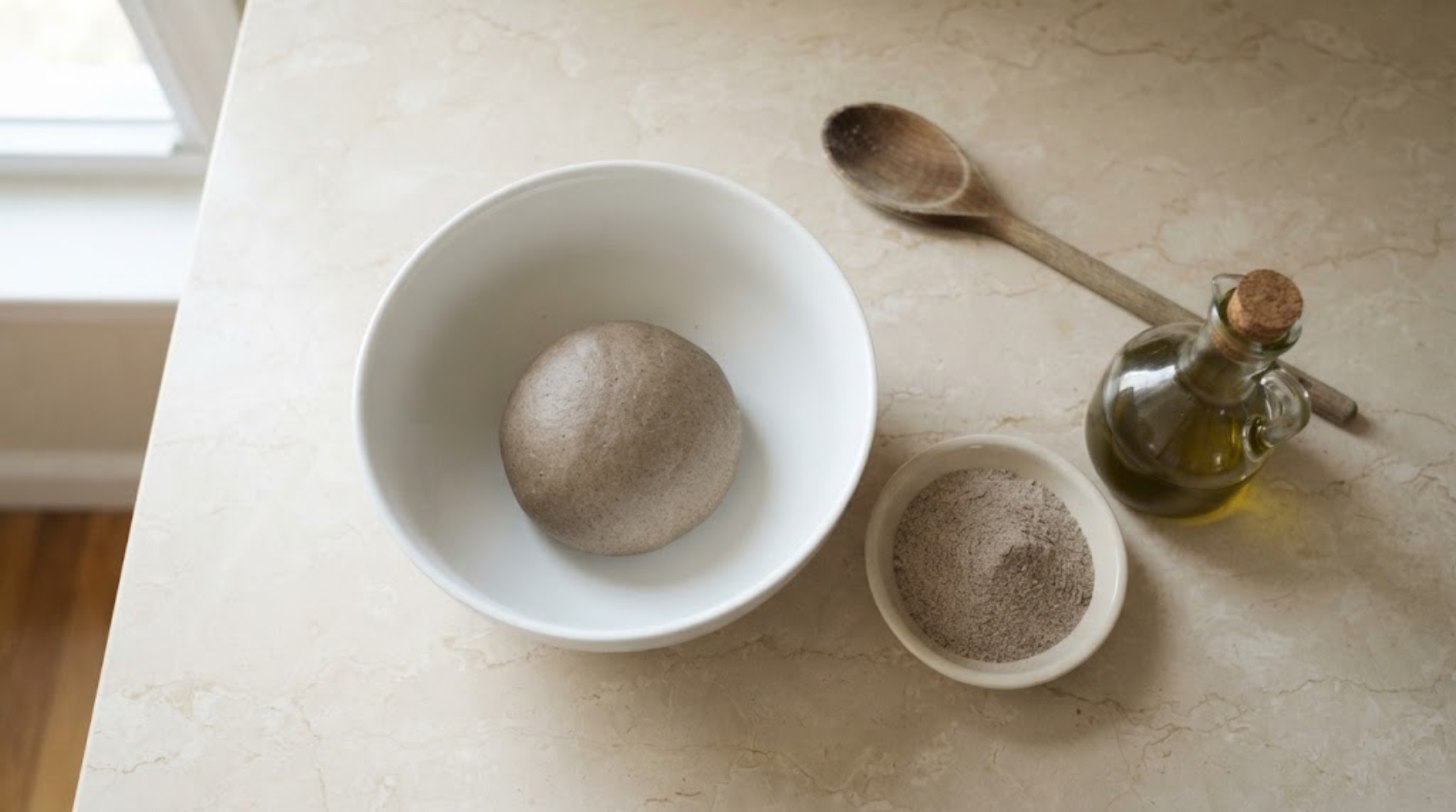
3. Roll the dough on parchment and cut the pieces
Roll the dough straight onto a sheet of parchment, about 1/8 inch thick, roughly the thickness of two stacked coins. Lay the paper pieces on top and cut around them with a sharp knife or pizza wheel, then peel the scraps away and leave the pieces where they are. Prick each piece all over with a fork and score the door and window marks lightly with a toothpick.
Why this matters: cutting on the parchment means the pieces never get lifted and stretched out of shape, and the fork holes help the thin sheet bake flat, the way cracker bakers dock crackers.
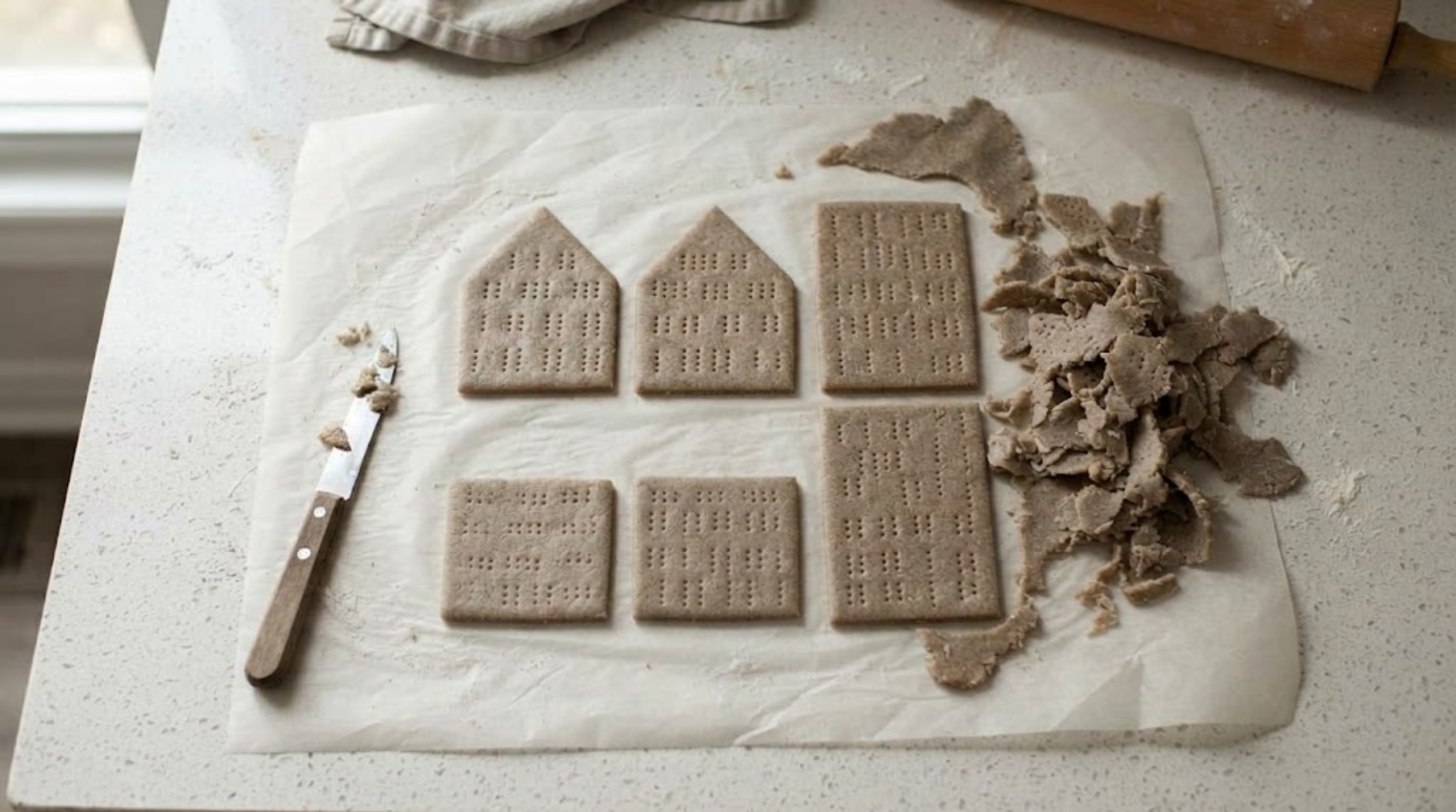
4. Bake the pieces and cool them on the tray
Slide the parchment onto a baking sheet and bake at 350 degrees F for about 20 minutes, until the pieces are dry, firm and lightly browned at the edges. Leave them on the tray until completely cool. Re-roll the scraps into snack crackers for the board.
Why this matters: the pieces finish hardening as they cool, so moving them warm can bend or crack them. Check as you go: ovens and rolling thickness vary, so start checking a few minutes early, and give thicker pieces a few minutes more if the centers still flex.
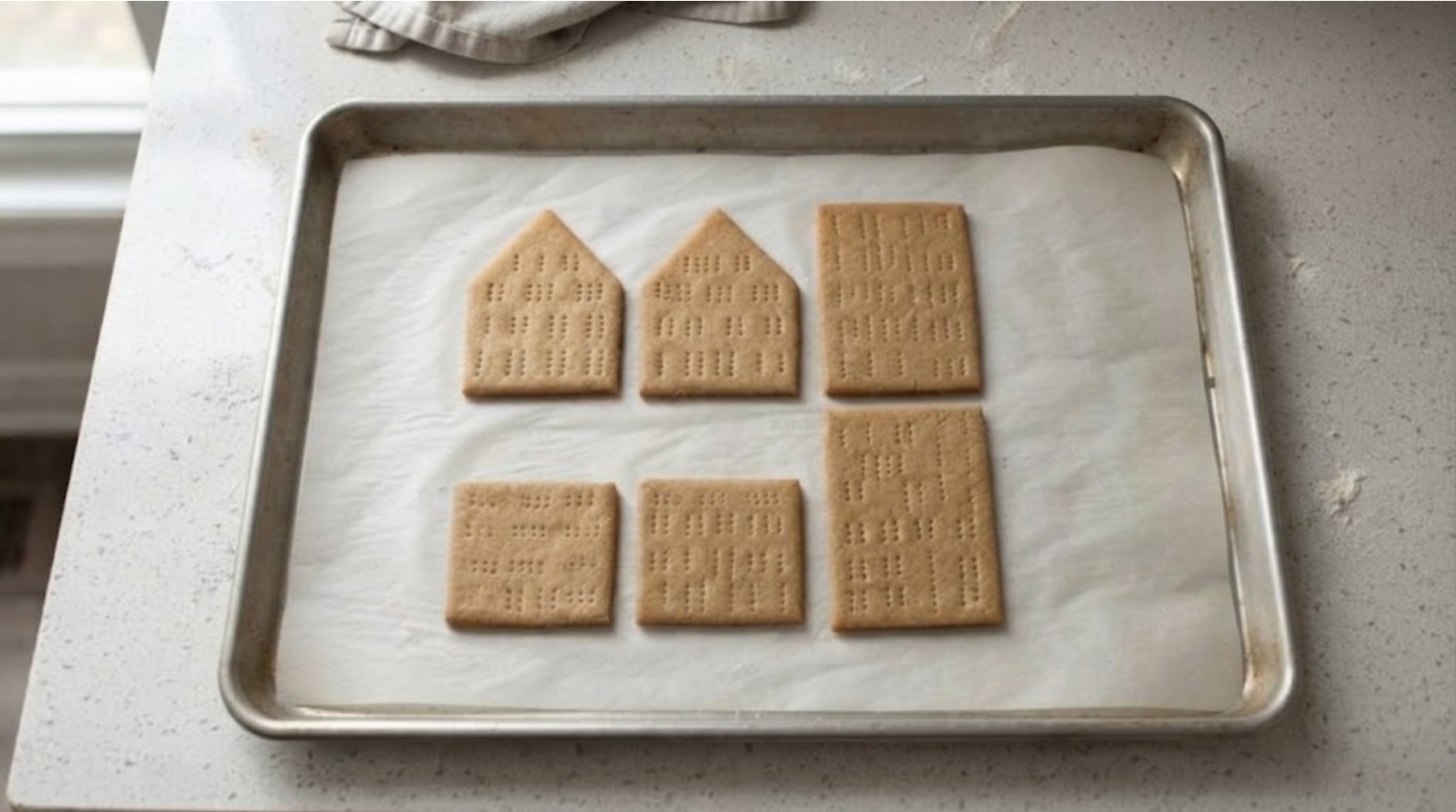
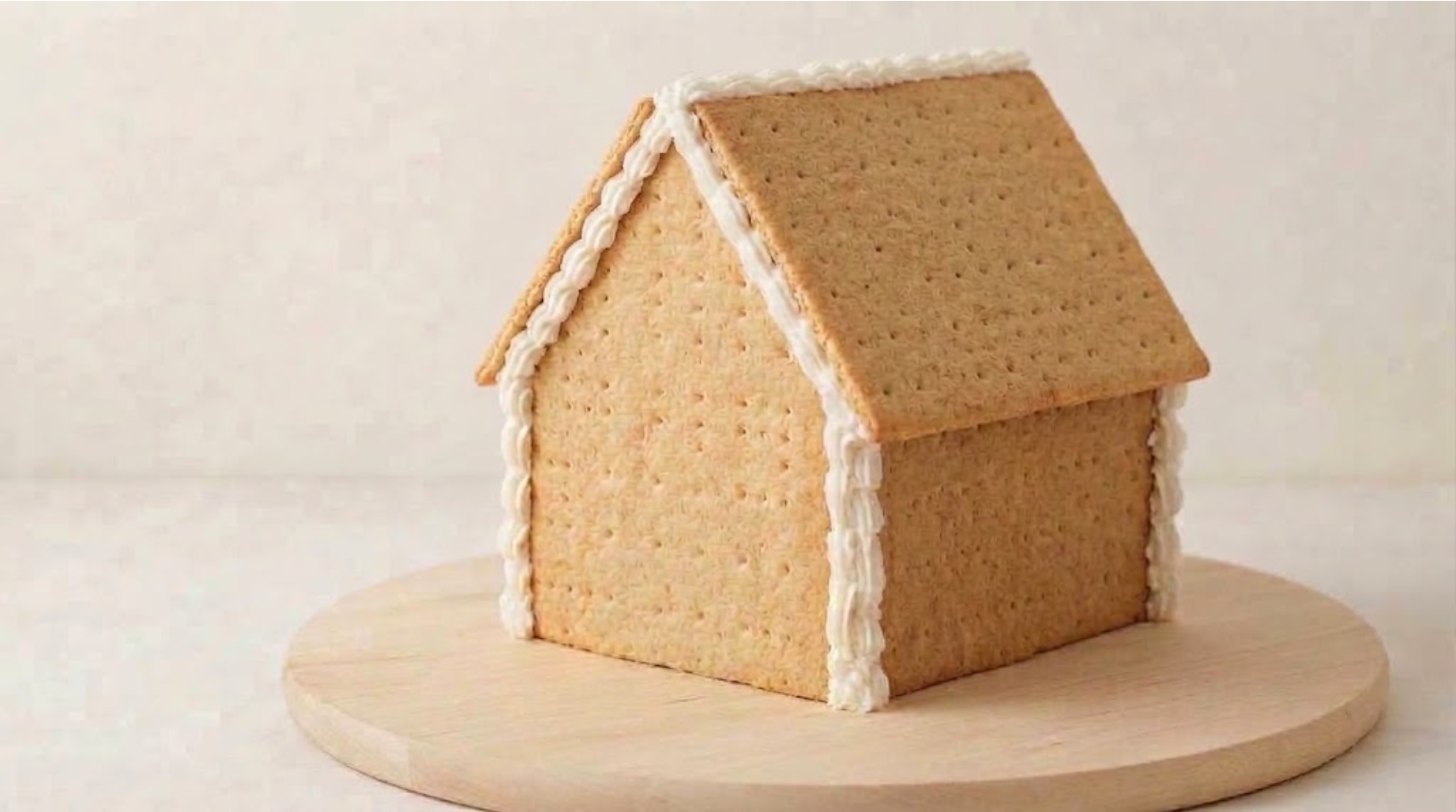
5. Glue the four walls with cold cream cheese, then chill
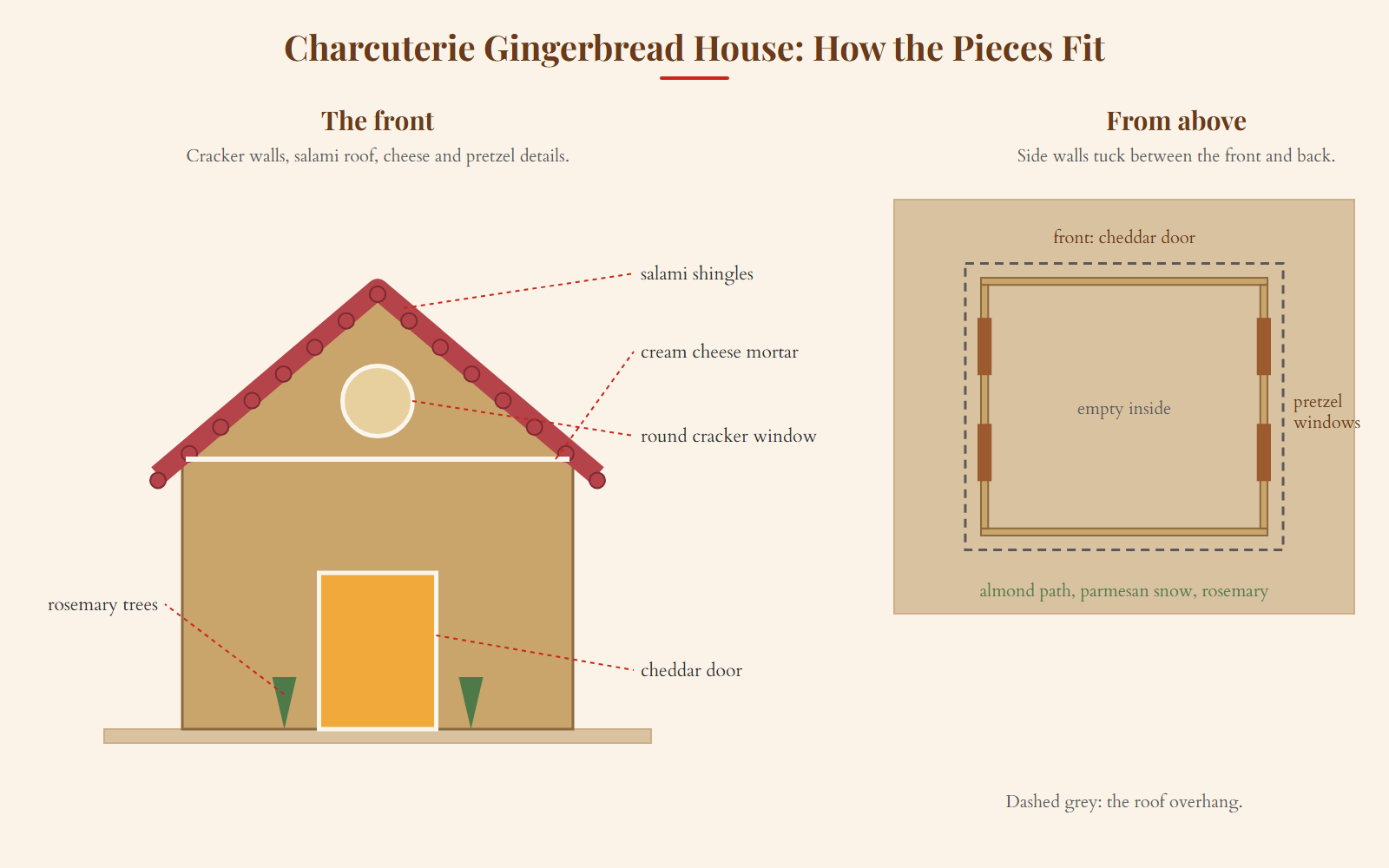
Spoon the cold cream cheese into a piping bag or a zip bag with the corner snipped. Pipe a thick line along the bottom of the front wall and stand it on the board, then pipe the edges of a side wall, tuck it behind the front wall, and add the second side wall and the back. Run a finger of cream cheese down each inside corner, then chill the house for 30 minutes.
Why this matters: cold cream cheese firms back up in the fridge and locks the corners before the roof adds weight.
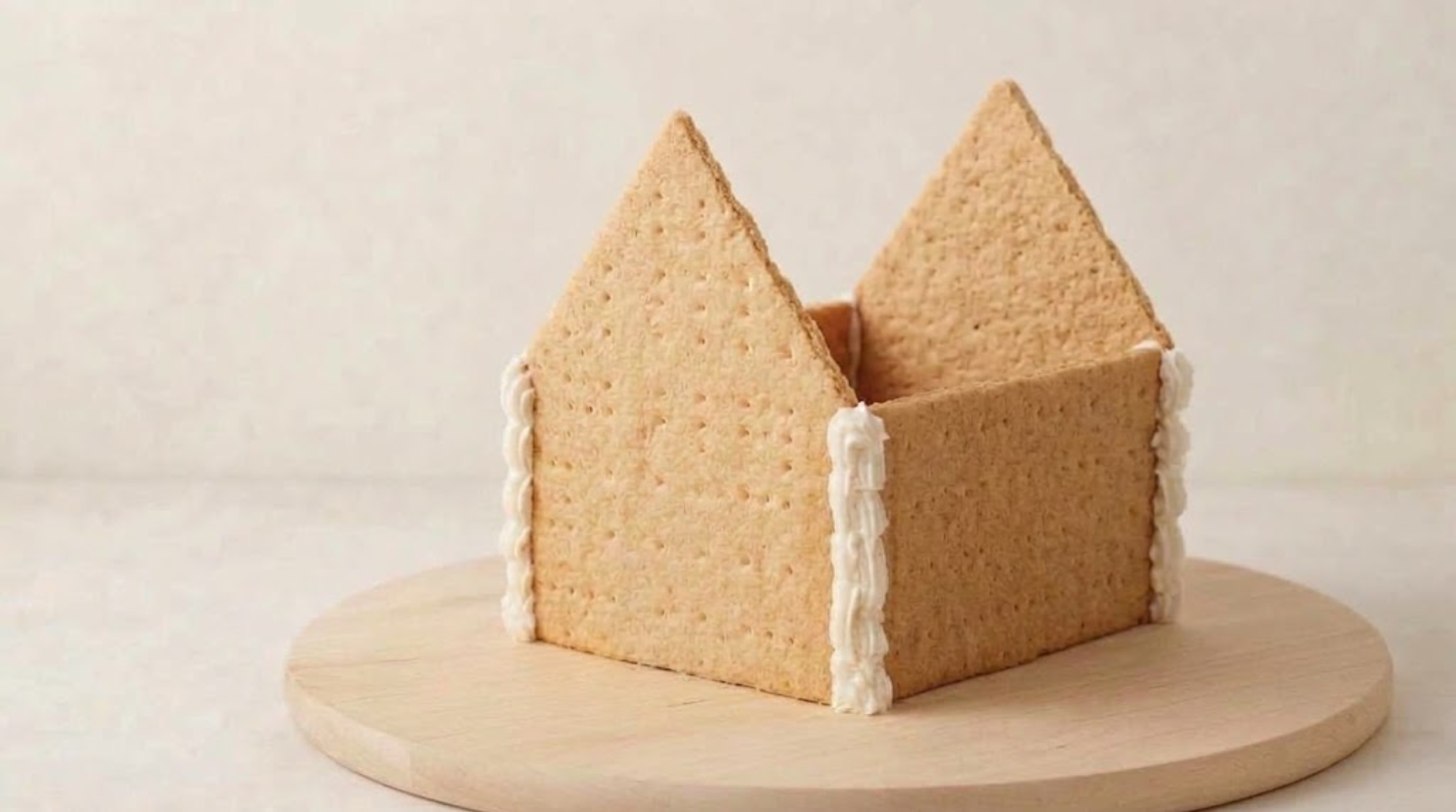
6. Set the roof, then chill again
Pipe cream cheese along the sloped tops of the front and back walls and along the side wall tops. Lay one roof panel on, then the second so its top edge butts over the first at the ridge, and pipe a line along the ridge. Hold each panel for a minute, then chill the house 30 minutes more.
Why this matters: the roof is the heaviest moment for the joints. A second chill means the salami goes on a roof that is already set.
7. Shingle the roof with salami
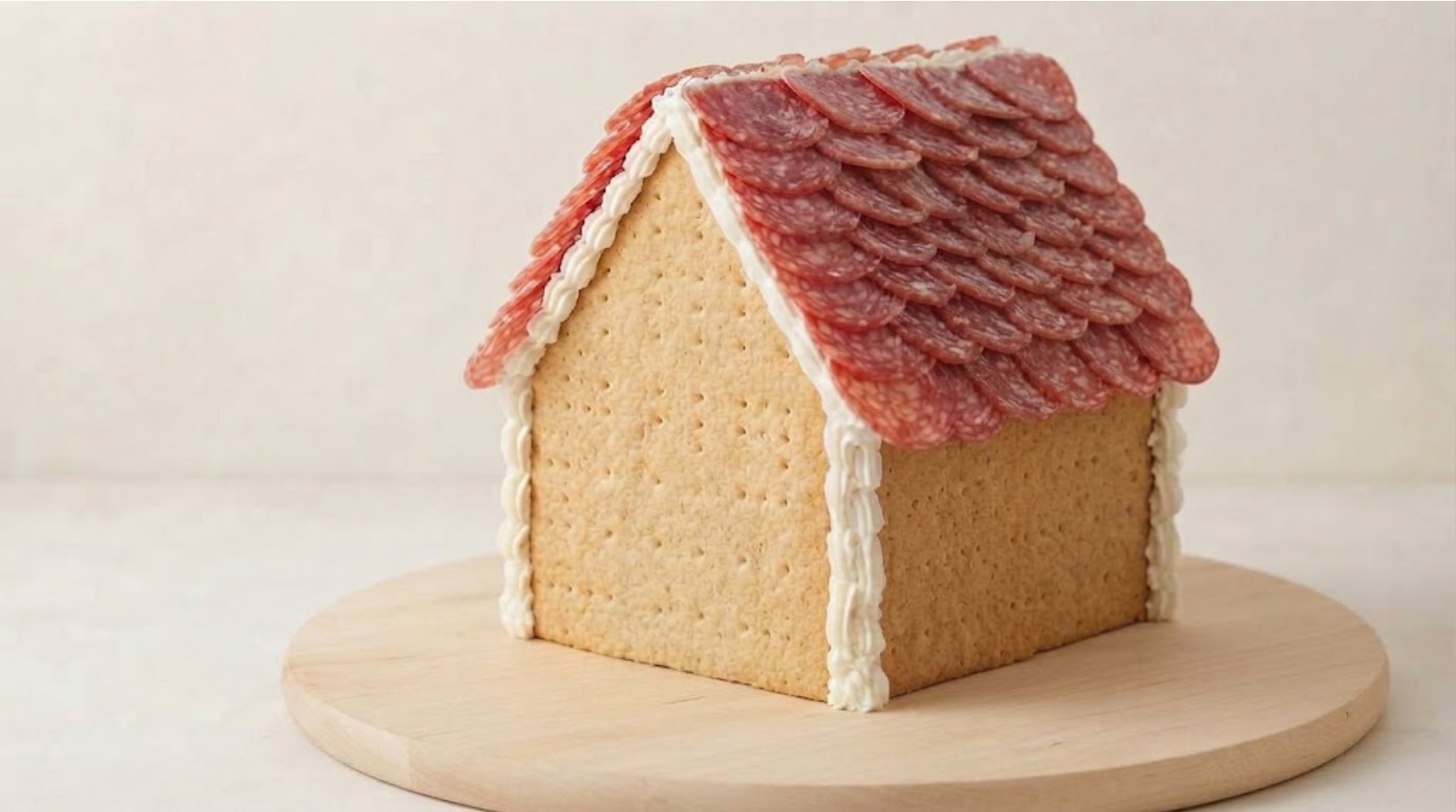
Spread a thin layer of cream cheese over one roof panel. Starting at the bottom edge, press a row of salami along the eave so it hangs just over, then lay the next row above it so each piece covers the top third of the row below. Work up to the ridge, fold the last row over the top, and repeat on the other side.
Why this matters: starting at the bottom means every row tucks under the one above, which is how real shingles shed rain and how these stay neat.
Shingle and Shopping Calculator
Pick how big you print the template and what salami you have. You get the shingle count and a shopping list for that size.
Planning estimates from the template’s roof area and a two-thirds-showing overlap, plus a few spares. Salami sizes vary by brand, so lay one row on the roof before you buy more. Nothing you enter leaves your browser.
8. Press on pretzel windows, a cheddar door and parmesan snow
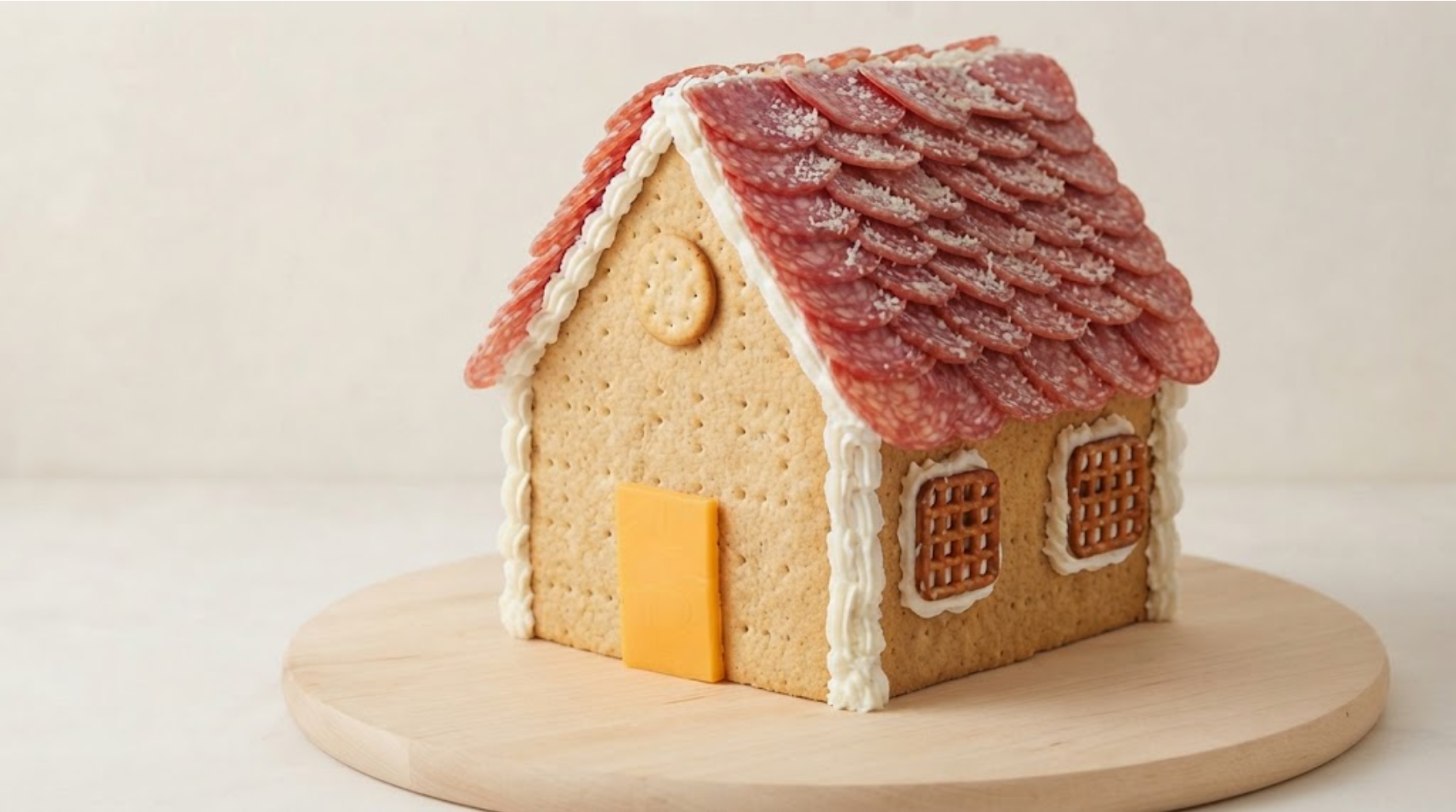
Dab cream cheese on the back of each square pretzel and press two onto each side wall at the marks. Cut a cheddar slice to the door mark, about 1 1/2 by 2 inches, and press it on, then add a small round cracker in each gable. Pipe a little cream cheese along the eaves and dust the roof with parmesan.
Why this matters: the marks you scored before baking put every window level and the door centered, so the house reads as a house from across the room.
9. Plant the yard and serve within 2 hours
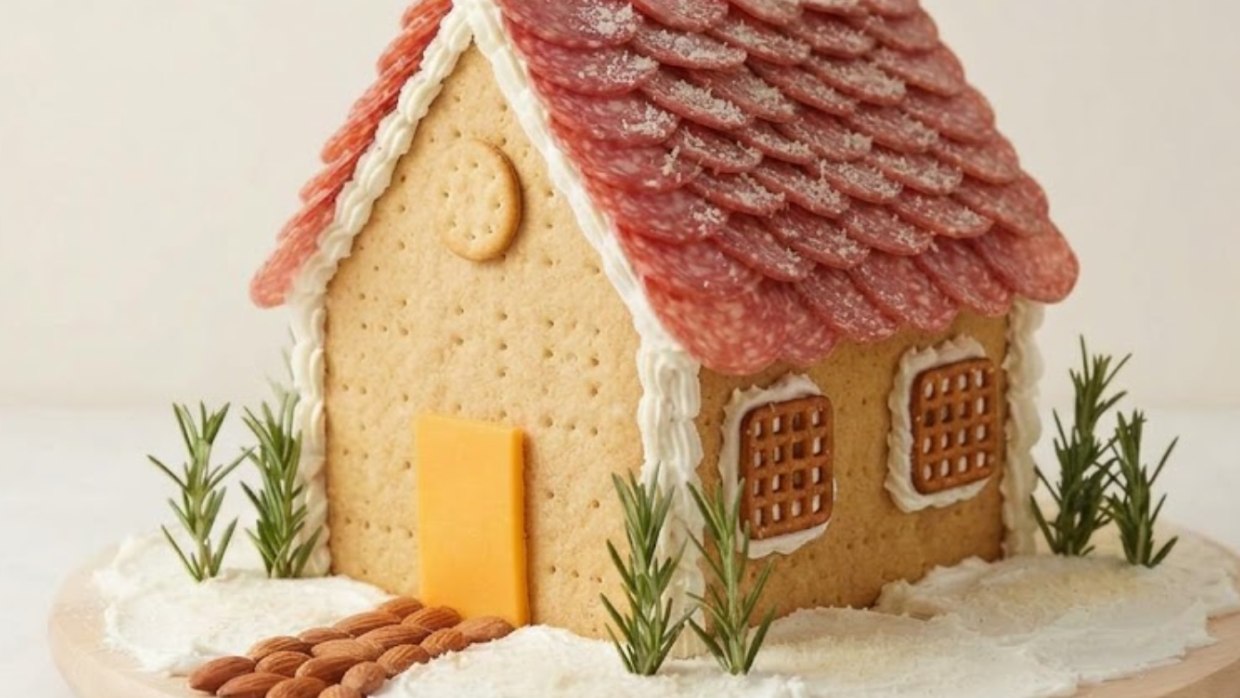
Spread cream cheese snowdrifts on the board, sprinkle parmesan over them, stand rosemary sprigs as trees and lay an almond path to the door. Return the house to the fridge until guests arrive, then carry it out and note the time. Clear it away within 2 hours.
Why this matters: once it is out of the fridge, the cream cheese, salami and cheese all count as perishable food, and food safety guidance puts a 2 hour limit on that.
Why Cracker Walls and Cold Mortar
A sweet gingerbread house can stand for weeks because royal icing dries rock hard and nothing in it spoils. A charcuterie house has neither advantage. Its glue never dries; it only firms up when cold. And everything on it but the crackers and pretzels is perishable. So the design has to stand on its own cold, for a few hours, and nothing more.
That is why the walls are crackers. A thin rye cracker is light and stiff, so it puts little weight on soft cream cheese joints, and it tastes right with salami. Sweet gingerbread under salami is the obvious mismatch when a chalet is built on a kit. It is also why the roof pitch is a gentle 39 degrees: steep enough to read as a chalet, shallow enough that salami pressed into cream cheese stays where you put it.
It is also why nothing is cut out of the walls. Every window opening is a weak spot, and a thin cracker wall with holes in it is weaker than a solid one. Here the windows and door sit on the surface, so the walls stay whole.
Food Safety: The Two Hour Clock
The USDA’s food safety guidance says to never leave food out of refrigeration over 2 hours, and no more than 1 hour if the room is above 90 degrees F. A charcuterie house is a cheese and meat platter in house form, so the same rule applies. Build it cold, keep it in the fridge until guests arrive, and clear it away when the time is up. Throw out what is left, crackers included, because they have been touching the cream cheese and meat.
Two more things to tell guests:
- Pregnant guests and anyone at higher risk. The CDC’s Listeria guidance lists unheated deli meats and fermented or dry sausages, which includes salami, among the foods people who are pregnant, 65 or older, or have weakened immune systems should avoid. Hard cheeses like cheddar and parmesan, and cream cheese made with pasteurized milk, are on its safer list. For those guests, shingle a second small roof with thin cheddar squares instead of salami.
- Allergies. This house carries milk in every cheese, tree nuts in the almond path, wheat in most pretzels and gluten in the rye. Milk, tree nuts and wheat are three of the nine major food allergens the FDA lists, so put a small card by the board, or swap the almonds for olives.
Troubleshooting
| Problem | Why it happens | Fix |
|---|---|---|
| Walls slide apart while you build | The cream cheese warmed up and went soft | Put the bag in the fridge for 10 minutes, prop the walls with cans, and chill the house between stages |
| Cracker pieces came out bowed | They were lifted while warm or rolled unevenly | Cool them on the tray; next time roll between two equal guides and prick well |
| A wall cracked when you stood it up | Dough rolled too thin at one spot | Glue the crack from behind with cream cheese and cover the front with a pretzel or a sage leaf |
| Salami slides down the roof | Too much cream cheese underneath, or a warm roof | Use a thin layer, chill the roof first, and start the rows at the eave |
| Crackers went soft | The house sat too long in the fridge with wet toppings | Build on party day, close to serving, and keep wet items such as olives and fresh mozzarella off the walls |
| Parmesan snow clumps | Coarsely grated or damp cheese | Use finely grated parmesan and dust it on last |
| Not enough salami | Slices smaller than expected | Lay one test row first; finish with cheddar or provolone squares |
Easier Versions
Pizza dough walls. Skip the cracker dough and roll out store-bought pizza dough. Family Fresh Meals’ charcuterie chalet cuts its walls by ruler and bakes them 3 to 4 minutes longer than the package says so they hold up. The template works the same way; expect the dough to puff, so trim the warm pieces against the paper.
A kit base. Build a plain gingerbread kit with its own icing and dress it savory on the outside. It is quick and sturdy, but sweet under salami, and kit icing is not cream cheese, so it lasts longer than the toppings do. Pick a sturdy one from the kits we rate for walls that stay up. For a branded shortcut that already leans savory, see the Cheez-It holiday house kit.
A flat front. Bake only the front wall, lay it on the board and decorate it like a picture: salami roof, pretzel windows, cheddar door. It takes a third of the time and never falls over.
For the kids’ table. A sweet graham cracker version for the kids’ table lets children build while the adults get the salami roof.
Storage Instructions
- Baked cracker pieces: airtight at room temperature, up to a few days ahead. If they soften, crisp them for a few minutes in a 300 degree F oven and cool them flat.
- The built house before serving: in the fridge, loosely covered, for no more than a few hours. The crackers slowly soften against the cream cheese.
- After serving: 2 hours out of the fridge, or 1 hour above 90 degrees F, then throw it away. Do not put it back in the fridge for tomorrow.
- Do not freeze the built house; cream cheese and crackers both turn soggy as they thaw.
FAQ
What is the difference between a charcuterie chalet and a charcuterie gingerbread house?
Nothing. They are two names for the same savory house: cracker or bread walls, cheese glue, salami roof and cheese board details.
Can you make a charcuterie house the day before?
Bake the walls the day before. Build and dress the house on party day, within a few hours of serving, and keep it in the fridge until it goes out.
What do you use to glue a charcuterie house together?
Cold, full fat block cream cheese is the usual glue, and processed cheese spread is a firmer option. Both are edible. Hot glue makes the house inedible, so keep it for display models only.
How long can a charcuterie gingerbread house sit out?
No more than 2 hours out of the fridge, or 1 hour if it is above 90 degrees F, under USDA food safety guidance. Then throw away what is left.
Is there a charcuterie chalet kit?
Yes. World Market and Edible Architecture both sell kits with cracker panels, cheese spread, salami, pretzels and parmesan, around $30 each when we checked. They save the baking but not the chilling: the cheese spread still needs to stay cold.
How many people does a charcuterie house feed?
The house on this template is a centerpiece that feeds about 8 as a snack. Set more crackers and cheese on the board around it, or print the template at 125 percent for a bigger house.
More Savory and No-Bake House Recipes
Want to build more than one? A row of mini houses scaled down from this template makes a savory village down the middle of a buffet. For other non-gingerbread builds, see other edible building materials, and for sweet houses that need a different template, browse our full set of printable house templates. The joints in any house follow the same let-it-set rules as any gingerbread house, and if you want a sweet one that lasts all season, here is how long a sweet gingerbread house lasts.
Best Gingerbread Houses reviews kits, templates and recipes for every kind of house, sweet or savory. When the salami is gone and someone asks for a house that lasts until New Year’s, start with our rated gingerbread house kits and templates.