
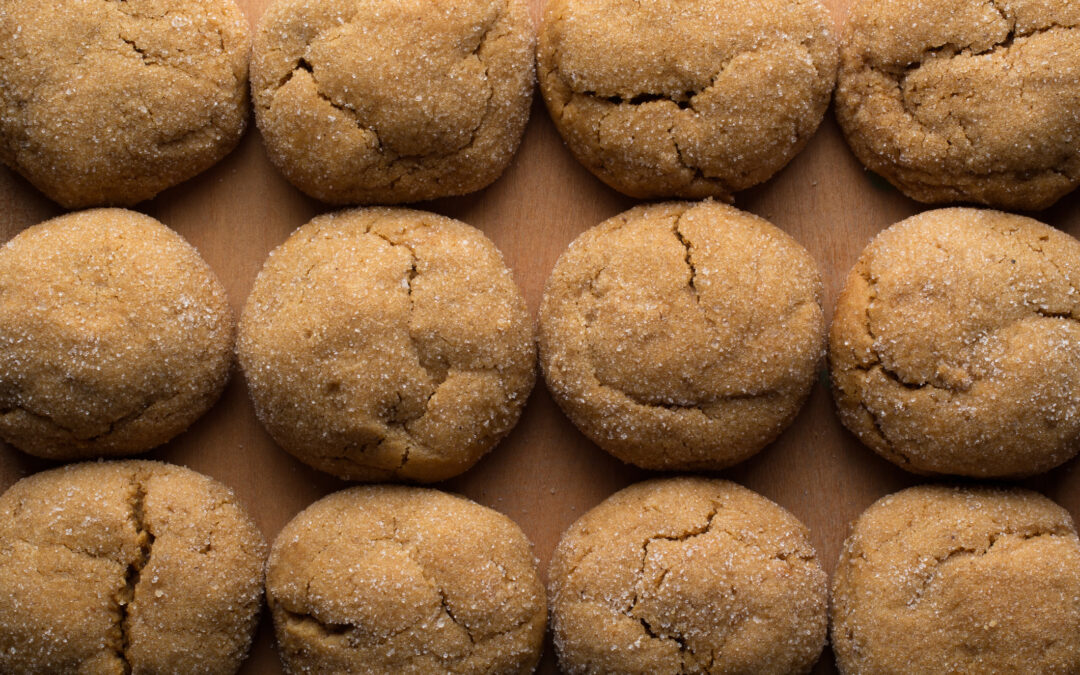
Almost every soft gingerbread cookie recipe delivers on its promise. You pull the tray out, the centres are yielding, the edges have just set, and the first one you eat standing at the counter is genuinely excellent. The recipe worked.
Then it is Thursday, the tin is on the side, and the cookies have gone hard. Nothing was done wrong. The recipe simply never addressed the part you cared about, because softness on the day and softness three days later are controlled by two different things, and only one of them happens in the oven.
This page covers both: a recipe for a thick, dark, molasses-heavy cookie that is soft the moment it cools, and the part nobody publishes, which is what keeps it that way.
The Recipe
Baked hot and fast, which sets the outside before the centre has time to dry out.
Soft Gingerbread Cookies
Makes about 22 cookies · Easy · Prep 20 minutes · Chill 45 minutes · Bake 8 minutes · Total about 1 hour 15 minutes
Equipment: a mixer or a sturdy spoon, two sheet pans, parchment, a shallow bowl for the sugar.
Ingredients
- 2 3/4 cups (330g) all-purpose flour, spooned and levelled
- 1 1/2 teaspoons baking soda
- 1/2 teaspoon salt
- 1 tablespoon ground ginger
- 1 1/2 teaspoons ground cinnamon
- 3/4 teaspoon ground cloves
- 1/4 teaspoon freshly ground black pepper, optional
- 3/4 cup (170g) unsalted butter, softened
- 1 cup (200g) packed dark brown sugar
- 2/3 cup (225g) unsulphured molasses
- 1 tablespoon honey or light corn syrup
- 1 large egg
- 1/3 cup granulated sugar, for rolling
Method
- Whisk the flour, baking soda, salt, spices and pepper together in a medium bowl.
- Cream the butter and brown sugar on medium for 2 minutes, until lightened.
- Beat in the molasses, honey and egg until smooth, scraping the bowl once. The mixture may look split for a moment; keep going.
- Work in the dry ingredients on low, stopping the moment no dry flour remains.
- Chill the covered bowl for 45 minutes. The dough is soft and needs this to be scoopable, not to protect a shape.
- Heat the oven to 375F and line two sheet pans with parchment.
- Scoop generous tablespoons, roll into balls, and roll each in granulated sugar.
- Bake 8 to 9 minutes, until the tops have puffed and cracked and the edges are set but the centres still look soft.
- Cool on the sheet for 5 minutes before moving them, then cool completely before storing.
Nutrition, per cookie, approximate: 195 calories. Nutrition figures are estimates calculated from ingredient quantities and are not a substitute for laboratory analysis.
Notes: the tablespoon of honey is not for flavour and you will not taste it. It is there for day three, and the reason is explained below. The black pepper is optional and does not read as heat; it sharpens the ginger.
The Two Kinds of Soft, and Why Recipes Only Solve One
Fresh-soft is a bake outcome. It is the softness you get by pulling a cookie out while its centre is still slightly underdone and letting it finish on the hot pan. It arrives free, it is entirely within your control, and it is gone by the second morning.
Keeping-soft is a moisture outcome. It is whether the cookie still has usable water in it two, three, five days later, and the oven has almost nothing to do with it. It is decided by what is in the dough and by what happens in the container.
The reason this distinction matters is that every recipe on the internet gives you levers for the first kind and then tells you to store the cookies in an airtight container, which is necessary and nowhere near sufficient. If your cookies are for tonight, underbake them and stop reading at the recipe. If they are for an event on Wednesday, the recipe is the smaller half of the job.
How to Make Soft Gingerbread Cookies Step by Step
1. Whisk the dry ingredients
Combine the flour, baking soda, salt, spices and the optional pepper in a medium bowl and whisk for a good ten seconds. You are distributing a teaspoon and a half of soda through nearly three cups of flour, and a pocket of it in one cookie tastes soapy.
2. Cream the butter and sugar
Beat the butter and dark brown sugar on medium for a full 2 minutes, until the mixture lightens and looks fluffy rather than grainy. Dark brown sugar is doing double duty here: flavour, and the molasses it carries is part of what keeps the finished cookie soft.
3. Beat in the molasses, honey and egg
Add all three and beat until uniform and glossy, scraping the bowl once. It will look split for a moment as two thirds of a cup of molasses goes in. Keep going and it comes back together.
4. Work in the flour
Add the dry ingredients on the lowest speed and stop the moment no dry flour is visible. The dough will be noticeably softer and stickier than a cut-out dough, which is correct. It is meant to be.
5. Chill the covered bowl
Refrigerate for 45 minutes. This chill exists only to make the dough scoopable, not to protect a shape, which is why it is far shorter than the two hours a cut-out dough needs.
6. Heat the oven to 375F
Do this near the end of the chill rather than at the start. 375F is hotter than most gingerbread recipes call for, and that is deliberate: a hot, short bake sets the outside of a thick cookie while the middle is still short of fully baked.
7. Scoop and roll in sugar
Scoop generous tablespoons, roll each into a ball between your palms, then roll in granulated sugar. The sugar coat is not only decoration. It dries the surface slightly and gives you the crackled top.
8. Bake 8 to 9 minutes
Pull them when the tops have puffed and cracked and the edges are set but the centres still look soft. A cookie that looks fully done in the oven is a hard cookie on the plate.

9. Cool on the sheet, then completely
Leave them on the hot pan for 5 minutes so the residual heat finishes the centres gently, then move them to a rack. Cool completely before they go anywhere near a container, for reasons the storage section explains.
The Softness Clock
Softness is not one number, it is a curve. Set how you are baking and storing, and this shows what the cookie will feel like at hour two, day one, day three and day seven, plus the one change that moves the curve furthest.
| When | Softness | What it feels like |
|---|
Why Gingerbread Stays Soft When a Sugar Cookie Does Not
Bake a sugar cookie and a gingerbread cookie to the same thickness on the same day, put them in the same tin, and by Thursday the sugar cookie will be noticeably harder. The gingerbread is not better made. It has different sugar in it.
Ordinary white sugar is sucrose. Molasses is not: it is a syrup carrying a large share of glucose and fructose, the two simple sugars that sucrose splits into, which the trade calls invert sugar. Invert sugars are hygroscopic, meaning they actively attract and hold water molecules from the air around them, which is why the sugar industry classes them as humectants. A humectant is an ingredient whose job is to stop a product drying out.

So a gingerbread cookie is not just flavoured with molasses. It is being actively defended by it. Every gram of molasses in the dough is a small water-retaining agent that keeps holding on while the cookie sits in the tin. Dark brown sugar helps for the same reason, since it is sucrose with molasses added back.
That is the mechanism behind the tablespoon of honey in the recipe, and honey is invert sugar in almost pure form. It is a small enough amount to be invisible in the flavour and large enough to matter on day three. Light corn syrup does the same job with even less flavour of its own.
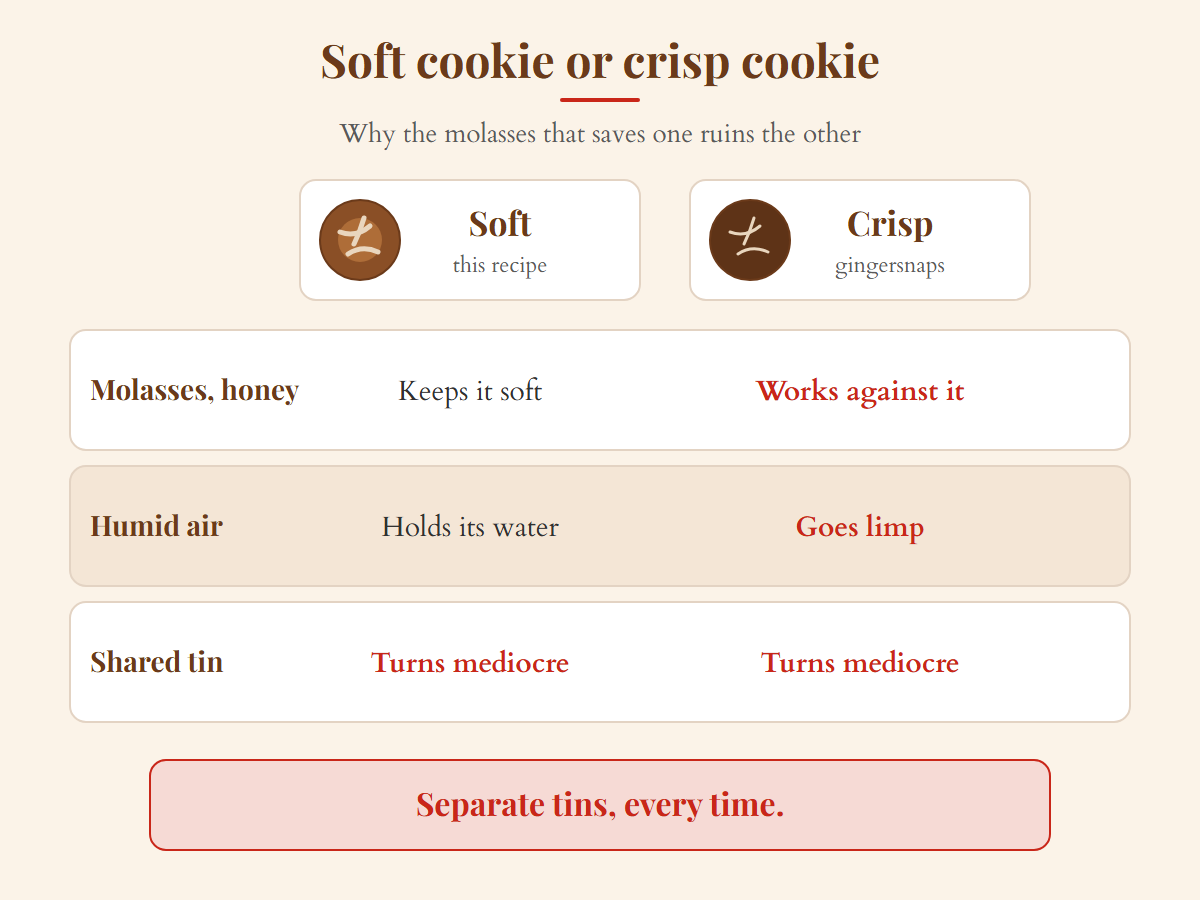
It also explains a limit worth knowing. The same property that keeps a soft cookie soft will ruin a crisp one, because a hygroscopic cookie pulls water out of humid air and goes limp. If you make gingersnaps, everything in this section works against you.
The Three Levers That Control Softness
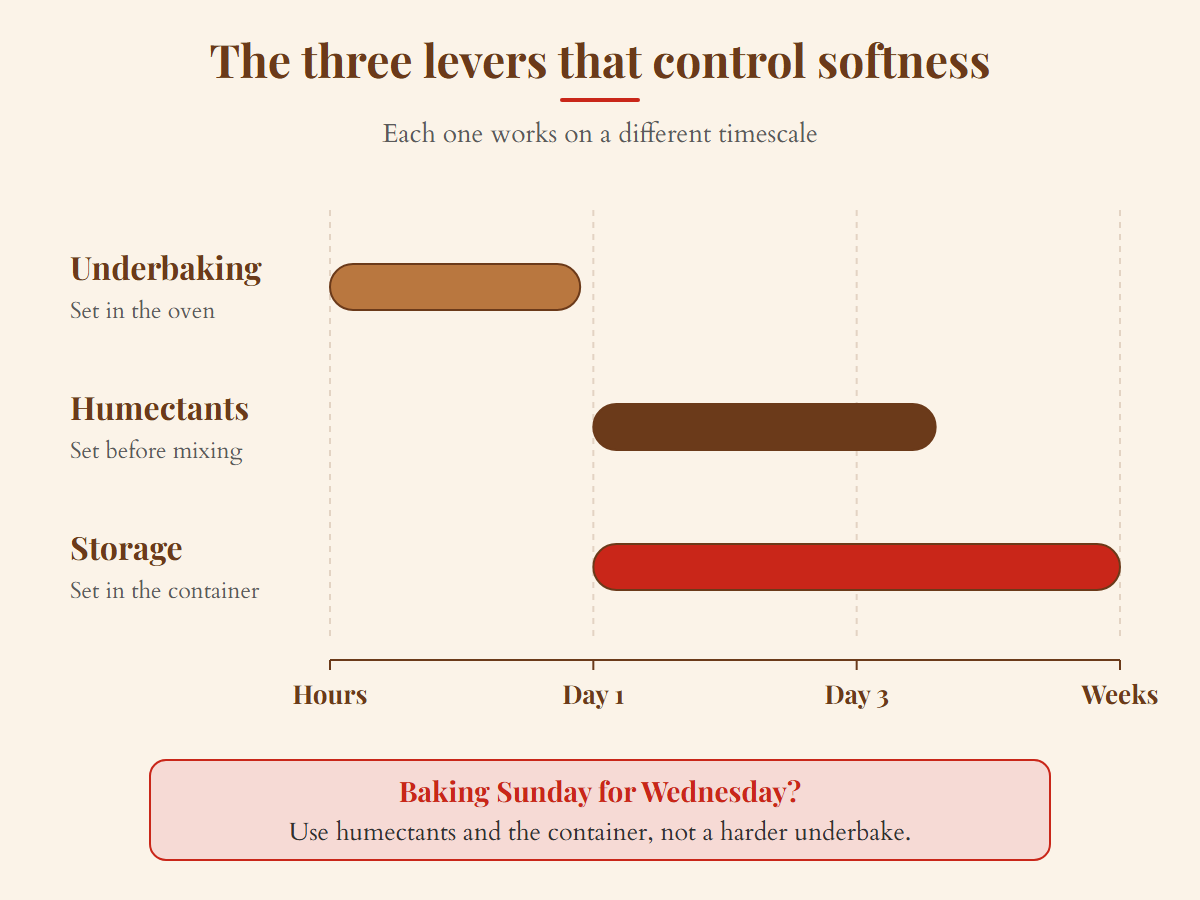
There are only three, they act on different timescales, and using the wrong one for the job is the most common mistake in this whole category.
- Underbaking. Acts on hours. Pull the cookies while the centres still look soft and the residual pan heat finishes them. This buys you a beautiful first day and does nothing at all for day three. It is also the only lever most recipes mention.
- Humectants. Acts on days. Molasses, dark brown sugar, honey and corn syrup hold water in the cookie against the air. This is the lever that decides whether Thursday works, and it is set before the dough is mixed.
- Storage. Acts on days to weeks, and it can undo the other two. A cookie in open air will equalise with the room no matter how well it was formulated.
Say you are baking on Sunday for a party on Wednesday. The instinct is to underbake harder, which is reaching for the hours lever to solve a days problem. It will not work, and it risks a cookie that is genuinely raw in the middle. The correct moves are the humectant and the container, and you can bake them to a completely normal doneness.
Storage Instructions
This is the section that decides whether Thursday works, and it is the one every competing recipe gives a single line to. Everything in a sealed container drifts toward the same moisture level. Water moves from wherever there is more of it to wherever there is less until the two sides equalise, which is what UC Agriculture and Natural Resources describes as water activity reaching balance. That single sentence explains every storage rule below, including the one that sounds like folklore.
- Cool them completely before the lid goes on. A warm cookie gives off steam, the steam condenses on the inside of the lid, and it lands back on the cookies as surface damp. You get soggy tops and a dry middle, which is the worst of both.
- Airtight, at room temperature. Not the fridge. A fridge is a dry environment and it will pull water out of the cookie faster than the counter does.
- Add a slice of plain bread. This is the folklore one and it is straightforwardly true. The bread holds more water than the cookie, so moisture moves from the bread into the cookie until they meet in the middle. The bread goes stale and hard. That is the trick working, not failing. Swap it when it does.
- Never mix textures in one tin. Soft cookies and crisp cookies in the same container will equalise into two mediocre cookies. Separate tins, every time.

To freeze them, do it on day one rather than day three, because freezing pauses the curve where it finds it. Baked cookies keep about three months wrapped tightly; thaw them sealed so the condensation forms on the outside of the bag rather than on the cookie. For the wider picture, including gingerbread that is on display rather than in a tin, see how long gingerbread lasts in each of its forms. The spice is the other variable worth controlling, and the blend you use decides how much of it survives the bake.
The Storage Fixer
Tell it what went wrong and when. It names the mechanism rather than the symptom, tells you what to change next time, and says whether this batch can still be rescued.
What happened?
How were they stored?
What actually happened
Soft, Chewy and Cakey Are Three Different Targets
These three words get used interchangeably across every recipe on this subject, and they describe three different cookies that are reached in three different ways.
| Target | What it feels like | How to get it |
|---|---|---|
| Soft | Yields under gentle pressure, tender rather than springy | Thick cookie, hot short bake, high molasses. The recipe above as written |
| Chewy | Pulls slightly as you bite, satisfying resistance | Melt the butter instead of creaming it and skip the chill. Melted butter develops more gluten in the mix, and gluten is chew |
| Cakey | Light and crumbly, closer to a small cake | Add an extra egg and raise the soda to 2 teaspoons. More lift and more moisture from the egg pushes it toward cake |
Decide which one you actually want before you start, because two of the three changes happen in the first five minutes of mixing and cannot be added later.
If You Want Them Soft and Cut Into Shapes
This is the request that seems impossible, and it is not, but it involves a trade you should make on purpose.
Soft cookies want to be thick, high in molasses and generously leavened. Cut-out shapes want to be thinner, restrained in leavening and cold going into the oven. Those pull in opposite directions, which is why the SERP treats soft cookies and cut-out cookies as separate recipes.
The workable middle is to take the cut-out recipe, or the gingerbread man recipe if the shapes have limbs, roll it to a generous quarter inch rather than thin, freeze the cut shapes so the outlines survive, and pull the cookies at nine minutes while the centres still look underdone. You get a shape that holds and a middle that stays tender for two days. What you give up is day five, because that dough carries a quarter of the molasses this one does and has far less water-holding power.
Picture someone making forty gingerbread men for a school event, wanting them soft enough that children enjoy eating them and sharp enough to take a piped face. That is exactly the compromise above, and it works. Trying to cut shapes from the soft dough on this page does not; it is too slack to hold an outline, and adding flour to fix that removes the softness you started for. For the piped detail, our royal icing page has the formula.
Troubleshooting
| What happened | Why | What to do |
|---|---|---|
| Hard the moment they cooled | Baked too long, or too cool and slow, so the whole cookie dried through | 375F for 8 to 9 minutes, and pull while the centres still look soft |
| Soft on day one, hard on day three | The bake was right; the dough had no water-holding power | Keep molasses at 2/3 cup and add a tablespoon of honey or corn syrup |
| Dough too sticky to scoop | Not chilled, or the kitchen is warm | Chill the covered bowl 45 minutes. This dough is meant to be soft |
| Cookies spread thin and flat | Butter was too warm when creamed, or the dough went onto a hot pan | Butter softened but cool, and a fresh cool pan for each tray |
| Tops damp and sticky in the tin | Stored before they were completely cool | Cool at least an hour on a rack. Spread the batch out uncovered to fix it |
| Flavour is flat despite the molasses | Old ground spices, which lose volatile oils within a year | Replace ginger and cloves annually, and add the optional black pepper |
| Bitter, almost metallic taste | Blackstrap molasses instead of unsulphured | Use standard unsulphured. Blackstrap is a third boiling and much more mineral |
Frequently Asked Questions
How do I keep gingerbread cookies soft? Two things, on two timescales. Underbake them slightly so they leave the oven soft, then give the dough water-holding power with plenty of molasses and a tablespoon of honey or corn syrup so it stays that way. Store them airtight at room temperature with a slice of plain bread, which transfers moisture into the cookies as the two equalise.
Why did my soft gingerbread cookies go hard? Almost always moisture loss over time rather than anything you did wrong on the day. Underbaking only controls the first day. If the dough is low in molasses and there is no humectant, there is nothing in the cookie holding water against the air.
Does molasses really make cookies softer? Yes, and for a specific reason. Molasses carries invert sugars, glucose and fructose, which are hygroscopic and attract water from their surroundings. That is the same property the food industry uses when it adds humectants to keep packaged baked goods soft.
Can I use the fridge to keep them fresh? No. A fridge is a dry environment and it will pull water out of a cookie faster than a countertop container will. Room temperature airtight for up to a week, freezer beyond that.
Should I underbake gingerbread cookies? Slightly, yes. Pull them when the tops have cracked and the edges are set but the centres still look soft. The residual heat in the pan finishes them over the next five minutes, which is why they need to rest on the sheet before moving.
Can I make these ahead for an event? Yes, and it is the better plan. Bake to normal doneness rather than underbaking harder, store airtight with a bread slice, and they will be good for three to four days. For longer, freeze on day one and thaw sealed.
What does the black pepper do? It sharpens the ginger. At a quarter teaspoon across the whole batch it does not read as heat, and it stops a heavily molassed cookie tasting flat and only sweet. Leave it out if you are baking for small children who will notice.
More Gingerbread Recipes
If you are choosing between recipes rather than committed to a soft one, we have three recipes at three difficulty levels, the best gingerbread cookie mixes with the failure points counted for each. For the wider sweep of gingerbread baking, from loaves to lebkuchen, there is a collection of gingerbread recipes worth browsing.
Bake Better Gingerbread with Best Gingerbread Houses
Most of our work is on gingerbread that has to stand up rather than stay soft, which sounds like the opposite problem and turns out to be the same one seen from the other end. A wall fails when it holds too much moisture. A cookie fails when it holds too little. Both are the same question about water, asked with a different answer in mind, and thinking about it that way is why this page has a storage section longer than its recipe.
Bake them soft, store them properly, and eat them on Thursday. If the cookies went well and you find yourself wanting to build something with a roof on it, the gingerbread house kits we rate are sorted by how well they actually hold together.