

No, gingerbread is not a food to share with your dog. But a dog that stole a bite of plain gingerbread is very rarely in danger, and the ingredient every warning leads with, nutmeg, is almost never the one that sends a dog to the vet. What decides it is what was on the gingerbread, how much is gone, and how big your dog is.
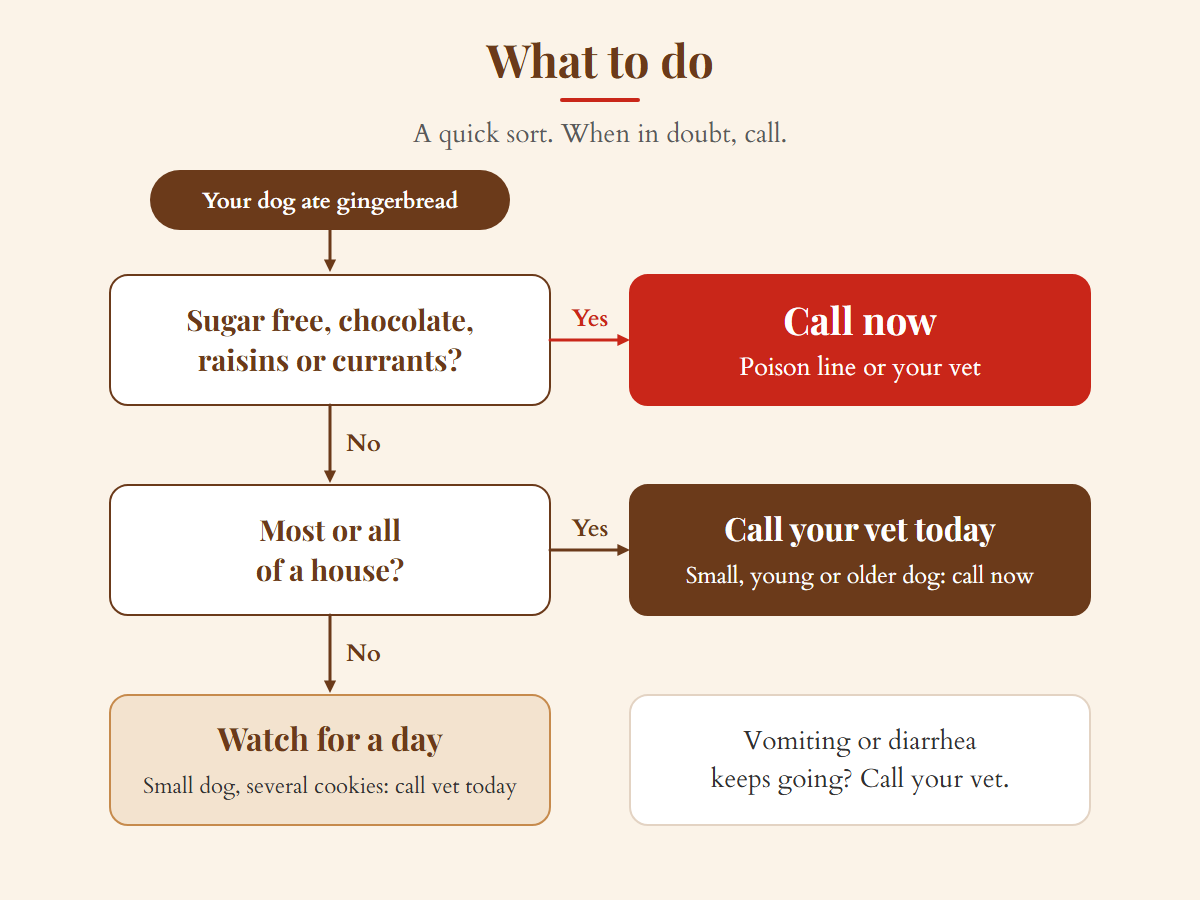
If your dog ate anything sugar free, anything chocolate, or raisins, stop reading and call now: the ASPCA Animal Poison Control Center at (888) 426-4435 or the Pet Poison Helpline at (855) 764-7661. Both answer 24 hours a day. Both charge a fee, $89 per incident at the Pet Poison Helpline.
This guide is built on the veterinary sources that deal with these cases every December: the Merck Veterinary Manual’s toxicology entries, which are written by veterinarians at the ASPCA Animal Poison Control Center, and the Pet Poison Helpline’s own guidance. It covers both the dog who licked the icing off one cookie and the dog who ate an entire gingerbread house, cardboard base and all.
If you are standing in the kitchen looking at an empty board, the checker below sorts your situation in under a minute. If you bake every December with a dog underfoot, you will learn which decorations to keep off the counter. And if you just brought home a puppy, or you simply want your dog to have a gingerbread cookie of its own, there is a recipe made for dogs further down.
By the end you will know which toppings are emergencies, how much spice a cookie and a whole house really carry, what to do in the first hour, and how many dog-safe treats fit in your dog’s day. Start with the fastest question: what did your dog actually eat?
What Did Your Dog Eat?
Four questions. It sorts the situation into a call right now, a call to your vet today, or a watch at home, and tells you why. It does not replace your vet, and when in doubt, call.
ASPCA Animal Poison Control: (888) 426-4435, 24 hours a day, a consultation fee applies. Pet Poison Helpline: (855) 764-7661, 24 hours a day, $89 per incident including follow-up calls.
The Answer Depends on What Your Dog Actually Ate
Plain gingerbread is flour, sugar, butter, molasses and spice. For most dogs, a stolen piece means an upset stomach at worst. The emergencies are the things people put on gingerbread, and the sheer amount a dog can get through when a whole house is at nose height.
| What happened | What it usually means | What to do |
|---|---|---|
| A crumb or a bite of plain gingerbread | Unlikely to be more than an upset stomach | Watch for a day |
| One or two cookies with regular icing and candy | Sugar and fat, a gassy or upset stomach in most dogs | Watch, and call your vet if vomiting or diarrhea keeps going |
| Several cookies eaten by a small dog | A big share of a small dog's daily food in one go | Call your vet today |
| Most or all of a house | A lot of sugar, fat and spice at once | Call your vet today |
| Anything sugar free | Possible xylitol | Call now |
| Chocolate candy, chips or chocolate cookie walls | Depends on the type, the amount and your dog's weight | Call now |
| Raisins, currants or grapes | Possible kidney injury, no amount known to be safe | Call now |
Size moves every row. The same two cookies are a snack for a 70 pound Labrador and a big meal for a 10 pound terrier, because every toxic threshold in veterinary medicine is measured per pound of dog. If your dog is small, move one row toward calling.

1. Sugar Free Candy Is the Real Emergency
Xylitol is a sugar substitute, and it is the most dangerous thing that can end up on a gingerbread house. The FDA warns that xylitol poisoning can start within 20 minutes and can cause vomiting, weakness, seizures, liver failure and bleeding problems. The Merck Veterinary Manual puts the danger point for low blood sugar at about 100 mg per kilogram of body weight, and notes that signs can be delayed by 12 to 18 hours with some products, with liver damage not showing for a day or two. That delay is why you call before symptoms, not after.
Kit candy is usually ordinary sugar candy. The risk is what gets added. Xylitol turns up in sugar free candy, mints, gum, jams and nut butters, and the FDA notes it can also be listed as wood sugar, birch sugar or birch bark extract.
Say you ran short of kit candy and finished the roof with a tin of sugar free mints from your bag. The box the kit came in says nothing about xylitol, because the mints were never in the box. When you call, bring the mint tin, not the kit.
2. Chocolate Depends on the Type, the Amount and the Dog
Chocolate is a dose question. The Merck Veterinary Manual puts mild signs at about 20 mg of theobromine and caffeine per kilogram, heart effects at 40 to 50, and seizures at 60 or more. The type matters because the amount per ounce varies so much: about 64 mg in milk chocolate, 150 to 160 in dark or semisweet, 440 in baking chocolate, and almost none in white chocolate. Signs usually start 6 to 12 hours after eating.
On a gingerbread house, chocolate comes as candy, chips, drizzles, and sometimes the walls themselves. The OREO Chocolate Cookie House, a Create-A-Treat gingerbread house kit, is built from chocolate cookie rather than gingerbread, and OREO cookies list both cocoa and chocolate among their ingredients. Treat chocolate walls as chocolate.
Picture a 60 pound dog that got less than half of a chocolate cookie house after the cat knocked it off the counter, which is exactly what one owner described on Reddit's dog advice forum. By Merck's figures, mild signs in a dog that size start around 8.5 ounces of milk chocolate, 3.4 ounces of dark, or 1.2 ounces of baking chocolate. Nobody standing over a broken house knows how many ounces were in it, and that is the point: call, give the product name and your dog's weight, and let poison control do the math.
3. Raisins and Currants, Starting With the Gingerbread Man's Eyes
Raisins and grapes can injure a dog's kidneys, and no amount has been established as safe. The Merck Veterinary Manual's rule of thumb is that more than one grape or raisin per 10 pounds of body weight may carry enough to pose a risk. Vomiting or diarrhea usually starts within 6 to 12 hours, and kidney failure can develop within 24 to 72 hours.
This is where gingerbread has a trap no other warning mentions. Many traditional recipes press currants into gingerbread men for eyes and buttons. Merck notes that true currants, the berry, have not been linked to kidney injury. But the dried currants sold for baking in the US are Zante currants, and those are grapes: Sun-Maid's own label lists the ingredient as California Zante currant raisins, made from the Black Corinth grape.
Say a 20 pound dog eats one old-fashioned gingerbread man with two currant eyes and three currant buttons. That is five dried grapes, more than double Merck's rule-of-thumb line for a dog that size. It looks like the most harmless cookie on the tray. It is the one to call about.
4. Nutmeg, the Warning Everyone Repeats, Measured
Nutmeg contains myristicin, and a very large amount can make a dog seriously ill, with disorientation, a racing heart, high blood pressure and even seizures that can last up to 48 hours. But the Pet Poison Helpline is direct about the everyday case: the small amount of nutmeg used in recipes is very unlikely to cause serious toxicity, though it may cause mild stomach upset. The question is how small "small" is, and nobody puts a number on it. So here are the numbers.
The Spice Ledger
These are the actual spice quantities in two of our own recipes, divided out. Our gingerbread cookie recipe makes 24 cookies. A whole house from our sturdy gingerbread recipe is one batch of dough, walls, roof and all.
| Spice | In one cookie | In a whole house | The reference point |
|---|---|---|---|
| Nutmeg | 1/96 teaspoon | 1/2 teaspoon | A veterinarian quoted by Chewy put a toxic dose at "as little as 1 teaspoon," without giving a dog size. The Pet Poison Helpline calls recipe amounts very unlikely to cause serious toxicity. |
| Cinnamon | 1/16 teaspoon | 2 teaspoons | The Pet Poison Helpline says it takes more than 1 teaspoon of powder to cause problems in most pets. |
| Cloves | 1/48 teaspoon | 1 teaspoon | No dose published by the veterinary sources we use. One veterinary hospital notes cloves and allspice contain eugenol, which can irritate the digestive system and liver. |
| Ginger | 1/8 teaspoon | 1 tablespoon | The AKC calls ginger safe for dogs in small amounts. |
Read the nutmeg row against the most alarming figure on the whole SERP. One cookie carries about a hundredth of it. A dog would have to eat roughly 96 cookies to reach that teaspoon, and a dog that ate an entire house would still have taken in half of it. The row that deserves more attention is cinnamon: a whole house carries twice the amount the Pet Poison Helpline says starts to cause problems in most pets. Nutmeg is not nothing. It is just rarely the story.

Store-bought gingerbread adds one wrinkle. US labeling rules let a manufacturer list ingredients like nutmeg, cloves and cinnamon collectively as "spice", so a label may not tell you whether nutmeg is in there. That matters far less than it sounds, for the reasons in the table. What a label must name is what actually matters here: chocolate, raisins, and sweeteners such as xylitol are ingredients, not spices.
5. When the Amount Is the Problem
A whole gingerbread house is a lot of sugar and fat for any dog, and the VCA notes that pancreatitis may be triggered by a fatty meal. Its common signs are nausea, vomiting, fever, low energy, belly pain, diarrhea and a poor appetite, and some dogs stretch into a "praying" position with the rear end up and the front end down. It can follow any big rich meal, which is why a whole house is a call to your vet even when nothing risky was on it.
One of the most upvoted gingerbread posts on Reddit's golden retriever forum, with more than 2,000 votes, shows a bare cardboard base: the dog ate the entire house and left no trace. The top replies are jokes, and the most popular one predicts gas for days. For a big retriever that is often how it goes, and it is exactly why people shrug. The same house split across a 12 pound dog is a different calculation, and nothing about the empty board tells you which story you are in.
If your dog is large and ate a house with only regular candy on it, call your vet today and expect advice to watch closely. If your dog is small, young, or older, or anything on the house was sugar free, chocolate or dried fruit, treat it as a call now.
What to Do in the First Hour
- Move your dog away and gather everything. Keep the kit box, candy bags, wrappers, and whatever is left of the house.
- Read the labels for the three that matter. Xylitol, which may appear as wood sugar or birch sugar; chocolate or cocoa; raisins or currants.
- Estimate how much is gone and weigh your dog. A rough guess is fine, and your bathroom scale works if you weigh yourself holding the dog.
- Call your vet or a poison line. Do not make your dog vomit on your own. The Pet Poison Helpline says to only induce vomiting under a veterinarian's guidance.
| What was eaten | When signs usually show | What to watch for |
|---|---|---|
| Xylitol | Within 20 to 30 minutes, or up to 12 to 18 hours later with some products; liver signs after a day or two | Vomiting, weakness, wobbling, seizures |
| Chocolate | 6 to 12 hours | Vomiting, diarrhea, panting, thirst, restlessness |
| Raisins or currants | Vomiting or diarrhea in 6 to 12 hours; kidney problems in 24 to 72 hours | Low appetite, low energy, drinking more, then less urine |
| A very large amount of nutmeg | Signs can last up to 48 hours | Disorientation, racing heart, belly pain |
| A lot of sugar and fat | Hours to a day or two | Vomiting, belly pain, the praying position, refusing food |

Keeping a Gingerbread House Out of Reach
Most dog and gingerbread emergencies start with a house left on a counter or a coffee table. A few habits prevent almost all of them.
- Display it high, or behind a door. Counter height is nose height for a large dog, and a cat can push a house off a shelf for a dog waiting below.
- Put the candy away between decorating sessions. An open bag of chocolate candy is more dangerous than the house.
- Keep sugar free candy out of the build entirely if you have a dog, so there is never a xylitol question to answer.
- Retire it before it becomes a snack. A house that is going stale is easier to forget about, and gingerbread house shelf life is shorter on display than most people think.
A Gingerbread Treat Made for Dogs
Taking the nutmeg out of human gingerbread does not make it dog food. The sugar and butter are still there. So this recipe changes the whole formula: plain pumpkin and eggs instead of butter and brown sugar, oat flour, ginger, a little cinnamon, and just enough molasses to taste like gingerbread. It is adapted from Zuke's gingerbread dog treat recipe, with the cinnamon halved.
If you are the kind of baker who makes a tray for the family and hates leaving the dog out, this is the one to make alongside it. Every ingredient below is a deliberate choice for a dog, not a leftover from a human recipe.
- No nutmeg, cloves or allspice. Do not reach for a jar of gingerbread spice mix here, because the standard blends include nutmeg and cloves.
- Plain canned pumpkin, never pie filling. PetMD warns that pumpkin pie filling may contain sugar, nutmeg and cloves, and sometimes xylitol. The can should say 100 percent pumpkin.
- Eggs, baked through. The AKC considers fully cooked eggs a good food for dogs in moderation; the cautions are about raw eggs.
- Ginger and cinnamon, kept small. The AKC's guidance on ginger for dogs is no more than a quarter teaspoon for small dogs and three quarters for larger breeds, and it cautions against ginger for dogs with bleeding disorders, on NSAIDs or facing surgery. One treat carries about 1/22 teaspoon. The half teaspoon of cinnamon is spread across the whole batch.
- No icing. Royal icing is sugar, and the cream cheese and yogurt toppings in many dog treat recipes are dairy, which the ASPCA notes can cause digestive upset.
Dog-Safe Gingerbread Treats
Makes about 22 treats with a 2.5 inch cutter · Easy · Prep 20 minutes · Bake 30 minutes · Cool 30 minutes
Total time about 1 hour 20 minutes. Yield is calculated from dough weight, not counted from a bake.
Equipment: two baking sheets, parchment, a rolling pin, a gingerbread man cutter, a wire rack.
Ingredients
- 2 cups oat flour
- 1 teaspoon ground ginger
- 1/2 teaspoon ground cinnamon
- 2 large eggs
- 1/2 cup plain canned pumpkin, plus up to 1/2 cup more as needed
- 2 tablespoons unsulphured or blackstrap molasses
Instructions
- Heat the oven to 350F and line two baking sheets with parchment.
- Whisk the oat flour, ginger and cinnamon together in a large bowl.
- Beat the eggs, pumpkin and molasses together in a second bowl until smooth.
- Stir the wet ingredients into the dry until a stiff dough forms, adding more pumpkin a tablespoon at a time if it crumbles.
- Roll the dough between two sheets of parchment to 1/4 inch and cut out shapes.
- Bake 15 minutes, flip each treat, and bake 15 minutes more, until dry and firm.
- Cool the treats completely on a wire rack before serving or storing.
Per treat, approximate: about 48 calories for a 2.5 inch treat. Calculated from USDA FoodData Central values, not measured; smaller cutters make smaller treats, and the calculator below does the math.
Notes: Adapted from Zuke's Gingerbread Dog Treat Recipe, with the cinnamon halved. These are treats, not meals: keep them inside your dog's treat allowance, and give one new treat and wait a day before giving more.

Treat Allowance Calculator
How many of these treats fit in your dog's day. Treats should stay under 10 percent of daily calories, and the VCA suggests aiming for 5. The limit here is calories, not spice.
| Daily calories, estimated | |
| Treat budget at the 10 percent limit | |
| Treat budget at the 5 percent target | |
| Calories in one treat this size |
Daily calories use the resting energy formula, 70 times body weight in kilograms to the 0.75 power, and the Merck Veterinary Manual multipliers, which Merck calls a starting point. Treat calories are calculated from USDA values, not measured from a bake.
The calculator uses the standard resting energy formula and the Merck Veterinary Manual's multipliers to estimate your dog's day, then applies the usual rule that treats stay under 10 percent of it. For a 10 pound dog, one full size treat is already over that line, so cut small or break them. For a 70 pound dog, three a day fits. Calories are the limit here, not spice: a small dog would need five of these treats to reach the AKC's ginger figure, and would blow its treat budget well before that.
How to Make Dog-Safe Gingerbread Treats Step by Step
1. Heat the oven and line two pans
Heat the oven to 350F and line two baking sheets with parchment. The treats bake on both sides, so parchment keeps the first side from sticking when you flip them.
2. Whisk the oat flour, ginger and cinnamon
Whisk until the spices disappear into the flour and the color is even, with no streaks of ginger.
3. Beat the eggs, pumpkin and molasses
Beat in a second bowl until the mixture is one smooth, even orange-brown with no streaks of molasses.
4. Stir the wet ingredients into the dry
Stir until a stiff dough forms and pulls away from the bowl in one mass. If it crumbles when pressed, add pumpkin a tablespoon at a time. If it sticks to your fingers, add oat flour a tablespoon at a time.
5. Roll and cut the dough
Roll between two sheets of parchment to an even quarter inch, then cut. The dough is ready when the cutter lifts away clean and the shape holds its edges.
6. Bake, flip and bake again
Bake 15 minutes, flip each treat, and bake 15 minutes more. They are done when both sides look dry and a treat feels firm when pressed in the center.
7. Cool the treats completely
Cool on a wire rack until there is no warmth in the center. Any trapped warmth becomes moisture in the storage container, and moisture is what shortens their life.
Troubleshooting
| Problem | Why it happens | Fix |
|---|---|---|
| Dough too sticky to roll | Canned pumpkin varies in how much water it holds, and oat flour absorbs less than wheat | Add oat flour a tablespoon at a time and roll between parchment |
| Dough cracks and crumbles | Not enough pumpkin to bind it | Add pumpkin a tablespoon at a time, up to the extra half cup |
| Soft or damp in the middle | Rolled too thick, or underbaked | Roll to an even quarter inch and give the second side a few more minutes |
| Dark or scorched bottoms | A dark pan, or the second side went too long | Use a light pan with parchment and check at 12 minutes on the second side |
| Mold in storage | No sugar or preservatives to slow it, and leftover moisture | Cool completely, refrigerate, and freeze anything you will not use within a few days |
| Your dog's stomach is upset after one | Any new food can do this | Stop, and ask your vet before trying again |
Storage Instructions
These treats have no preservatives and they hold moisture from the pumpkin and eggs, so treat them like cooked leftovers rather than crackers. We could not find an official shelf life for homemade dog treats, so the conservative benchmark is the USDA's guidance for leftovers: 3 to 4 days in an airtight container in the fridge, or 3 to 4 months in the freezer. Freeze them flat, then bag them, and thaw a few at a time.
FAQ
Can dogs eat gingerbread cookies?
Not as a treat. One stolen cookie is usually a stomach problem and nothing more, as long as it had no sugar free candy, chocolate or raisins on it. If you want to give your dog a gingerbread cookie, make the dog-safe version above.
Can dogs eat ginger snaps?
Treat them like gingerbread cookies: the same spices and sugar, just crunchier. The one to watch is a sugar free ginger snap, which could contain xylitol, so check the label before you decide it is harmless.
Can a puppy eat gingerbread?
No, and a puppy is where you call sooner. Every threshold in this guide is measured per pound, so the same cookie is a bigger dose in a small, young dog. If a puppy ate a gingerbread house, call your vet.
Can dogs eat gingerbread icing?
A lick of royal icing is sugar and egg white, not an emergency. The icing is not the problem; what was stuck in it is. Check the candy on it before you relax.
Can gingerbread kill a dog?
Plain gingerbread in the amounts a dog usually steals is very unlikely to. The serious cases come from what is on it: xylitol, which the FDA warns can kill a dog, chocolate in a large enough dose for the dog's size, and raisins or currants. Pancreatitis after a very large rich meal is the other serious outcome.
Can dogs have gingerbread without nutmeg?
Taking out the nutmeg removes the ingredient that matters least. The sugar, butter and other spices are still there, which is why the recipe above rebuilds the formula instead of dropping one spice.
More Gingerbread Recipes
For the people in the house, our gingerbread men recipe is built so the arms and legs survive, with candy eyes rather than currants if you have a dog who counter-surfs.
Pick Your Next House Kit With Best Gingerbread Houses
A gingerbread house should be the fun part of December, not a late night phone call. We grade every kit we cover on whether its icing will actually hold the house together, so you can pick one worth building and then keep it well out of reach. Start with our gingerbread house kit reviews.