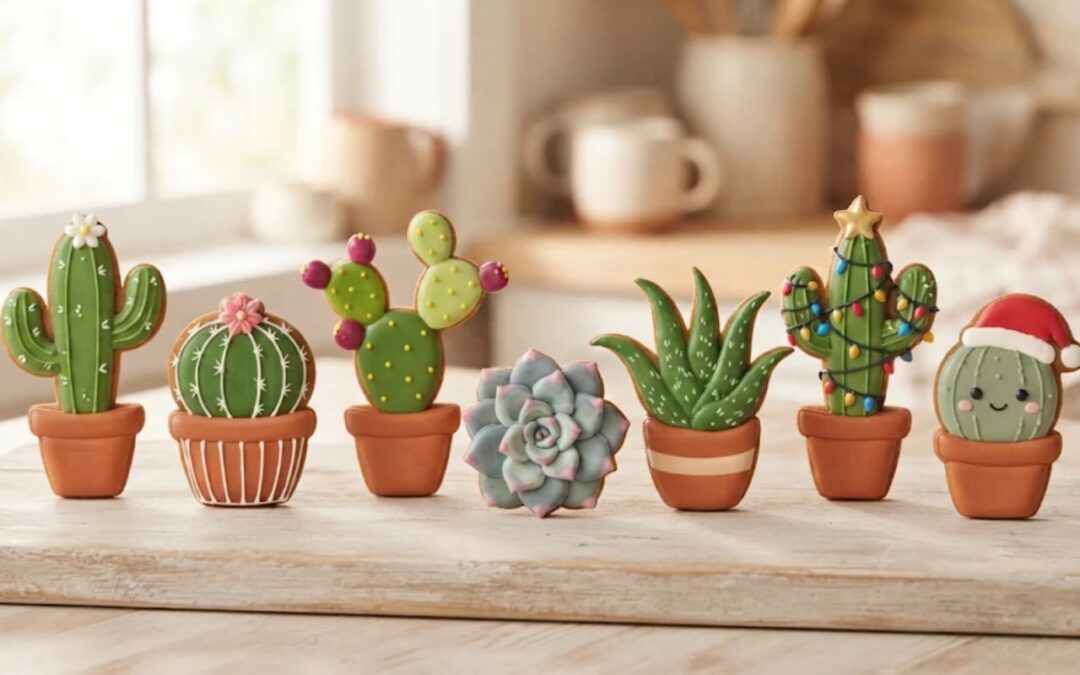
Cactus cookies are the houseplants nobody can kill. A green saguaro in a little terracotta pot, a barrel cactus with one pink flower, and a plate of them looks like a sunny windowsill in the middle of winter.
This set uses one free printable template with five potted plant shapes, a cut-out dough that keeps saguaro arms from spreading and the royal icing cure times from our icing pages. It is for anyone baking for a plant lover, a desert birthday or fiesta, or a Christmas tray that could use a cactus in a Santa hat.
You get an icing palette, three steps for each design, a picker and a party batch planner. Start with the recipe card, then the shapes.
Cactus Gingerbread Cookies
Makes about 40 cookies, about 3 inch potted cacti and 2 1/2 inch rosettes · Prep 30 minutes · Bake 11 minutes · Chill and freeze 2 hours 30 minutes · Icing cure overnight, 8 hours
Total time about 11 hours, most of it hands off. The overnight cure is what lets you stack them in a tin.
Equipment: Stand or hand mixer, Rolling pin with 1/4 inch guides, The free template printed on card stock, A small sharp paring knife, Two light-colored half sheet pans, Parchment paper, Piping bags with small round tips, Toothpicks or a scribe tool.
Template: free 1-page PDF, US Letter, a saguaro, a barrel cactus, a prickly pear, an echeveria rosette and an aloe, with icing guides and a 1 inch test bar.
Ingredients
Dough
- 3 cups all-purpose flour, 360 g, spooned and levelled
- 1 teaspoon baking soda
- 1/2 teaspoon salt
- 1 tablespoon ground ginger
- 1 1/2 teaspoons ground cinnamon
- 1/2 teaspoon ground cloves
- 1/4 teaspoon ground nutmeg
- 3/4 cup unsalted butter, 170 g, softened but still cool
- 3/4 cup dark brown sugar, packed, 150 g
- 1/2 cup unsulphured molasses, 170 g
- 1 large egg
- 1 teaspoon vanilla extract
Royal icing, a double batch
- 1/4 cup meringue powder
- 1/2 cup cold water, plus a few drops more for flooding
- 1/2 teaspoon cream of tartar
- 4 cups confectioners sugar, unsifted, 454 g
- Leaf green, teal, orange, brown, pink, red, yellow, blue and black gel food coloring, or the shades from the palette chart
- For the no-bake cacti: round store-bought butter cookies, green frosting, white sprinkles, pink candies and mini paper baking cups, optional
Method
- Make the dough: whisk the flour, soda, salt and spices, cream the butter and brown sugar until lighter in color, beat in the molasses, egg and vanilla, then mix in the dry ingredients on low and stop the moment no dry flour remains.
- Chill the dough as two flat wrapped discs about an inch thick for 2 hours, until a pressed thumb leaves a clean dent rather than a smear.
- Roll each disc to 1/4 inch between two sheets of parchment, so the dough never picks up extra flour.
- Cut round the paper shapes laid on the dough with a small sharp knife held straight up, cutting the saguaro arms and the aloe tips last.
- Freeze the cut cacti on the parchment-lined pan for 30 minutes, until the saguaro arms feel hard and lift without bending.
- Bake at 350F for 9 to 11 minutes straight from the freezer, until the surface looks matte and the edges are set, then cool completely on the pan.
- Mix the icing to stiff peaks, tint the biggest bowls saguaro green and terracotta, then tint small bowls of clay peach, white and the accent colors your designs need from the palette chart.
- Flood the plants and pots wet-on-wet, let them crust for an hour, add the ribs, paddles, hats, lights and petal rings, then pipe the spines, flowers and faces and leave the cookies flat overnight.
Notes: times are worked out from the set times on our icing pages, not timed on a build, and ovens vary, so judge by the surface rather than the clock. The yield is an estimate: a batch rolls to about 162 usable square inches at 1/4 inch, and the five shapes average about 3.7 square inches, which gives about 43, rounded down to 40. Bake one test tray before you shop for a big party. Dough adapted from King Arthur Baking gingerbread cut-outs.
What Makes a Cookie Read as a Cactus
Every potted plant on the template has one detail people look for first: the arms, the paddles, the rosette of petals. Each shape is built round it.
| Plant | The detail that gives it away | What the cookie does with it |
|---|---|---|
| Saguaro | A tall ribbed trunk with arms that bend up like elbows | One arm high and one low, rounded at every tip, with rib guides down the trunk |
| Barrel cactus | A chubby round body with deep ribs and a flower on top | A round body with three curved rib guides and a bump on top for the flower |
| Prickly pear | Flat oval paddles growing from the edges of other paddles, with round fruit | Two small paddles growing from a big one, fruits along the edges and a guide where they overlap |
| Echeveria | A tight rosette of fat petals, often with pink tips | A round of nine petals with two inner petal rings and a center circle |
| Aloe | Thick pointed leaves with white flecks and tiny teeth | Five leaves curving out of the pot, each with a center guide |
The saguaro is the slow one. A saguaro may grow its first arm around 75 to 100 years of age, and some never grow one at all. It can reach 52 feet and lives only in the Sonoran Desert of Arizona, Sonora and a corner of California. Its white, waxy blossom is the state wildflower of Arizona, which is why the classic saguaro here wears one white flower on top.
The prickly pear is the one you can eat. Its young pads are called nopales, and its fruit is called tuna, in red, wine red, green or yellow orange. The pads also carry glochids, tiny hairlike prickles that stick to skin, so the yellow dots on this cookie are the only kind you want to touch.
The two succulents earn their own colors. Echeveria grow as compact rosettes of fleshy, often brightly colored leaves and come from Mexico, Central America and northwestern South America; the genus is named for a Mexican botanical illustrator, Atanasio Echeverría y Godoy. Aloe vera leaves are thick and fleshy, green to grey green, with white flecks on some plants and small white teeth along the edges. That is where the white dots on the aloe cookie come from.
One Template, 5 Cactus Shapes
Every baked design starts as one of five cookies on a single page. The saguaro is about 2 inches wide and 2 7/8 inches tall, the barrel about 1 3/4 by 2 3/4 inches, the prickly pear about 1 3/4 by 3 inches, the aloe about 2 3/8 by 3 inches and the rosette about 2 1/2 inches round. Four of them stand in the same terracotta pot shape, so a tray lines up like a windowsill.

The free template prints on one US Letter page at 100 percent. Measure the red bar first: if it is not exactly 1 inch, your printer scaled the page.
The red dashed lines are icing guides, not cut lines: the saguaro and barrel ribs, a stripe across each pot, the line where the prickly pear’s small paddles tuck behind the big one, the two inner petal rings on the rosette and a line down each aloe leaf. Dotted circles mark the saguaro blossom, the barrel flower and the rosette center.
A script checked the parts most likely to snap. The saguaro arms are 0.42 inches thick, the prickly pear’s small paddles 0.51 inches, and the center aloe leaf is still 0.22 inches thick a quarter inch below its point, and every guide sits inside its cut line. The saguaro also serves the twinkle light saguaro, and the barrel serves the kawaii cactus, so print one page and cut two of each.
Icing Palette for All 8 Designs
Each row lists the colors one design needs and what each covers, so you can pick the plants you want and mix only those bowls. Gel brands vary, so tint a spoonful and test it on a scrap cookie first.
| Design | Shape | Colors and what they cover | Difficulty |
|---|---|---|---|
| The Saguaro in a Terracotta Pot | Saguaro template | saguaro green for the trunk and arms; sage green for the rib lines; terracotta for the pot; clay peach for the pot rim; snow white for the spines and blossom; sunny yellow for the blossom center | Medium |
| The Barrel Cactus with a Pink Flower | Barrel cactus template | saguaro green for the round body; cactus flower pink for the flower on top; terracotta for the pot; clay peach for the pot rim; snow white for the spines | Easy |
| The Prickly Pear with Pink Fruit | Prickly pear template | saguaro green for the front paddle; sage green for the top paddles; prickly pear magenta for the fruits; sunny yellow for the bristle dots; terracotta for the pot; clay peach for the pot rim | Medium |
| The Echeveria Rosette | Echeveria rosette template | dusty blue green for the outer petals; mint frost for the middle petals; pale celadon for the inner petals and center; rosy blush for the petal tips | Hard |
| The Aloe in a Striped Pot | Aloe template | aloe green for the leaves; snow white for the flecks; terracotta for the pot; clay peach for the pot rim; cream for the pot stripe | Medium |
| The Twinkle Light Saguaro | Saguaro template | saguaro green for the trunk and arms; terracotta for the pot; clay peach for the pot rim; pine green for the light wire; cranberry red for the bulbs; star gold for the bulbs and star; winter blue for the bulbs | Hard |
| The Kawaii Cactus in a Santa Hat | Barrel cactus template | sage green for the round body; cranberry red for the Santa hat; snow white for the hat brim and pom-pom; coal black for the eyes and smile; blush pink for the cheeks; terracotta for the pot; clay peach for the pot rim | Medium |
| No-Bake Cactus Cookies for Little Kids | Store-bought round butter cookies | green frosting for the cactus; white sprinkles for the spines; pink candy for the flower; brown paper baking cup for the pot | Easy |
Terracotta and clay peach go on six of the seven baked designs, since every one but the rosette sits in a pot, so mix those two in the biggest bowls. Saguaro green covers four designs. A saguaro and barrel plate needs 7 colors, while a saguaro, barrel, prickly pear and kawaii plate needs 11. The picker shows each design’s swatches, steps and difficulty, or picks one from where the plant lover would spot it.
Which Cactus Cookie Should You Make?
Pick a design to see its icing colors, its three steps and how hard it is. Or say where the plant lover would spot one, filter by skill, or let the button choose.
For ideas only: these palettes are original color choices and gel brands vary in shade, so tint a little and test on a scrap cookie. Nothing you pick leaves your browser.
Difficulty follows one rule. Easy means the base colors go on wet-on-wet in one sitting, then the dots. Medium means an accent has to wait for the base to crust before it goes on top, like ribs on a trunk or a hat on a bump. Hard means two or more layered accents plus fine lines on one cookie.
Ingredient Notes
The dough is a cut-out dough on purpose. It holds a sharp edge. A soft dough puffs, and the saguaro arms melt into round stubs.
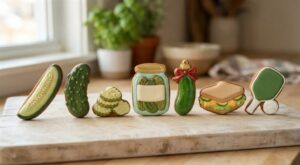
Cactus green is a dull green. Straight leaf green gel looks like a lime. Start saguaro green with leaf green and add a pinpoint of brown or black until it looks like a desert plant, then pull out a spoonful and lighten it with white for the sage ribs. The same trick makes the bumpy dill greens on our pickle cookie set. Green deepens as it sits, so judge it after an hour.
Terracotta is orange calmed down. Tint orange and add brown a drop at a time until it looks like a clay pot, then lighten a spoonful with white for the clay peach rim.
Meringue powder, not raw egg whites. Royal icing is never cooked and a party tray sits out for hours, so use meringue powder, dried egg white sold as a pasteurized product. For flood consistency and the full cure table, see how runny to make flood icing for a smooth cactus.
How to Make Cactus Cookies Step by Step
1.Make the dough
Whisk the flour, soda, salt and spices, cream the butter and brown sugar until lighter in color, then beat in the molasses, egg and vanilla. Mix in the dry ingredients on low and stop the moment no dry flour remains, so the dough stays tender.
2.Chill the dough
Chill the dough as two flat wrapped discs about an inch thick for 2 hours. It is ready when a pressed thumb leaves a clean dent rather than a smear.
3.Roll the dough
Roll each disc to 1/4 inch between two sheets of parchment. Keep it even: a thin spot under a saguaro arm or an aloe leaf is where a cactus breaks.
4.Cut the cacti
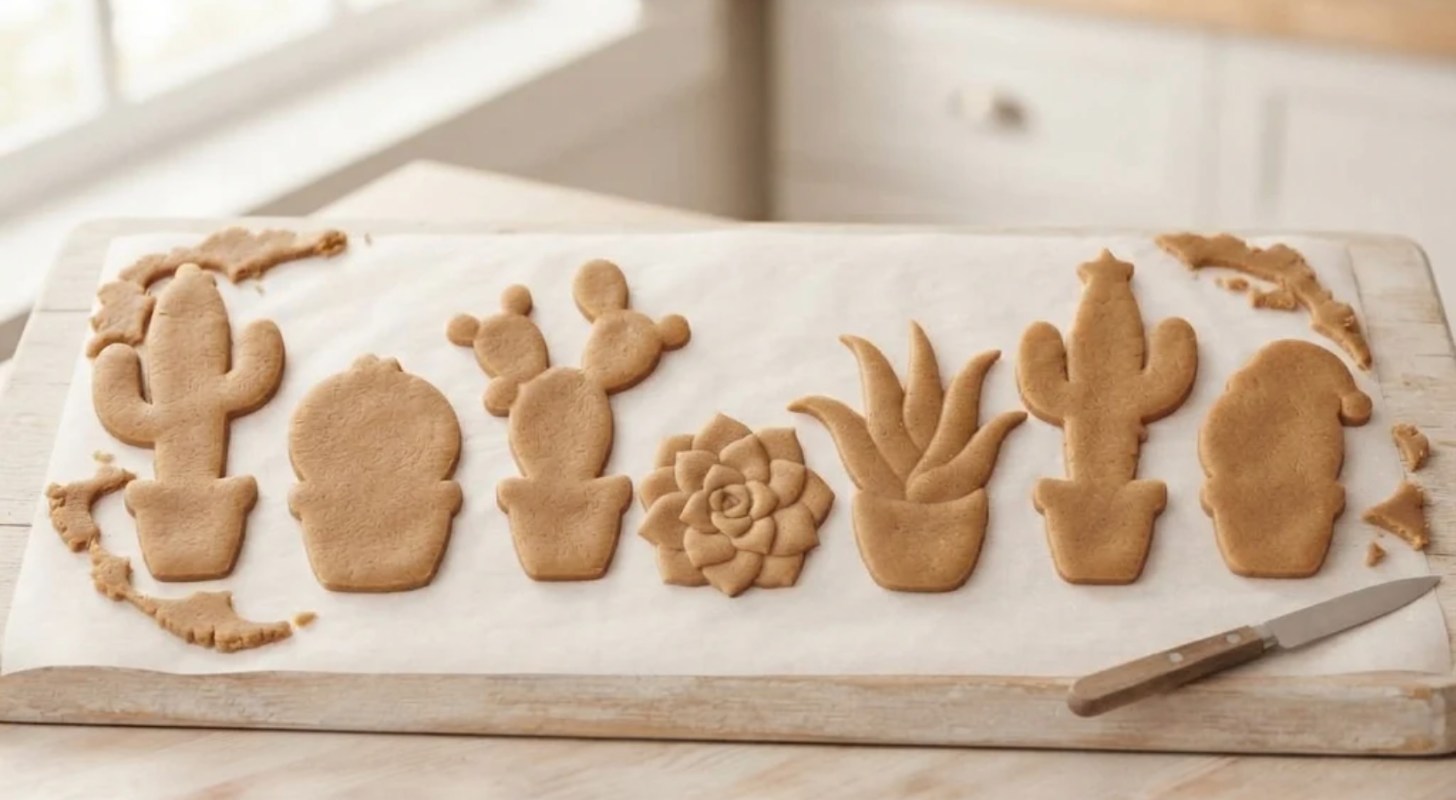
Lay the card stock shapes on the dough and cut round them with a small sharp knife held straight up. Cut the saguaro arms and the aloe tips last, then peel the scraps away from the cookie rather than lifting the cookie out.
5.Freeze the shapes
Slide the parchment onto a pan and freeze the cut cacti for 30 minutes. They are ready when the saguaro arms feel hard, which keeps those rounded tips crisp in the oven.
6.Bake at 350F
Bake for 9 to 11 minutes straight from the freezer. Judge by the surface rather than the clock: matte all over, with edges that are set. Cool completely on the pan, because a warm arm or leaf tip snaps.
7.Mix and color the icing
Beat the icing to stiff peaks. Tint the biggest bowls saguaro green and terracotta, then small bowls of clay peach, white and the accents. Thin each to flood consistency, keeping a little white, pink and black stiff for spines, flowers and faces.
8.Flood the cacti and pipe the details
Flood each plant and its pot right up against each other while both are wet, so they settle into one smooth surface. Let everything crust for an hour, then pipe the ribs and add the top paddles, hats, lights and petal rings. Pipe the white spines, flowers and faces last, leave the cookies flat overnight and give the small details about 2 hours before anything touches them.

Say you are decorating with a six-year-old who wants to do it all. Flood the plants and pots yourself the night before, then hand over a bag of stiff white icing for the spines. Nobody can pipe a spine wrong, and a cactus with too many still looks like a cactus.
7 Cactus Cookie Designs
Each design lists its colors, difficulty and three short steps, plus a no-bake cactus for the youngest helpers. The saguaro and the twinkle light saguaro share a shape, and so do the flowering barrel and the kawaii cactus.
1.The Saguaro in a Terracotta Pot

Colors: saguaro green, sage green, terracotta, clay peach, snow white, sunny yellow. Difficulty: Medium.
The cactus everyone draws, and the one to make first, because the twinkle light saguaro starts from it. Keep the spine dots tiny and in neat rows along the ribs.
- Flood the trunk and arms saguaro green, the pot terracotta and the rim clay peach right up against it, in one sitting.
- After an hour, pipe sage green rib lines down the trunk and each arm on the guides.
- Dot tiny white spines along the ribs, then pipe a white blossom of five dots in the circle with a yellow dot in the middle.
2.The Barrel Cactus with a Pink Flower
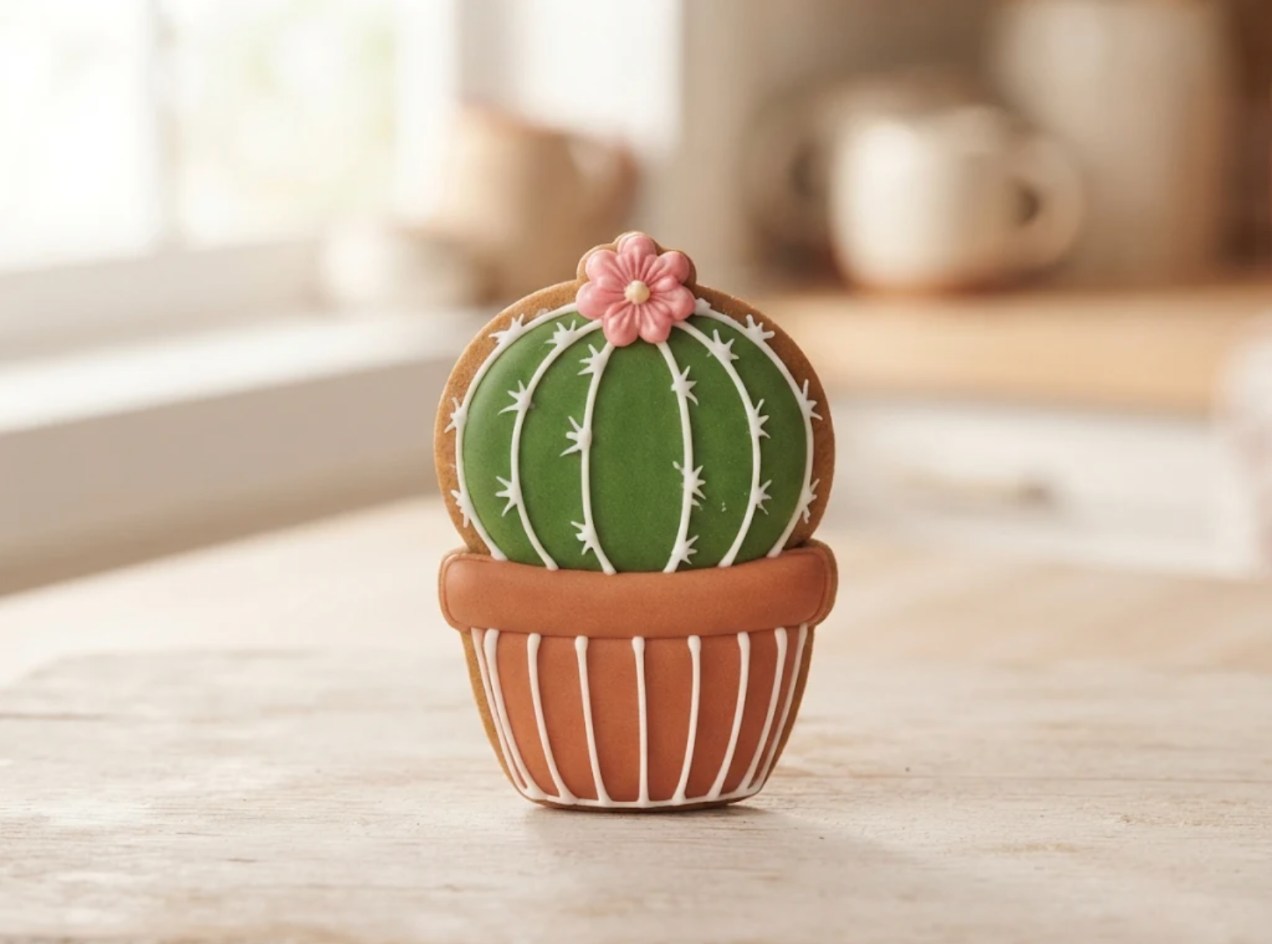
Colors: saguaro green, cactus flower pink, terracotta, clay peach, snow white. Difficulty: Easy.
The easiest baked design. The ribs come from a toothpick dragged through wet green, so there is no fine line to pipe.
- Flood the body green, the flower bump pink, the pot terracotta and the rim clay peach, all in one sitting.
- While the green is wet, drag a toothpick down the three rib guides from top to bottom so the body looks ridged.
- Once it crusts, dot white spines in short rows between the ribs and pipe a few pink petal points round the flower.
3.The Prickly Pear with Pink Fruit
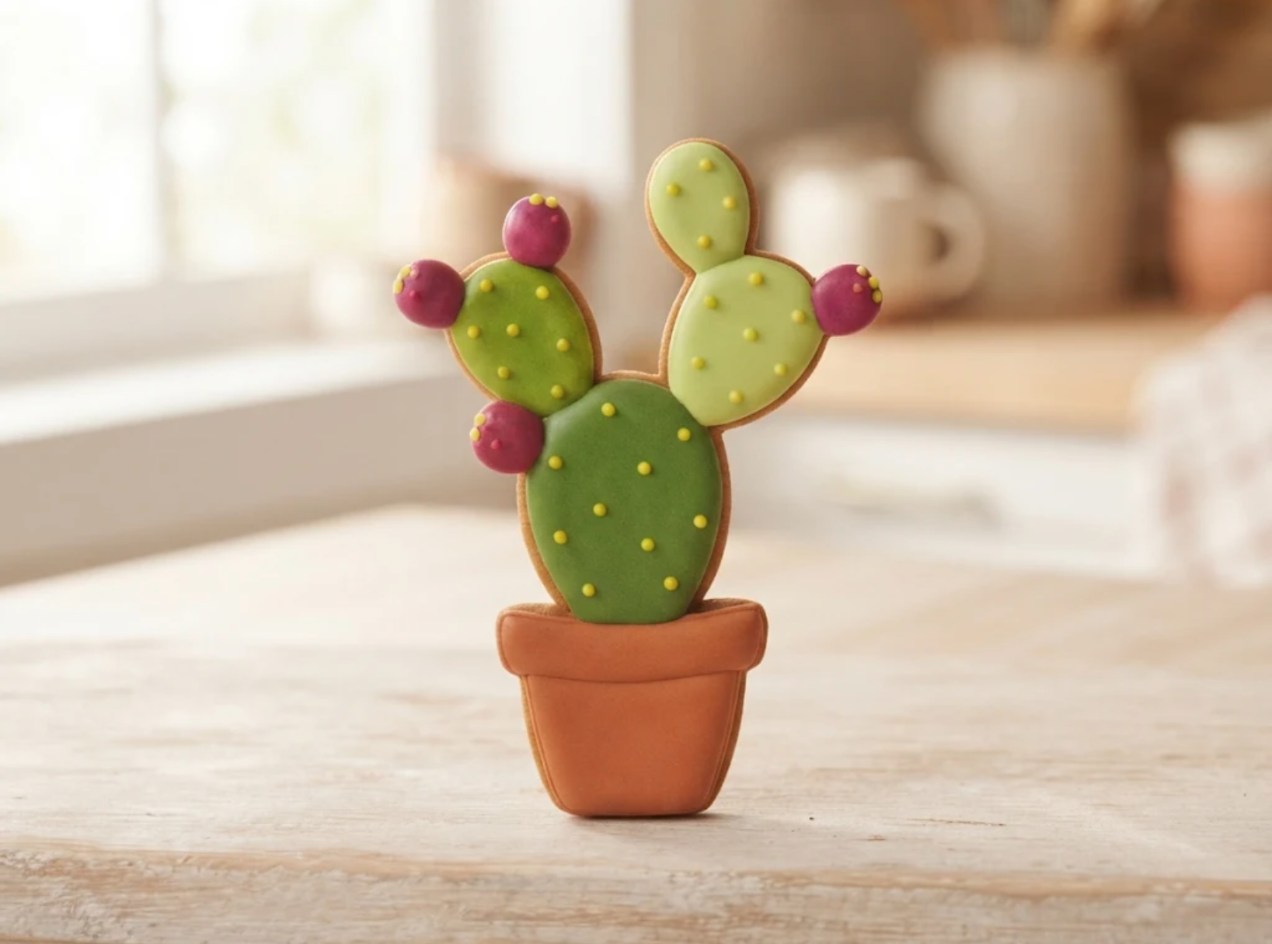
Colors: saguaro green, sage green, prickly pear magenta, sunny yellow, terracotta, clay peach. Difficulty: Medium.
Two greens make it work: the lighter top paddles read as sitting in front of the darker one. The magenta fruit is the bit kids point at.
- Flood the front paddle saguaro green, the pot terracotta and the rim clay peach, and let them crust for an hour.
- Flood the two top paddles sage green above the tuck lines and the fruits magenta, so each paddle sits in front of the next.
- Once it crusts, scatter small yellow dots over all three paddles for the bristles.
4.The Echeveria Rosette
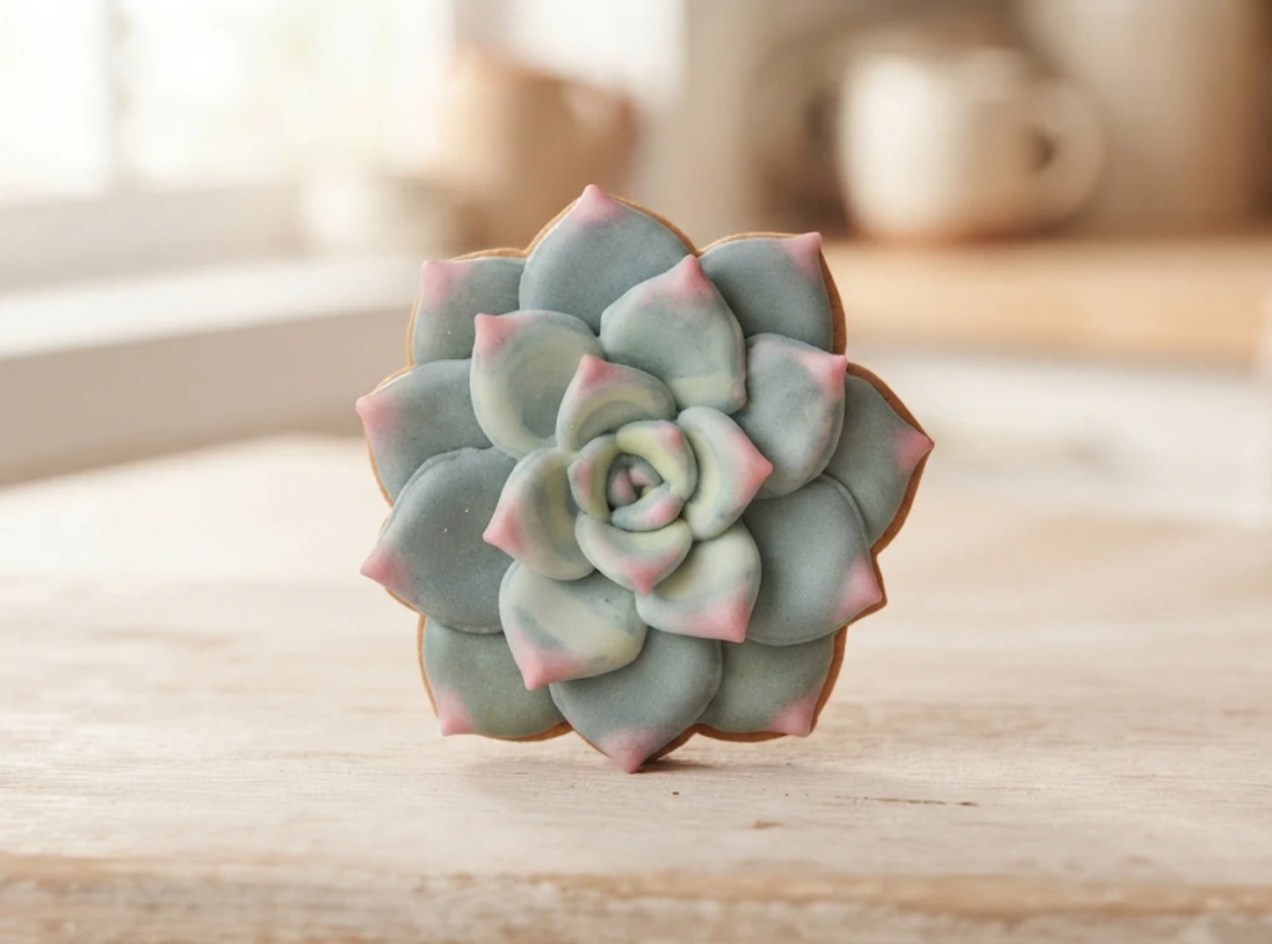
Colors: dusty blue green, mint frost, pale celadon, rosy blush. Difficulty: Hard.
The succulent in the set, and the one that looks like a flower. Three greens that step lighter toward the middle give it depth, and the pink tips finish it.
- Flood the whole rosette dusty blue green and let it crust for an hour.
- Flood the middle ring mint frost inside the outer guide, let it crust, then flood the inner ring and center pale celadon.
- Pipe a small rosy blush dot at the tip of every petal and drag it toward the center with a scribe.
5.The Aloe in a Striped Pot

Colors: aloe green, snow white, terracotta, clay peach, cream. Difficulty: Medium.
The spiky one. Drop the white flecks into wet green so they sit flat.
- Flood the leaves aloe green, the pot terracotta and the rim clay peach in one sitting.
- While the green is wet, drop a few white flecks onto each leaf so they settle flat.
- After an hour, pipe a cream line on the pot stripe guide.
6.The Twinkle Light Saguaro
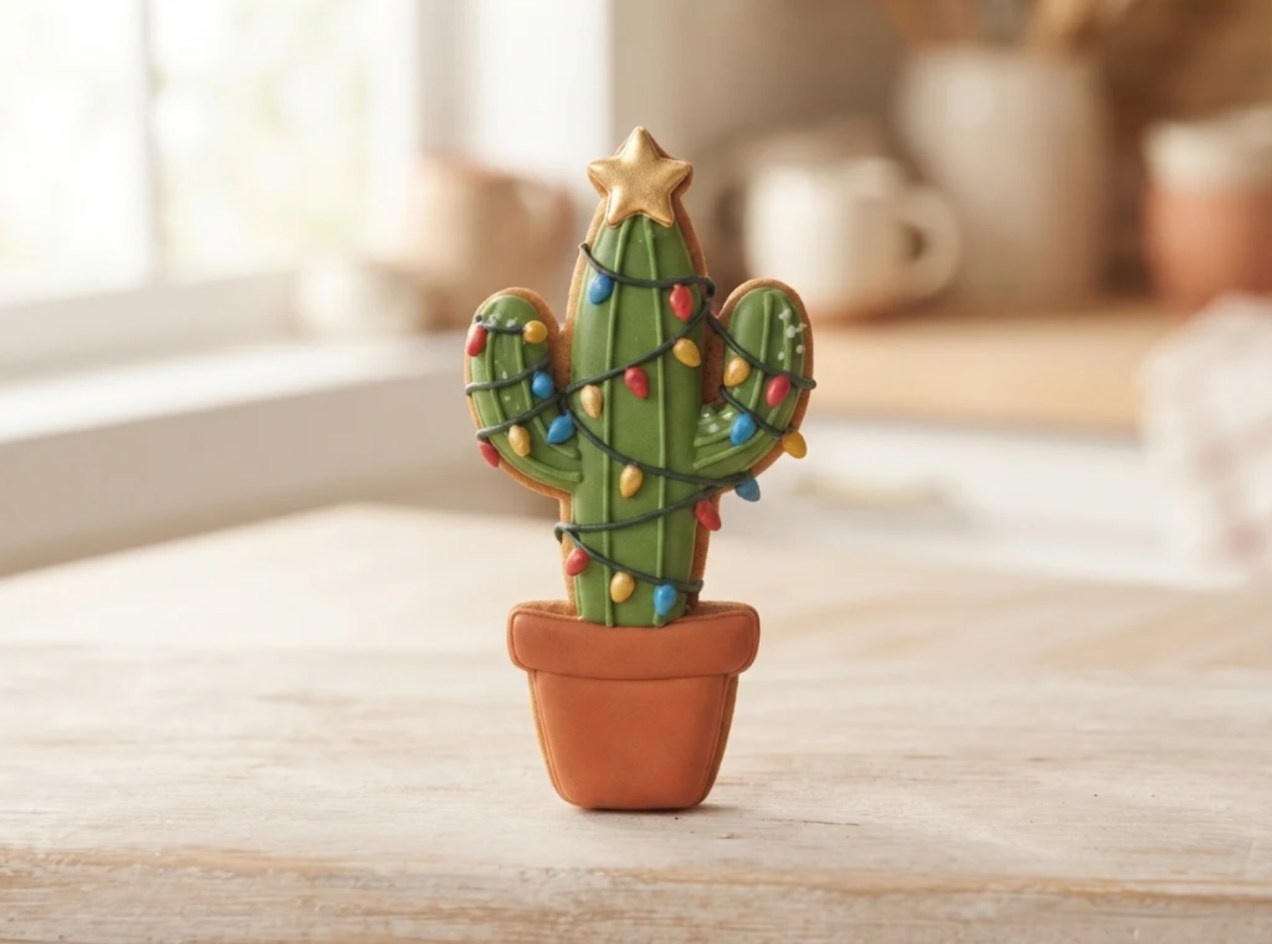
Colors: saguaro green, terracotta, clay peach, pine green, cranberry red, star gold, winter blue. Difficulty: Hard.
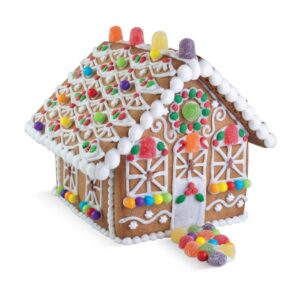
The desert Christmas tree, and the one that sells the holiday tray. The bulbs are just teardrops, so it looks harder than it is. For lights that really glow, set the tray round a gingerbread house with battery lights glowing in its windows.
- Flood the trunk and arms saguaro green, the pot terracotta and the rim clay peach, and let them crust for an hour.
- Pipe a thin pine green wire in loose diagonal swoops round the trunk and up each arm.
- Pipe teardrop bulbs along the wire, red, gold and blue in turn, then a gold star in the blossom circle.
7.The Kawaii Cactus in a Santa Hat

Colors: sage green, cranberry red, snow white, coal black, blush pink, terracotta, clay peach. Difficulty: Medium.
The cutest cookie in the set. Keep the ribs faint so the face has room, and keep the eyes low and wide apart. The brim and pom-pom work just like the white piped brim on our Santa hat gingerbread man.
- Flood the body sage green, the pot terracotta and the rim clay peach, let them crust for an hour, then pipe faint sage green lines on the rib guides.
- Flood the bump and a little cap shape over the top of the body red, then pipe a thick white brim across it and a white pom-pom on the tip.
- Pipe two black dot eyes, a short curved smile and a pink dot on each cheek.
No-Bake Cactus Cookies for Little Kids

Colors: green frosting, white sprinkles, pink candy, brown paper baking cup. Difficulty: Easy, no oven.
For a table of four-year-olds, or a day the oven is busy. Dragging the fork through the frosting is the part every small child wants to do twice.
- Spread green frosting over each cookie and drag a fork down through it for the ribs.
- Shake a few white sprinkles over the frosting for spines and press a pink candy on top for the flower.
- Stand each cookie upright in a mini paper baking cup so it looks potted.
Cactus Cookies for a Party
How to set cactus cookies out depends on the crowd.
- If it is a Christmas cookie tray, lean on the twinkle light saguaro and the kawaii cactus in a Santa hat, with one echeveria rosette in the middle like a wreath.
- If it is a desert birthday or a fiesta, bake the saguaro, the barrel and the prickly pear, and put them out next to taco cookies with shredded lettuce and cheese piped on. Flood the cacti ahead and let the guests pipe the spines.
- If it is a gift for a plant lover, bag one of each pot together, or line them up in a shallow box like a nursery shelf.
The planner does the math for cookies, batches, colors and days, working the dough out from each shape’s size: the rosette uses about half as much dough again as the prickly pear.
Cactus Party Cookie Planner
Enter the guests, the cookies each and the party date, then tick the designs. It works out the dough batches from how big each shape is, how many of each to cut, the icing colors and which day each job falls on.
For planning only: the dough per batch figure is an estimate and dough rolls out differently in every kitchen, so bake one test tray before you shop for a big party. The no-bake version is not counted because it uses store-bought cookies. Nothing you enter leaves your browser.
Picture a party for 12 on a Saturday, with the saguaro, the barrel, the prickly pear and the kawaii cactus ticked. The planner calls for 14 cookies, one batch of dough and one double batch of icing in 11 colors, with 4 saguaros, 4 barrels, 3 prickly pears and 3 kawaii cacti. Bake and flood on Wednesday, add the ribs, hats and spines on Thursday, and Friday stays free in case an arm snaps.
Troubleshooting
| Symptom | Cause | Fix |
|---|---|---|
| A saguaro arm or aloe tip snaps off | Dough rolled thin there, or the cookie lifted by the arm | Roll an even 1/4 inch, freeze before baking and lift every cookie with a spatula under the pot |
| The green looks like a lime | Straight leaf green gel | Add a pinpoint of brown or black and let it sit an hour before judging |
| Green bleeds into the pot | The two floods were thinner than each other, or one went on late | Flood plant and pot at the same thickness, side by side, within a minute of each other |
| The ribs disappear | The toothpick went through after the green crusted | Drag barrel ribs while the green is wet, and pipe saguaro ribs only after it crusts |
| Spines spread into blobs | White icing too runny | Pipe spines from toothpaste-stiff icing with the smallest round tip |
Make-Ahead and Timeline
Plan on three days: bake and flood on day one, ribs, accents and spines on day two, bag on day three. For a big party, freeze the plain cookies flat in an airtight container and thaw them sealed so condensation forms on the outside. For how long decorated cookies stay good to eat, see how long iced cactus cookies keep in a tin.
Storage Instructions
Once cured, store the cookies in an airtight tin at room temperature, with parchment between layers and out of sunlight, which fades pinks and reds.
Lay the saguaros and aloes flat and side by side, since the arms and leaf tips are the thinnest parts. Hold to the overnight cure on our royal icing card before you stack the cacti, or the raised spines will print onto the cookie above.
Frequently Asked Questions
Do I need a cactus cookie cutter?
No. The free template does the job for all five shapes. If you own a saguaro cutter, use it for the two saguaro designs and print the template for the barrel, the prickly pear, the rosette and the aloe.
Is a Christmas cactus a real cactus?
Yes, though not the desert kind. The Christmas cactus comes from the coastal mountains of southeastern Brazil, where it grows on trees or rocks, and its common names refer to when it flowers. It has no leaves at all, only green stems in segments, and flowers in white, pink, red, orange or purple, so the closest cookie here is the prickly pear with its pink fruit.
How far ahead can I make cactus cookies?
Baked, undecorated shapes freeze for up to about 3 months. Decorated cookies keep about two weeks in an airtight tin once cured, so decorating three days ahead leaves plenty of margin.
More Gingerbread Cookie Recipes
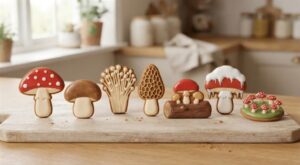
- toadstools, morels and a fairy ring from one template, the same one cute thing done seven ways
- poinsettia cookies for the other Christmas plant, for a red and green tray
- every look-alike cookie set we have baked so far, for the next party
Pair the Cookies with a Best Gingerbread Houses Kit Pick
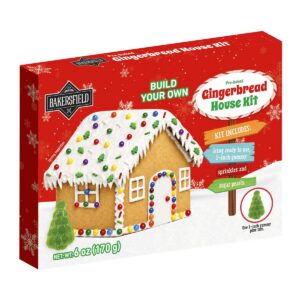
When the party wants something to build too, start from a gingerbread house kit to line the cacti up in front of.