

Every guide to a gluten free gingerbread house is a guide to the dough. Which
blend, how much xanthan gum, how thick to roll it. That advice is fine, and you will find ours
below.
It is also aimed at the wrong part of the house. A gingerbread house is mostly
candy by surface area, and candy is where the gluten usually is. The recipes that rank for this search spend their words on flour instead.
So this covers both, in the order that matters: the candy first, the structure
second, the dough third, and the kits for anyone who would rather buy the whole thing solved.
The Candy Is the Part to Check
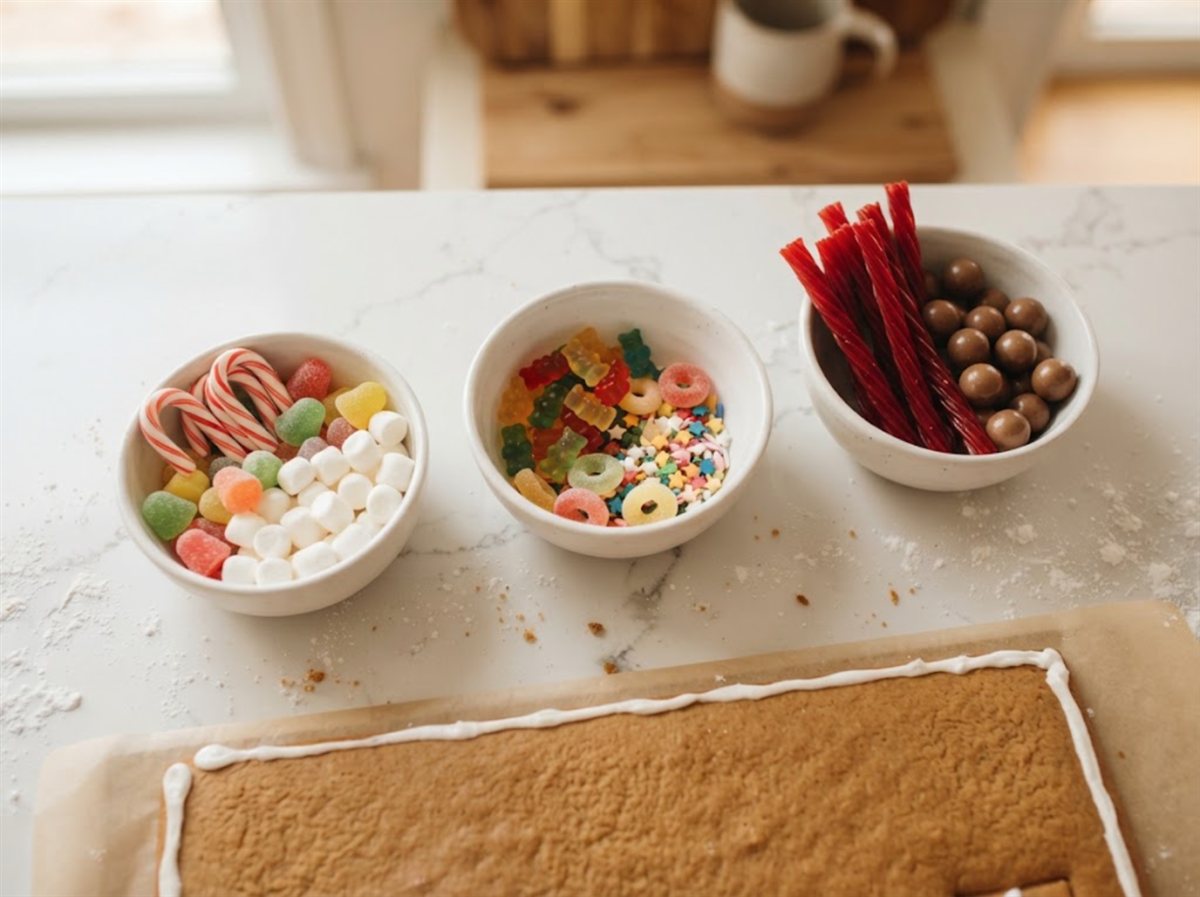
A finished house carries maybe half a pound of gingerbread and a bowl of candy
that a child works through as they build. The gingerbread was measured carefully from a certified blend.
The candy came out of a shared bowl and nobody read the back of anything.
The Gluten Intolerance Group’s own page on gluten free gingerbread houses says
“You can use traditional candy and icing or get creative with your decorations. Use gluten-free pretzels
for a log cabin look.” It catches the pretzels, which are obvious. It waves through the candy bowl, which
is not.
Four categories to check, every time
Brands reformulate and regional versions differ, so a list of safe brand names
goes stale. Categories do not. These four are where wheat and barley actually turn up in a decorating
bowl:
- Licorice and licorice-style twists. Wheat flour is structural
in most of them, not an additive. Twizzlers list enriched wheat flour among their main ingredients on
Hershey’s own product page. This is the one that catches people, because red twists are the classic
gingerbread house trim. - Anything malted. Malt means barley unless it says corn malt.
Whoppers and malted milk balls are the common ones on a roof. - Wafer and crisp centers. A wafer is a thin baked biscuit, and
biscuit usually means wheat. Kit Kat is the standard example. - Cookie pieces and anything cookies-and-cream. The cookie is a
cookie. Crushed cookie is also a common “dirt” or “shingle” texture in decorating tutorials.
Plain hard candy, most gummies, plain chocolate, candy canes, marshmallows and
most sprinkles are usually fine, and you still read the pack, because “usually fine” is not a standard
anyone should build a celiac child’s afternoon on. Beyond Celiac keeps a
current candy list and is a better reference than anything frozen into an article.
Once you have the safe pile, the second question is which of it will actually
stay on a wall, and that is a different problem. We went through which candy holds up on a gingerbread
house separately, on structural grounds rather than safety ones.
Gingerbread House Candy, Checked
Sorted by why, not by brand. Formulations change and brands vary by country, so the category is the thing worth learning.
Usually contains gluten
Check the label
Usually fine
This is a guide to categories, not a substitute for the packet. Manufacturers reformulate, the same brand name differs between countries, and a shared production line can matter even when the ingredients do not. For a maintained brand-level list see Beyond Celiac. Nothing you select here is stored or sent anywhere.
Shared bowls, shared kitchens, shared tables
If the build is for a child with celiac disease rather than a preference or an
intolerance, the bowl matters as much as its contents. Decorate before anyone else opens a bag of
pretzels at the same table. Use separate bowls rather than a communal one. At a school or scout event,
assume the shared candy is contaminated regardless of what it started as, and send a labeled kit of your
own. This is the advice that gets given, correctly, in every December thread on r/Celiac, and it is worth
more than any flour recommendation.
Why Gluten Free Panels Break Differently
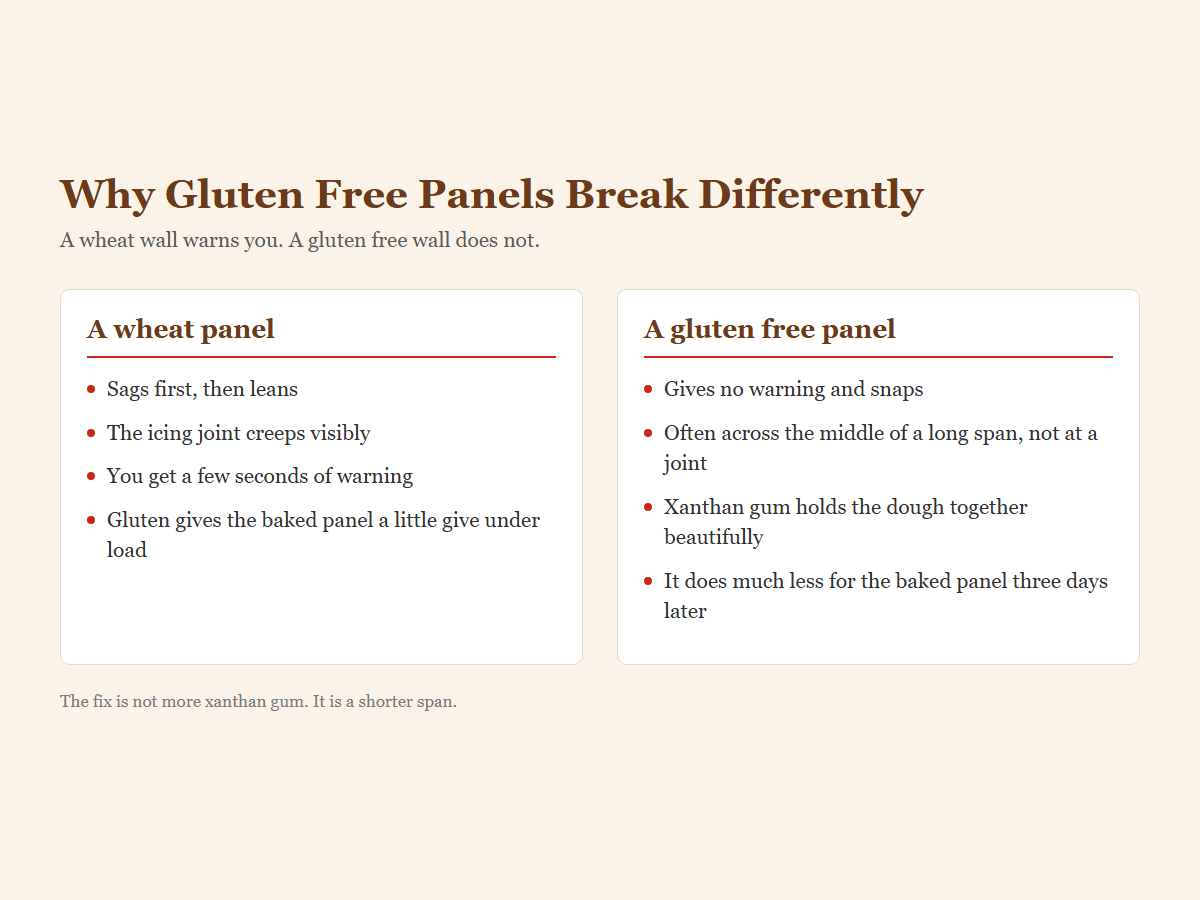
A wheat gingerbread wall that is going to fail usually sags first. It leans, the
icing joint creeps, and you get a few seconds of warning. A gluten free wall tends to give no warning and
snap, often across the middle of a long span rather than at a joint.
That difference is the missing gluten network. Gluten gives baked gingerbread a
little give under load. Xanthan gum, which is what a 1-to-1 blend uses in its place, does an excellent
job on the dough, holding it together while you roll and lift it. It does much less for the baked panel
under its own weight three days later.
The practical consequence is not "use more xanthan gum". It is
shorten the span. A brittle panel is strong until it is not, and what decides the moment
is unsupported length. A 9 inch wall in gluten free gingerbread is genuinely harder than a 9 inch wall in
wheat, and a 6 inch wall is not. If you are building with a child who wants a big house, a cluster of smaller
houses, which also buys you time, since how long gingerbread keeps depends on span as much as on recipe is more likely to survive the evening than one large one.
Interior corner supports do more here than they do on a wheat build, for the same
reason. A bead of icing run down the inside of every vertical corner, and a small triangle of offcut
gingerbread glued into each one, turns two unsupported panels into a braced box.
How Thick to Roll, and Why the Advice Disagrees
Some guides say to roll about 1/4 inch. One popular UK recipe says about 7mm, a shade over a quarter. The highest ranking recipe for this search rolls to 3/8 inch, describing it as more than a quarter and less than a half. All of these numbers
are published as the answer, and the disagreement is not sloppiness. It is a trade nobody states
out loud.
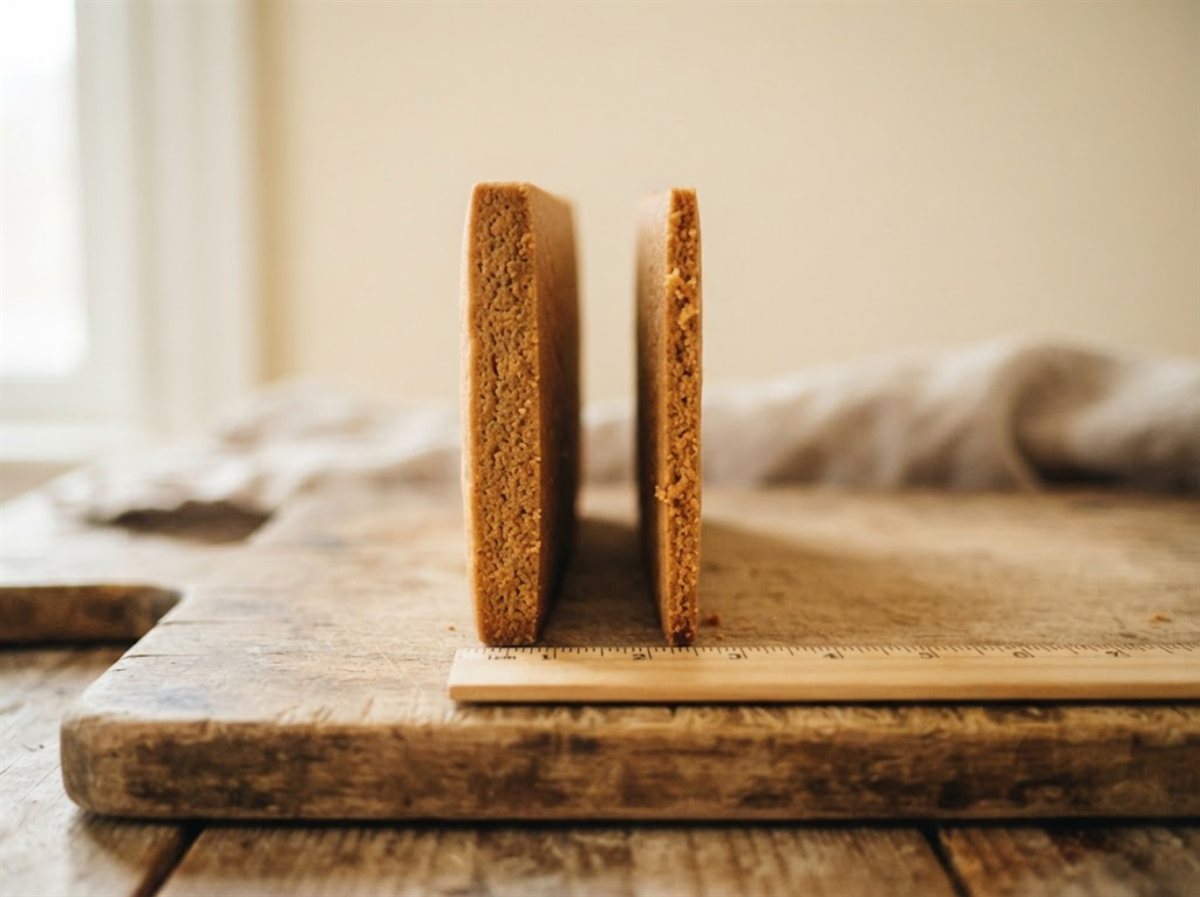
Thicker is stronger and thicker is heavier. On a wall, weight is not the problem
and strength is, so thicker wins. On a roof, the panel's own weight is exactly the load that breaks it,
and the walls have to carry it, so thicker loses on both counts.
| Panel | Roll to | Why |
|---|---|---|
| Walls | 3/8 inch | Carrying load, not being carried. Strength is the only thing that matters |
| Roof | 1/4 inch | Every extra millimeter is extra weight on the walls and on itself across the span |
| Base | 3/8 inch or thicker | Nothing is carrying it. Make it as stiff as you like |
| Chimneys, doors, small trim | 1/4 inch | Short spans, so brittleness never gets the chance to matter |
Gluten Free Span Check
Measure the longest unsupported edge of a panel on your template and see how much bracing it needs in gluten free dough.
A rule of thumb built from the span and thickness advice on this page, not a lab test. Humidity, your flour blend and how long the panels dried all move the line. Nothing you enter is stored or sent anywhere.
Rolling to two thicknesses in one session sounds fussy and takes about four extra
minutes: roll and cut the roof and trim first at the thinner setting, then roll the rest thicker. Both
trays bake at the same temperature.
The Dough
This is the part every other page leads with, and it is the part that gives the
least trouble.

Makes enough for one house of roughly 6 by 7 inches · Prep 20 min plus
chilling · Bake 14 to 16 min · Oven 325°F
Ingredients: 3 cups (420g) all-purpose 1-to-1 gluten free flour
blend · 3/4 teaspoon xanthan gum, omitted entirely if your blend already contains it · 1 tablespoon
ground ginger · 1 1/2 teaspoons ground cinnamon · 1/2 teaspoon ground cloves · 1/2 teaspoon salt ·
3/4 teaspoon baking soda · 3/4 cup (170g) butter, softened · 3/4 cup (150g) brown sugar, packed ·
1 large egg · 3/4 cup (255g) unsulphured molasses
Whisk the dry ingredients. Cream butter and sugar, beat in the egg and molasses,
then add the dry mix and combine until it comes together as a stiff dough. Divide in two, flatten into
discs, wrap and chill at least two hours.
Two things about this dough that are specific to the gluten free version. It is
stickier at mixing than the wheat version and it will feel wrong. Do not correct it with more flour.
It also seems to keep drinking water while it rests, so a dough that felt slightly too
wet going into the fridge often rolls out perfectly two hours later, and one that felt right going in can
crack at the edges when you roll it. Bakers report this consistently, though I have not seen it
measured. Roll from the center out, and patch a cracked edge by pressing it back together rather than
re-rolling the whole sheet.
Cut the panels on the chilled sheet, not after. Our free printable templates
work for this dough unchanged, and if you want to see how the two doughs differ side by side, the wheat version of
this dough, and the rolling advice in our gingerbread house tips holds either way is the direct comparison.
Bake at 325°F for 14 to 16 minutes, until firm and evenly colored to the middle
rather than just at the edges. Leave the panels on the tray until completely cold. Warm gluten free
gingerbread is far more fragile than warm wheat gingerbread, and most breakages happen at the moment
someone moves a hot panel.
Gluten free dough spreads a little in the oven, so trim the panels while they are still warm and still on the tray. Lay the paper template back on top and cut along it with a sharp knife, then leave them alone to cool. A straight edge is what makes a tight icing joint, and a warm panel cuts cleanly where a cold one cracks.
If a cold panel still flexes when you lift it by one corner, it is underbaked, and it will sag or snap once it is carrying a roof. Bakers in the celiac forums give the same fix year after year: bake gluten free panels a few minutes longer than you would cookies, so they dry out right through. Return a soft panel to the oven for a few minutes rather than building with it.
Assembly, Which Is the Same as Any Other House
Nothing about gluten free assembly is different, so this is short. Use a stiff
royal icing, build the four walls first, let them set properly before the roof goes anywhere near them,
and support the walls with tins or mugs while they dry. Our page on royal icing that sets
hard covers consistency and set times, and both are the same regardless of which flour is in
the walls. The build itself is no different either, so the full assembly walkthrough and our 45 decorating ideas apply here too. Royal icing is sugar, egg white and a little acid, so it is naturally gluten free. If egg is the problem instead, our vegan gingerbread cookies cover an egg-free royal icing. Check any
pre-made icing or fondant, which is the one assembly ingredient that can carry a surprise.
The No-Bake Route, With Gluten Free Graham Crackers
If baking is off the table, the swap people suggest most often in gluten free forums is gluten free graham crackers, with Pamela's and Partake the names that come up. It works, with one honest warning from the parents who tried it: gluten free crackers are crumblier than the wheat kind, so they break when you saw them and the joints need far more icing.
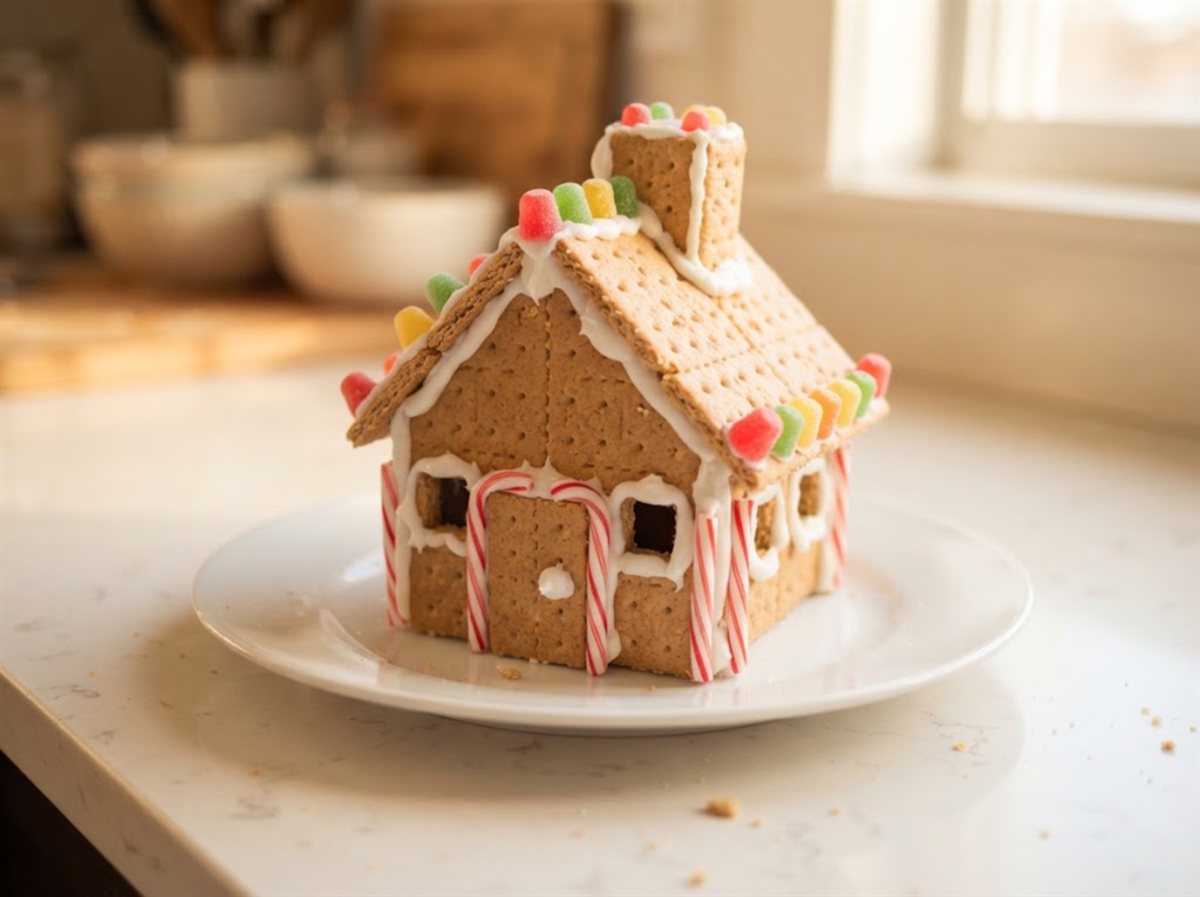
Three things make it easier. Score a cracker with a serrated knife and snap it rather than cutting straight through. Use the stiffest royal icing you can pipe, and let each wall stand for a full hour before the next goes on. And keep the house small, because the same short-span rule from above applies to crackers too. Our graham cracker gingerbread house walks through the build step by step, and it works unchanged with gluten free crackers. Check that the box says certified gluten free rather than just wheat free.
Or Buy One Already Solved
We checked all five gluten free kits directly on 8 September 2026, and the picture has moved since. Little GF Chefs is $35.00 and states a gluten free certification. It was pre-order in September, and its listing showed in stock in early November. The A&J Bakery pre-baked kit through Gluten Free Palace is $48.99 and is still listed in stock. The LillyBean tiny house village kit was $31.99 and sold out on LillyBean's own site in September, so check it before you count on it. Full prices, stock and the certification question are in our guide to gluten free gingerbread house kits. Confirm certification on the pack before you buy for a celiac child.
The complaint that comes up most in gluten free forum threads about these kits is not the taste. It is pieces arriving broken. Gluten free gingerbread snaps rather than bends, and pre-baked panels travel badly. Order early enough to replace a broken kit, open the box the day it arrives, and keep a batch of stiff royal icing ready. A cracked wall glued with icing and propped overnight usually holds.
There are five in our kit database rather than three, and price is the least
useful thing to sort them on when the real questions are whether it needs baking, whether the icing is
any good, and whether it suits the age of the child doing it. The finder below is filtered on those. The
full comparison of
31 kits has the rest.
Which Allergen-Friendly Kit
Five kits from our comparison of 31, filtered on the things that actually decide it rather than on price alone.
Prices are the most recent figures we have and move constantly, so treat them as a band rather than a quote. Where a price is not shown, the kit is sold in several configurations or by subscription. Certification wording is the manufacturer's, so confirm it on the pack before buying for a celiac child. Nothing you select is stored or sent anywhere.
Gluten is not the only reason to change what a house is made of. If yours is time, small builders or an allergy other than gluten, what to use instead of gingerbread works through the five reasons and gives a different answer to each, starting with the icing rather than the walls.
Gluten Free Gingerbread House Questions
Where can I buy a gluten free gingerbread house?
Mostly online, from the specialty kits above, and from local gluten free bakeries, which often sell their own kits in December. Most supermarket gingerbread house kits are made with wheat flour, so read the box rather than assuming.
Is royal icing gluten free?
Homemade royal icing is powdered sugar, egg white and a little acid, so yes. Check the label on a pre-made icing tube or a meringue powder, since those are the ingredients that can carry a surprise.
Can I use a regular gingerbread house template?
Yes. Any template works with gluten free dough, but pick one where no wall or roof edge runs much past 6 inches, or brace the longer panels as the span check above suggests.
Build Your Gluten Free Gingerbread House with Best Gingerbread Houses
The dough is the easy part. Get the candy right, keep the spans short, and the
rest of it is an ordinary gingerbread house that happens to be safe for everyone at the table.
We test kits, doughs and icings every season and publish what actually held up.
Start with the candy guide if you are
buying decorations this week, and the templates if you are
baking this weekend.