A milk carton gingerbread house is the one most of us made in kindergarten: a school milk carton for the frame, graham crackers stuck on for walls, and as much candy as the icing would hold. It is still the easiest way to give a whole class a gingerbread house each, because the carton does the hard part. Nothing has to stand up on its own.
We built this guide on the published methods of teachers who run this build every December. The main one is the kindergarten teacher behind Sharing Kindergarten, who has made these houses with her classes for 18 years. Another is Vanessa Levin of Pre-K Pages, an early childhood teacher and curriculum writer. Where a tip comes from a teacher’s classroom or a parent’s thread rather than from us, we say whose it was.
When we say a milk carton gingerbread house, we mean both the edible version, with graham crackers, icing and candy, and the craft version, painted and decorated with no food at all, for rooms where food is off the table.
If you’re a kindergarten or preschool teacher with 22 cartons to find and one afternoon to fill, this is your plan. If you’ve been handed the job as the parent volunteer, it tells you what to do the night before. And if your school has a no-food rule, or a child with allergies, the craft version gives every child the same house.
By the end you’ll know how many cartons and crackers to get, which glue suits the age of your builders, and what to do on each day before decorating day, so the afternoon itself is the fun part. It comes in four parts: getting and prepping the cartons, building the house, running decorating day, and the version for classrooms that cannot use food.
It all starts with the one thing that makes this build different from every other gingerbread house.
The Short Answer: The Carton Holds the House Up, So the Glue Does Not Have To
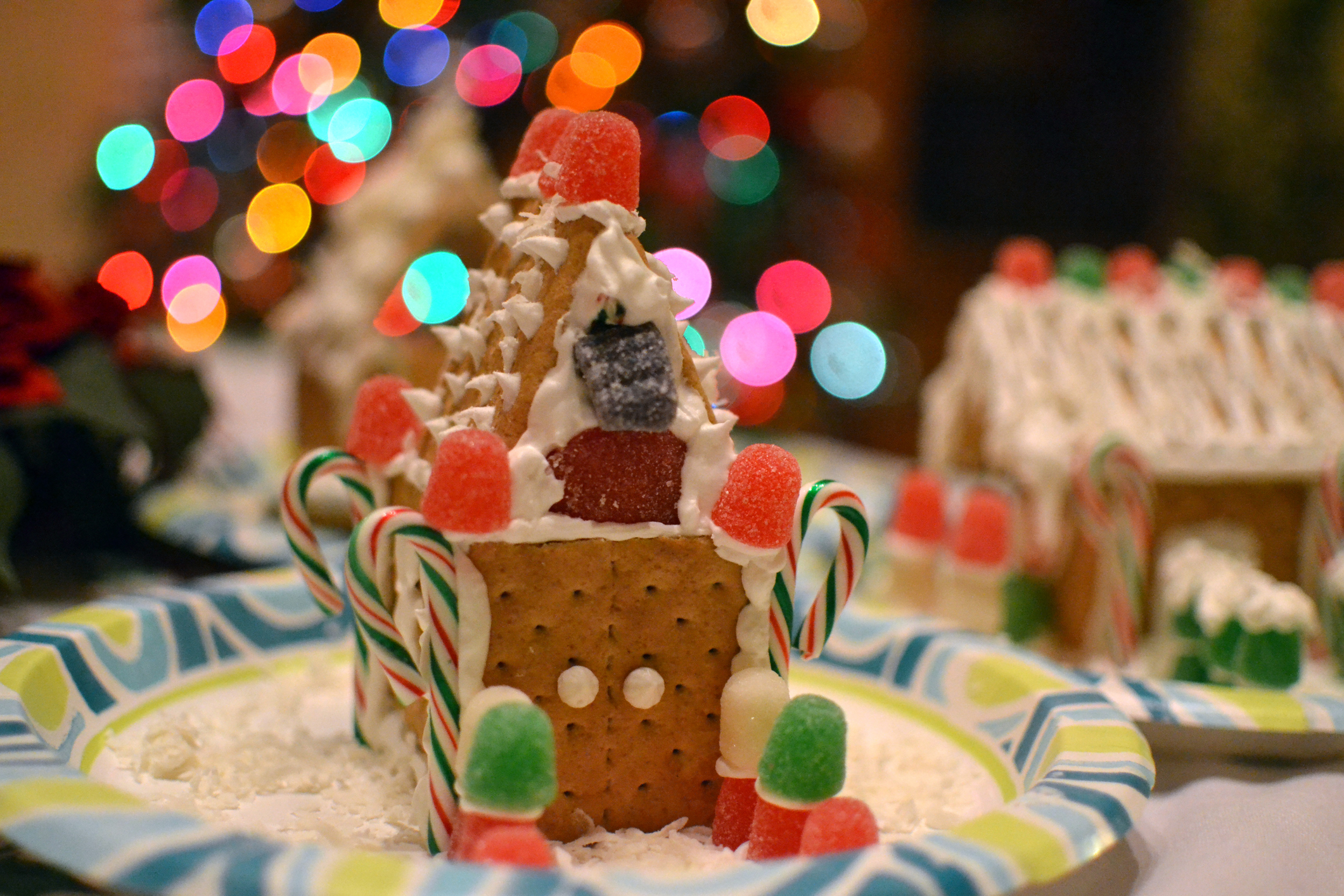
A milk carton gingerbread house is a clean, dry school milk carton, stapled shut, with graham crackers stuck to its four sides and two roof slopes, set on a paper plate and decorated with candy. Each house takes 7 graham cracker squares: 4 for the walls, 2 for the roof, and 1 cut corner to corner into the 2 triangles that fill the ends under the roof. That count comes from the Sharing Kindergarten teacher, who says the triangles fit the carton perfectly.
The carton is the reason this build works for five year olds. On a normal gingerbread house the icing is the only thing holding the walls up, so it has to set hard before the roof goes on. Here the carton is already standing, so the crackers only have to stick to it. That one difference changes which glue you can use, how young the builders can be, and how much can go wrong.
What to Get for One House and for a Whole Class
Here is the list for one house. Multiply it by your class, then add spares, because every teacher who writes about this says the same thing: crackers break, cartons get lost, and somebody always arrives on the day without one.
| Item | Per house | Why |
|---|---|---|
| School milk carton, washed, dried and stapled | 1 | The frame. Collect extras |
| Graham cracker squares | 7 | 6 whole squares, 1 cut into 2 triangles |
| Glue | Royal icing, tub frosting or hot glue | Choose by who builds and who eats it, below |
| Sturdy paper plate | 1 | Flimsy plates fold when a child lifts the house |
| Candy or craft decorations | 1 cup | Presorted, one cup per child |
| Craft stick or plastic knife | 1 | For spreading icing |
| Gallon zip bag | 1 | For the trip home |
Class Carton Kit Counter
How many cartons to collect and how many graham crackers to buy for your group, with spares for the ones that break.
Planning numbers, not a guarantee. The 7 squares per house follows a kindergarten teacher’s published method of 6 squares plus 2 triangles cut from one square, and a full graham sheet snaps into 2 squares. Box counts vary by brand and size, so count the sheets in one box and enter that number. Check every food label against the allergies in your group; this is not medical advice. Nothing you enter is stored or sent anywhere.
Picture a class of 22 on the tub frosting route with 20 percent spare. That comes to 27 cartons, 185 squares and 93 full sheets of graham crackers. Count the sheets in one box before you shop, because box sizes vary, and that one number is what turns sheets into boxes.

Finding Enough Cartons, Even When Your School Serves Milk in Bags
The school cafeteria is the source. Empty cartons go in the trash every day, as one school worker put it in a thread about finding them, so ask the cafeteria staff to save them and start two to three weeks before decorating day. Pre-K Pages suggests writing each child’s name on the bottom of their carton in permanent marker, which also settles any worry about germs, because every child gets their own carton back.
Two ways teachers spread the work:
- Use an older buddy class. One commenter on r/Teachers pairs third graders with kindergarteners: the big kids collect and wash the cartons the week before. The same class has had unused cartons donated by a milk company.
- Send a note home. Kelly’s Classroom Online suggests asking families to send in supplies, which cuts the cost and the shopping.
Not every school still serves milk in cartons. The writer behind Disneyland Daily found her children’s elementary schools used bags instead. If that is your school, there are three other places to look:
- The grocery store dairy case. Disneyland Daily found small milk cartons for $1 each at Albertsons in late 2025 and says Target carries them too.
- Other small cartons. Heavy cream and liquid egg substitute come in small gable top cartons. Parents in a Reddit thread point out they run slightly bigger than school milk, so your cracker squares may not quite cover them.
- Flat packed craft cartons. Bird seed house craft kits ship as flat milk carton shapes you fold yourself. Disneyland Daily lists a pack of 15 for under $9 on Amazon.
Wash, Dry for Days, Then Staple the Top Shut
Rinse each carton in warm soapy water as soon as it comes in, stand it upside down to drain, and let it dry for days rather than overnight. Milk left in the seams is what makes a classroom smell sour by Friday. Kelly’s Classroom Online, Pre-K Pages and Sharing Kindergarten all warn about it, and the Sharing Kindergarten teacher lets hers dry for several days for exactly that reason.
Once a carton is bone dry, staple the spout closed. The Sharing Kindergarten teacher calls this the step you cannot miss: the one year her class skipped it, the roof crackers came off and the cartons had to be stapled shut and the roofs stuck back on. The reason is simple. An open spout is a flap, and the weight of icing and candy on that slope pushes it open, taking the roof with it. If your carton has a plastic cap instead of a fold out spout, Happy Hooligans takes the cap off and lets the plastic spout stand in as a chimney.

Every carton you will use is paperboard coated in plastic, which is why it survives a wash without going soft. The same slick coating is why paint can go on streaky, which matters for the craft version later.
Carton Countdown
Pick your decorating day and the version you are running. This works backwards to when to start collecting, washing, stapling and cutting, and moves any job that lands on a weekend to the Friday before.
A planning guide, not a guarantee. The day counts are our suggested lead times, built from the order teachers who run this every year describe; your cafeteria, class size and room humidity can move them. Nothing you enter is stored or sent anywhere.
Picture a kindergarten teacher who sets decorating day for Friday, December 11. Working backwards, her note home goes out Friday, November 20, collection starts the Friday after Thanksgiving, when school is likely closed, and stapling lands on Monday, December 7. Seeing that second date early is the point: she asks the cafeteria before the break instead of losing a week of cartons.
Cutting the Crackers: Six Squares and Two Triangles
Snap each full graham sheet in half along its middle line to get two squares. For the triangles, cut one square corner to corner. The Sharing Kindergarten teacher found a plastic knife works best for that diagonal cut, better than a metal one, and she breaks all the crackers the day before she assembles the houses rather than on the day.

Buy more than the math says. Crackers snap in the wrong place, get dropped, and get eaten, and the teachers on r/Teachers repeat that warning more than any other. Cut the triangles in matched pairs, too: two triangles from the same square sit level on both ends of the roof, while triangles from two different squares rarely do.
Royal Icing, Tub Frosting or Hot Glue: Choose by Who Eats It
Use royal icing if adults are building the houses the night before and you want them solid by morning. Use tub frosting if the children are sticking the crackers on themselves. Use hot glue only if an adult builds the house and nobody will eat it.
| Glue | Who puts it on | How it sets | Edible | Watch for |
|---|---|---|---|---|
| Royal icing | Adults, the evening before | Hard overnight | Yes, made with meringue powder | Slow. In a humid room the crackers can shift a little as it sets |
| Tub frosting | Children | Never fully hardens | Yes | Roof squares can creep down the slope. Press and hold |
| Hot glue | Adults only | Seconds | No | The house looks edible and is not |
This is the one gingerbread build where we will tell you tub frosting is fine. On a freestanding graham cracker house, the icing is the only thing holding the walls up, and frosting never sets hard enough to do that. On a carton it never has to. It only holds a flat cracker against a wall that is already standing. Disneyland Daily found store bought tub frosting worked best of what she tried, and powdered sugar mixed with water worked worse.

If you make royal icing, make meringue powder royal icing rather than the raw egg white version. That is what the Sharing Kindergarten teacher uses. Small children lick their fingers and eat the decorations whatever the rules say, and the FDA advises pasteurized eggs or egg products for anything that is eaten raw.
Hot glue is the teacher's shortcut when there are a lot of houses to build. One parent on r/Teachers, who helped pre-build 40 houses for a kindergarten team, recommends hot glue and reminding the children, again and again, not to eat the house. Plenty of adults remember being on the other side of that rule. If you use it, tell the children at the start, and keep the hot glue houses off any table where food is being served.
Say a first grader presses frosted roof squares onto a carton and walks off to choose candy. Ten minutes later, the bottom edge of each square has crept a little way down the slope. The fix takes no new supplies: press each roof square flat for a slow count of ten, and decorate the roof last, after the walls, so the extra candy weight goes on once the frosting has stiffened.
Pre-Build or Let Them Build: Decide by Age
The age of your builders decides who puts the crackers on. Building is the fiddly part and decorating is the fun part, so the younger the class, the more of the building the adults should do.
- Under 6: adults pre-build. Pre-K Pages recommends a parent volunteer assembles the houses for preschoolers, because it is tedious and little ones get frustrated when crackers break. A teacher replying on r/Teachers put it the same way: at this age, decorating is the fun part and building is frustrating.
- About 6 to 8: adults prep, children build. Adults staple the cartons and glue them to the plates. Children spread tub frosting and press the squares on themselves, then decorate.
- Older children: the whole build. Children from about 9 can do every step, and they make the best helpers. One r/Teachers teacher brings in responsible fifth and sixth graders she used to teach.
Running Decorating Day Without the Chaos
Teachers who do this every year agree on four rules:
- Presort one cup of candy per child. Muffin tins work well, because cups and bowls tip over, as Pre-K Pages points out. Each child having their own also means no sharing and less tension.
- Leave out round candy. It rolls off the table and across the floor. The top reply in the r/Teachers thread called it "the glitter of gingerbread houses."
- Put icing in small zip bags with one corner snipped. Squeezing a full bag is hard for little hands, so fill them a third of the way.
- Plan an hour or so, as Kelly's Classroom Online suggests, and longer for younger children. Put one adult at each table if you can.

Pick flat candy that stays put on a frosted wall: gumdrops, peppermint rounds pressed flat side down, and short pretzel sticks for logs. One r/Teachers commenter adds colored marshmallows and colored cereal circles, which are cheaper than candy and less messy than anything chocolate.
Picture a table of six five year olds with one parent. If the candy arrives in one shared bowl, the parent spends the hour refereeing who took the last gumdrop. If it arrives as six labeled cups, the same parent spends it helping pipe icing, and every house goes home finished.
For less mess, one r/Teachers commenter suggests decorating flat first and assembling after. On a carton house, that means each child decorates their crackers on the plate, and an adult sticks them on once the icing has had a moment. The candy cannot slide off a cracker that is lying flat.
The Craft Version for No-Food Classrooms
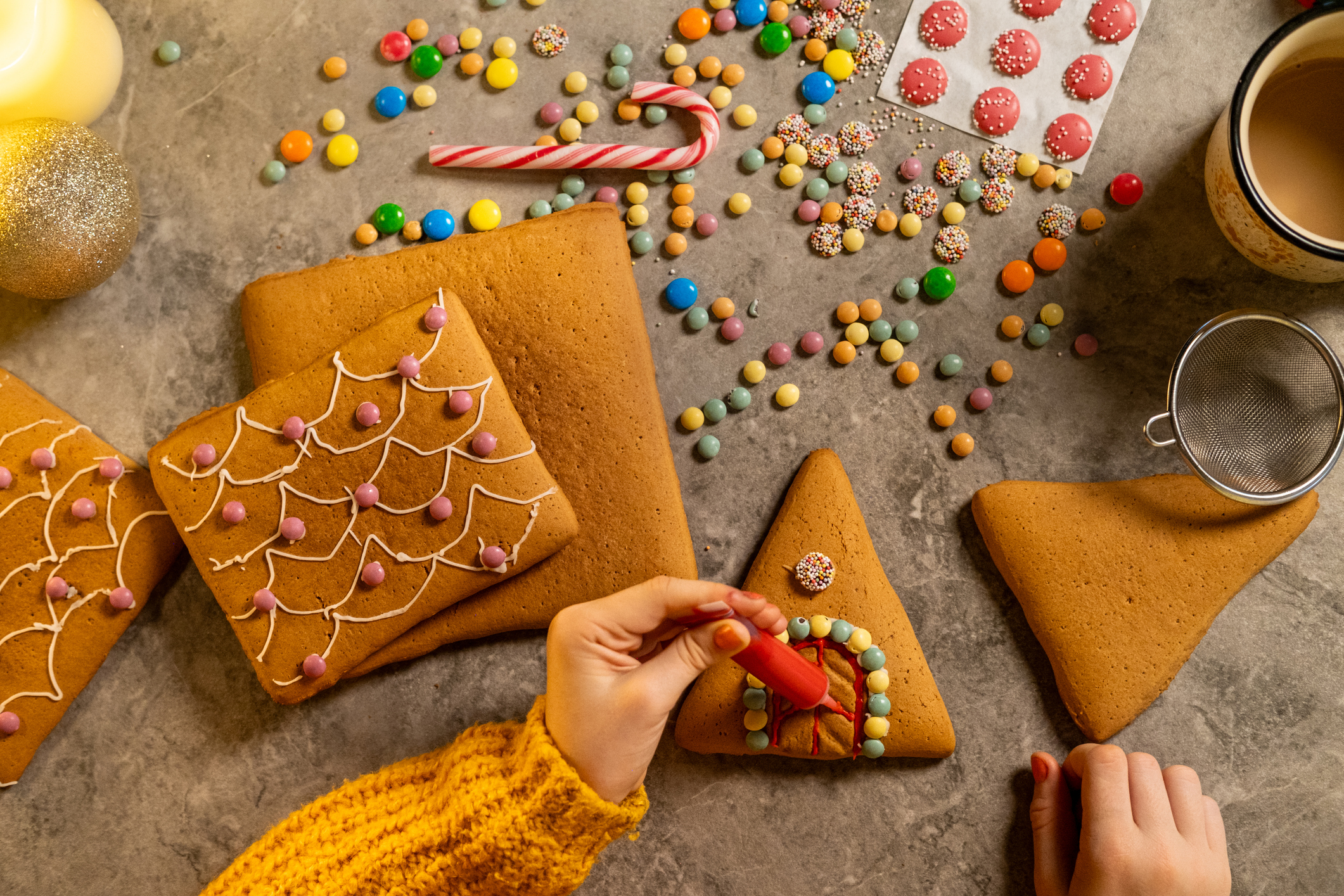
The craft version swaps food for paint and craft supplies. Happy Hooligans, a home daycare provider's site, gives each carton two coats of brown acrylic craft paint, then decorates the way you would with candy:
- Windows cut from aluminum foil
- Doors cut from the colored squares of paint chip samples
- Buttons, sequins and craft gems where the candy would go
- Cotton balls, stretched and fluffed, for snow on the roof and smoke from the chimney
Two coats suit that plastic coating: expect the first to look streaky, and the second to give you the gingerbread brown. A hair dryer speeds up the drying between coats. A reader at a school with a no-food policy, prepping 25 cartons, asked Happy Hooligans about spray paint, and the reply suggested to let the painted cartons air out in a garage or shed for a few days before they come into the classroom.

Allergies are the other reason to choose this version. Graham crackers contain wheat, and common decorating candy can contain milk, peanuts, tree nuts or soy, all on the list of major food allergens the FDA tracks, which has included sesame as the ninth since 2023. Pre-K Pages suggests asking a child's parents which candies and supplies are safe before you shop. If even one child cannot touch the food, the craft version keeps the whole class on the same house.
If you want something bigger that still lasts for years, a cardboard house built from a template is the next step up from a painted carton.
Milk Carton Gingerbread Houses for Teachers, No-Food Classrooms and Families
A milk carton gingerbread house works for almost any group of children, because the carton takes the engineering out of it. Before you pick a path, decide two things: who will be putting the crackers on, and whether anyone is allowed to eat the result.
For Kindergarten and Preschool Teachers Running It for the First Time
A K-1 teacher at a Title I school posted on r/Teachers in December 2025 that none of her students had ever built a gingerbread house, and she had two parent volunteers to make it happen. The replies were the plan in this guide: presort the candy for each child, skip anything round, buy extra crackers, and pre-build the houses so the children only decorate. If that is you, let the volunteers do the building the day before, and spend decorating day helping children pipe.
For Classrooms With a No-Food Rule
On Happy Hooligans, a reader wrote that her school had a no-food policy and she had 25 cartons to prep, which is why she wanted the painted version. Paint replaces icing, and craft gems and cotton balls replace candy, so nothing on the table can be eaten. Start the painting at least two days early, since each coat needs to dry, and give children glue sticks or white craft glue instead of icing.
For Families at Home
Casey Starnes of Disneyland Daily set up a family decorating night with milk cartons, tub frosting and whatever candy was already in the house, from peanut butter chips to M&Ms, with a roll of paper over the table for cleanup. At home you have the time a classroom does not, so let everyone build their own, line the houses up as a village, and add a string of lights behind them.
Getting Them Home, and How Long They Last
Send each house home in a gallon zip bag, the way the buddy class teacher on r/Teachers does, with the plate flat on the bottom of the bag. Stiff plates matter here more than anywhere: a flimsy one folds when a child lifts it and the house slides off.
These houses are not built to last. Pre-K Pages says plainly not to expect one to still be standing next Christmas. Graham crackers go soft as they pull moisture from the air and the icing, which is why our graham cracker guide gives freestanding cracker houses about half a day before they start to soften. The carton keeps a milk carton house standing long after that, but the crackers will still soften and the candy has been handled by a classroom of children, so treat it as a decoration once it leaves school.
When a Milk Carton Is the Wrong Choice
A carton is the right frame for a class of young children on one afternoon. It is the wrong one in three situations:
- You want a real gingerbread house that lasts the season. Make small houses baked from real gingerbread instead. They take longer but they keep.
- You cannot find cartons and the day is close. Buying kits by the case gets every child a house with no collecting at all. Our guide to buying kits by the case covers minimums and costs per child.
- The children are old enough to want a challenge. Older children enjoy a freestanding cracker house more, because the building is the point.
Questions Teachers Ask About Milk Carton Gingerbread Houses
How many graham crackers do you need for one milk carton gingerbread house?
Seven graham squares, which is three and a half full sheets: 4 for the walls, 2 for the roof and 1 cut into 2 triangles for the ends. Buy extra for breakage.
Do you have to staple the milk carton closed?
Yes. An unstapled spout opens under the weight of icing and candy and the roof comes off with it.
What do you use to stick graham crackers to a milk carton?
Royal icing if adults build the night before, tub frosting if children build on the day, and hot glue only if nobody will eat the house.
Can kids eat a milk carton gingerbread house?
Only the edible version, and only if it was made with meringue powder icing or frosting and has not sat out for days. Hot glued houses are never edible.
Build Your Class's Houses With Best Gingerbread Houses
A milk carton house is a planning job more than a baking job, and the afternoon goes well when the cartons, crackers and candy cups are ready before the children sit down. If the carton hunt comes up short, or you want one show house for the classroom window, we rate boxed gingerbread house kits on how well they actually hold together. Then all that is left is a table of children and a lot of icing.