The best gingerbread churches have two things: windows that glow like stained glass and a steeple that stays up. Most church tutorials manage the first. Two of the best known skip the steeple, and one of the most loved can’t share its template at all.
This one has both. Our house dough and royal icing recipes set every bake temperature and wait. A script checked the free template so all nine windows keep enough cookie around them and the tower clears the roof.
You will end up with a church about 10 1/2 inches tall from one batch of dough over two days. Start with the template, then the glass, three looks, a day by day plan and 16 steps.
Stained Glass Gingerbread Church: At a Glance
- Difficulty: Intermediate. The nave is a plain box. The tower is a second, taller box, and the steeple is four triangles.
- Total time: about 2 days, in seven sessions. Most of it is icing drying.
- Active time: about 6 1/2 hours, counting the dough chill and the bake.
- Makes: one church about 3.5 inches wide, 8.4 inches deep with its tower and about 10 1/2 inches to the spire tip. 15 baked pieces, 9 candy glass windows.
- Template: free 5-page PDF, US Letter, true size with a 1 inch test bar on every page.
Tools: printer, ruler, scissors, a small sharp knife, rolling pin with 1/4 inch guides, parchment, 2 half sheet pans, a zip bag and a rolling pin for crushing candy, piping bags with a small round tip, cans for propping, a board at least 10 by 12 inches.
Materials
- 1 batch of our gingerbread house dough for crisp, flat walls
- 2 batches of stiff royal icing that sets like mortar
- About 27 clear hard candies such as Jolly Ranchers or Life Savers, in your window colors, plus a few spare
- 1 small round yellow candy and a licorice lace for the bell
- Gel food coloring: black for grey stone, plus red or green for the door
- For the night look, a battery micro LED string with a small battery box
Steps
- Print the template at Actual Size and measure the test bar.
- Make the dough and chill it for at least an hour.
- Roll the dough 1/4 inch thick and cut the nave walls, gables and roof.
- Cut the tower walls, cap and spire faces.
- Cut out every window and belfry arch before baking.
- Bake at 300 degrees F, then melt crushed candy into the windows.
- Trim every piece against the template while it is warm.
- Pipe the frames, stonework and door while the pieces lie flat.
- Build the steeple on its cap, then leave everything overnight.
- Stand the nave walls and gables on the board, then wait 2 hours.
- Add the lights and set the roof flush at the front, then wait 2 hours.
- Hang the candy bell inside the front tower wall.
- Build the tower on the board against the front gable, then wait 2 hours.
- Lift the steeple onto the tower, then wait 4 hours.
- Finish the look and the yard.
- Let it stand overnight before you move it.
Notes: times are worked out from the set times on our icing page, not timed on a build. Ovens and doughs vary, so treat every bake time here as a starting point: check early, go by the matte surface and firm edge, and bake a test strip with one candy window before you build. Want something smaller? Our chapel gingerbread house template is a 14 piece church under 4 inches tall that bakes in an afternoon.
Free Printable Gingerbread Church Template
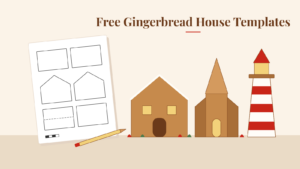
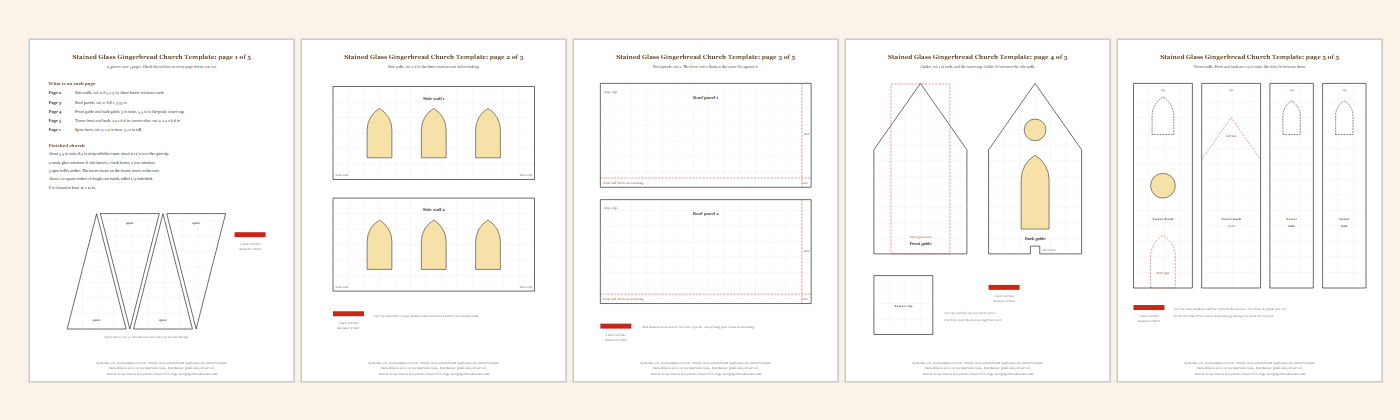
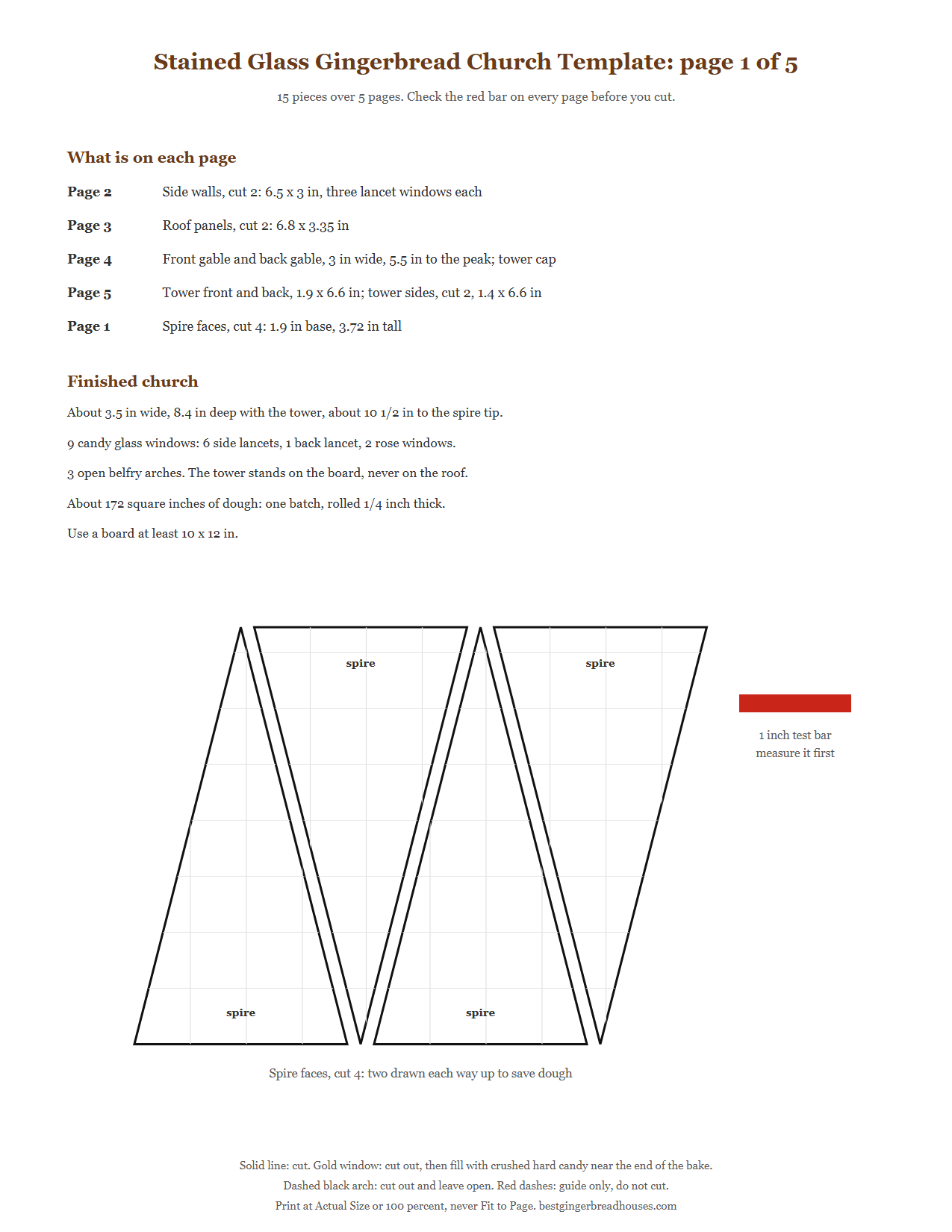
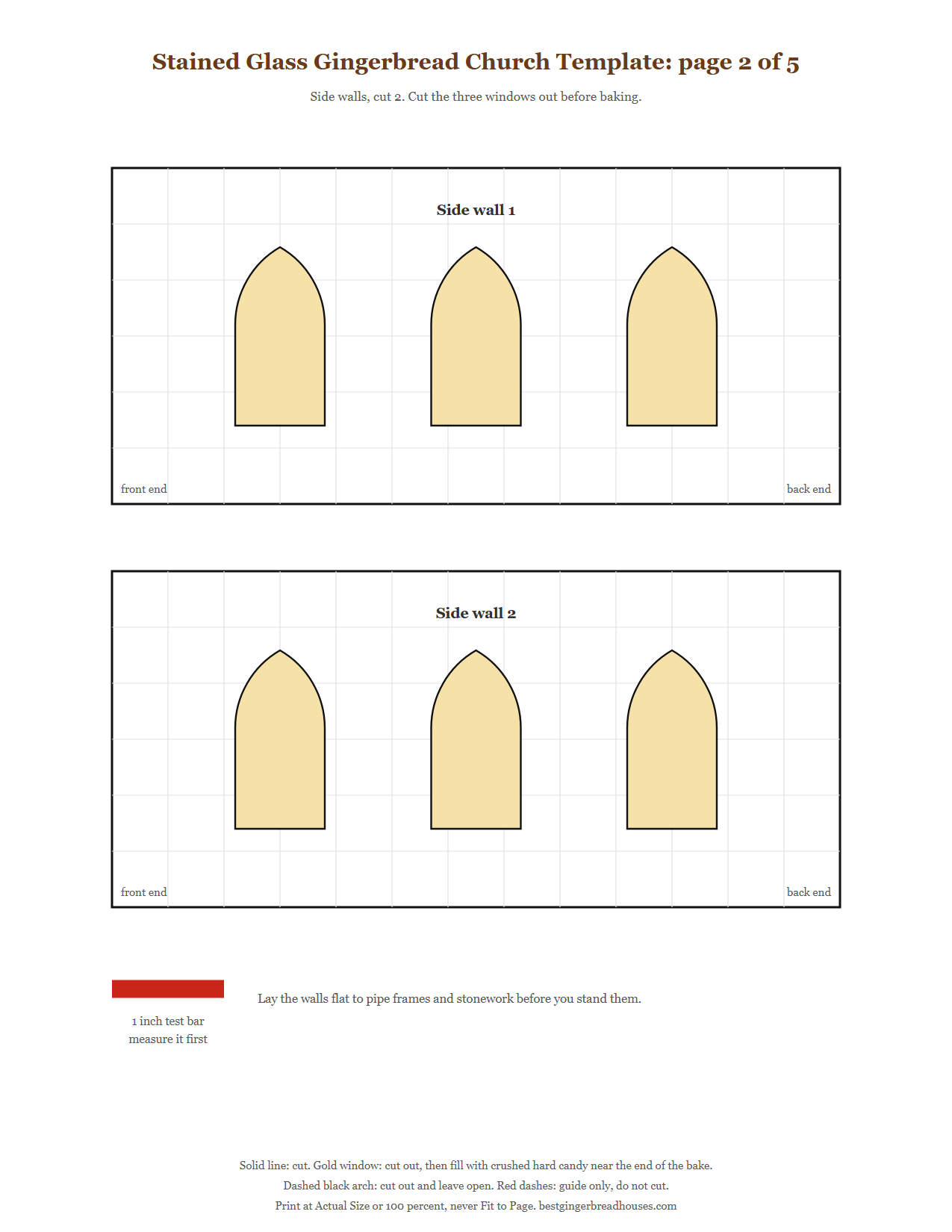
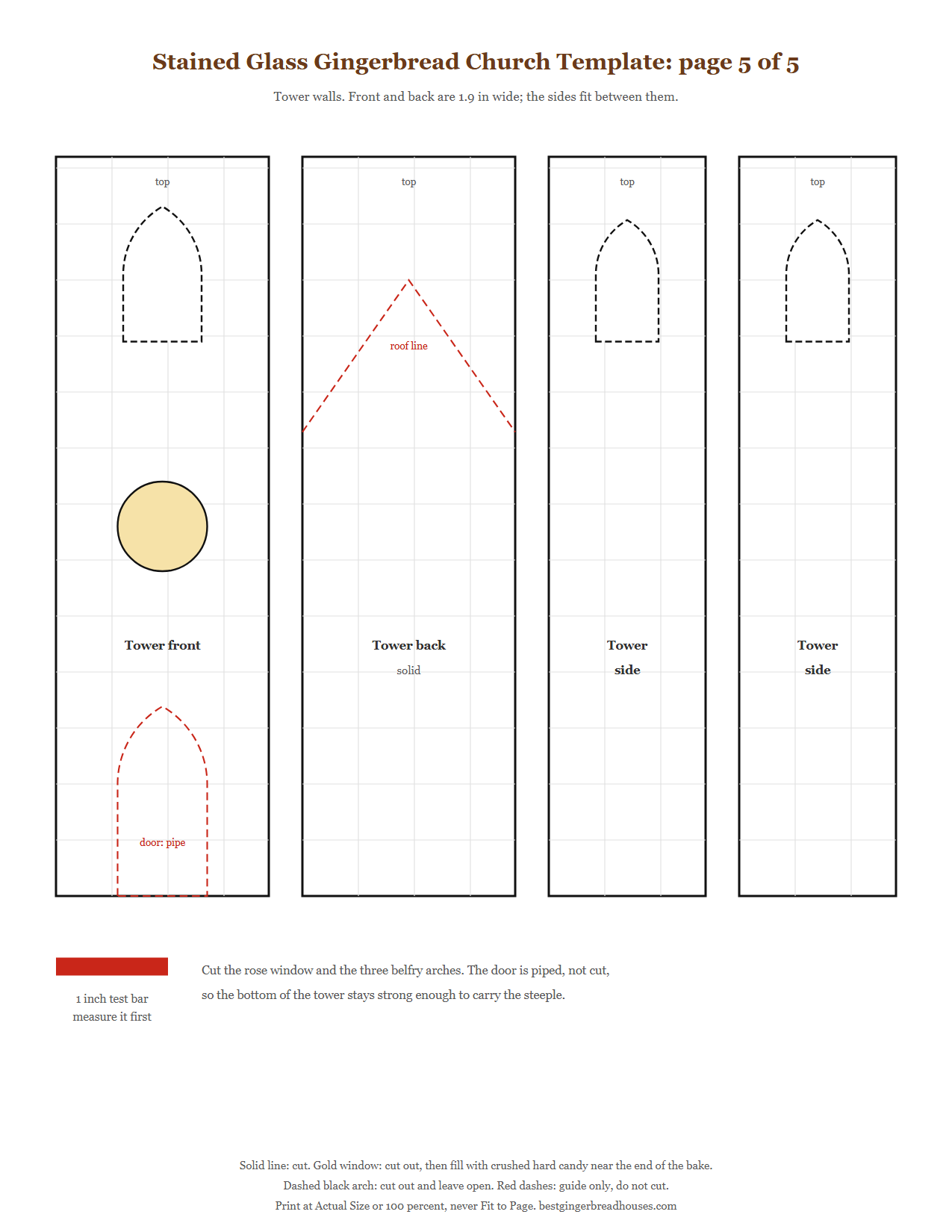
The template is five US Letter pages with every piece at true size over a faint 1/2 inch grid. Download the PDF, print it at Actual Size, and check that the red bar measures 1 inch before you cut anything. Gold shapes are glass windows. Dashed black arches are belfry openings you leave empty. Red dashes are guides you never cut.
| Piece | Cut | Size |
|---|---|---|
| Side walls | 2 | 6.5 x 3 in, three pointed lancet windows each |
| Roof panels | 2 | 6.8 x 3.35 in, flush at the front |
| Front gable | 1 | 3 in wide, 5.5 in to the peak, plain |
| Back gable | 1 | Same outline, a tall lancet, a rose window and a wire notch |
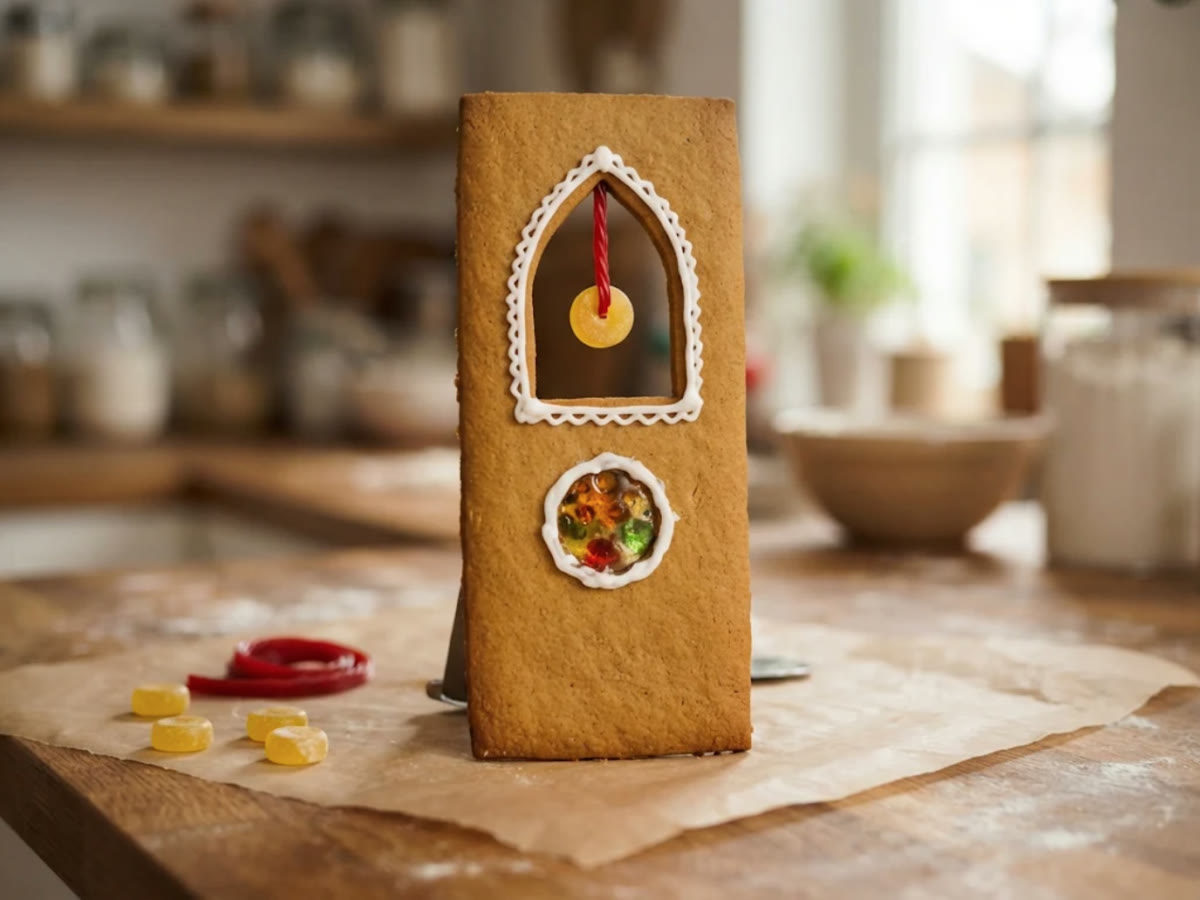
| Tower front | 1 | 1.9 x 6.6 in, rose window, open belfry, door marked to pipe |
| Tower back | 1 | 1.9 x 6.6 in, solid, roof line marked |
| Tower sides | 2 | 1.4 x 6.6 in, open belfry |
| Tower cap | 1 | 1.9 in square |
| Spire faces | 4 | 1.9 in base, 3.72 in tall |
The pieces come to about 172 square inches. One batch of our house dough covers about 225, so you have room for a test strip and a spare spire face. The roof is pitched at 55 degrees, steeper than a cottage, because a steep roof is what makes a building read as a church from across the room.
Why the Steeple Stands on the Board
Look at the church builds people search for and you notice what is missing. The Gingerbread Country Church from Taste of Home has a chimney, dormers and a porch, but no steeple. Salad in a Jar’s church house has stained glass and no steeple either. Sweetopia’s much loved 2015 church does have one, but its template came from an old Woman’s World magazine and the author says she can’t share it.
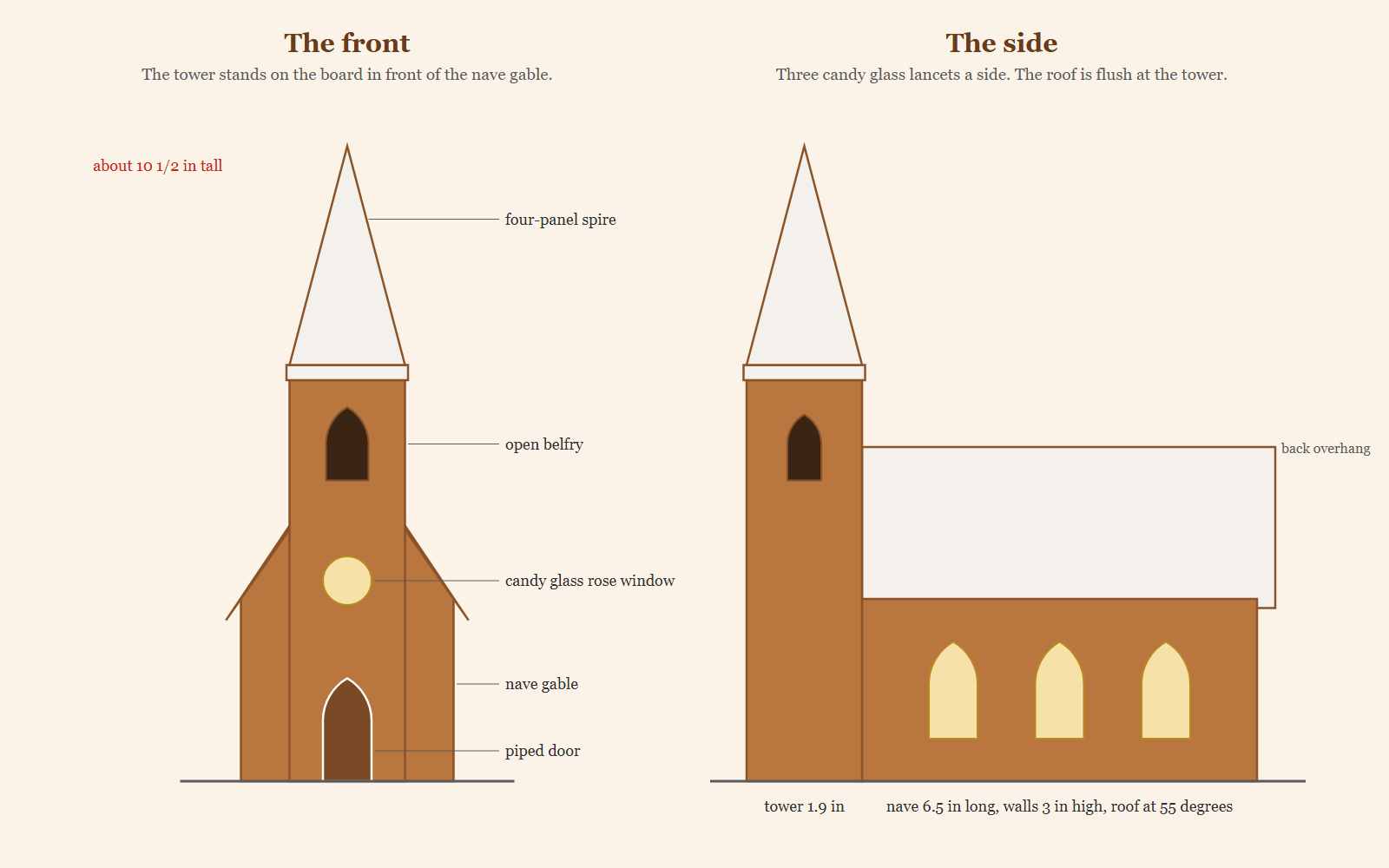
A steeple is hard because of where people want to put it. Set on the roof ridge, a tall spire presses down on the weakest joint of the house, and it leans as the icing softens. So this church does what many real village churches do: the bell tower is its own box, standing on the ground in front of the nave.
The tower carries the steeple, not the roof. The tower walls stand 6.6 inches tall, 1.1 inches above the nave ridge, so the spire starts clear of the roof line.
The roof stops flush at the front. At the back and the eaves it overhangs 0.3 inch. At the front it stops at the gable, so nothing pushes on the tower.
The steeple is built ahead. Four triangles stand at about 75 degrees, steep enough to lean on each other at the tip. You glue them on the cap the day before, so you lift one finished piece instead of balancing four.
The door is piped, not cut. A cut door would weaken the bottom of the tower right where it carries the most weight.
Stained Glass Windows That Actually Glow
The glass is crushed hard candy, melted into the window openings in the oven. Clear candies like Jolly Ranchers and Life Savers work. Anything opaque or shell-coated does not. Our guide to which hard candies melt into clear windows covers the method in full. This is what changes on a church.
Nine windows, three shapes. Each side wall has three pointed lancets. The back gable has one tall lancet with a round rose window above it, and the tower has a second rose window over the door. Plan on about 3 candies for each side lancet, 5 for the tall back one and 2 for each rose.
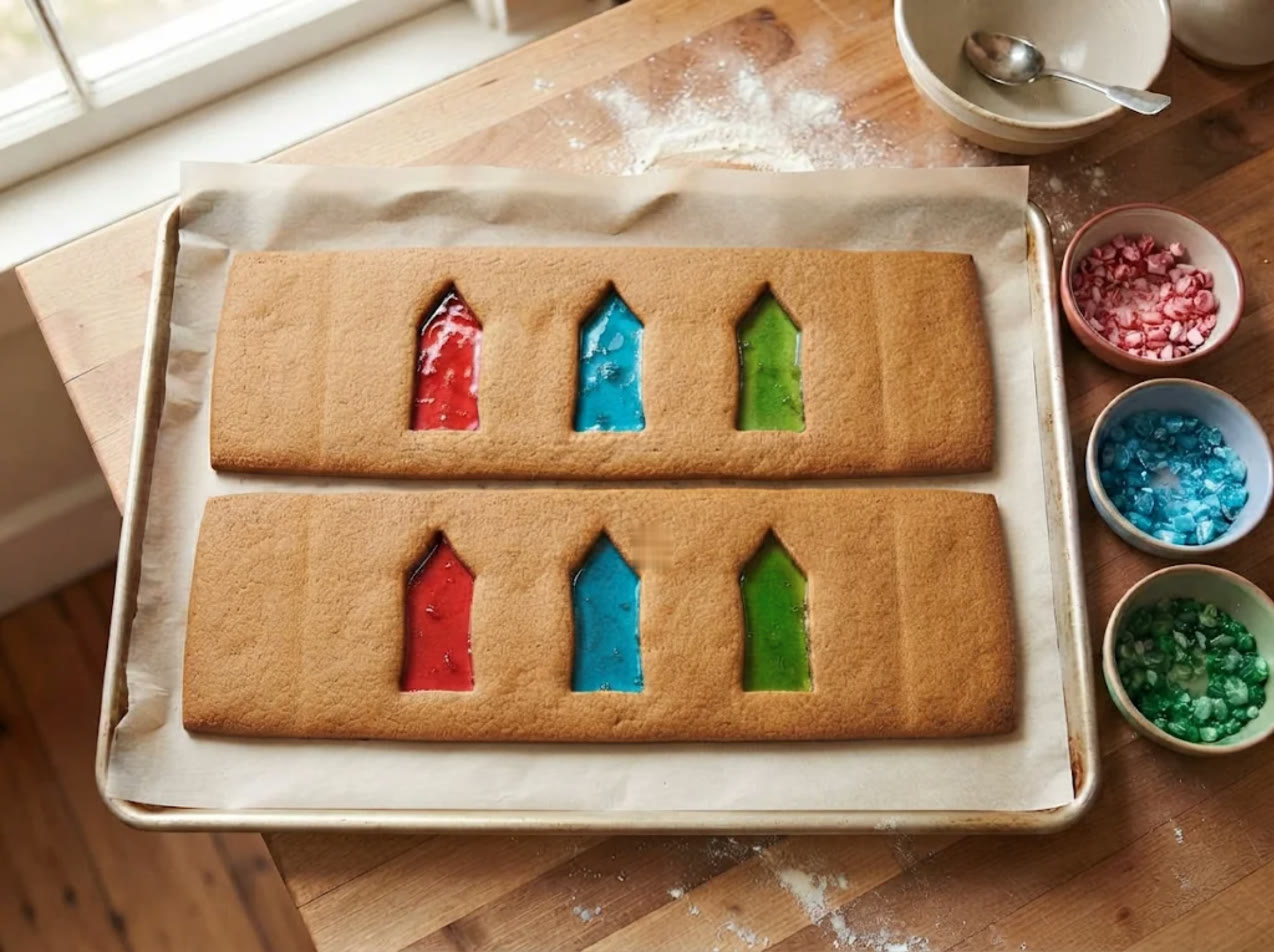
Keep colors apart until the last moment. Crush each color in its own bag until no piece is bigger than a pea. A mixed bag melts muddy brown. For a two-color window, spoon one color into the top half and the other into the bottom.
Watch the yellow. Sweetopia’s Marian found her yellow window melted less clearly than her red, blue and green Jolly Ranchers, and used yellow Life Savers for that pane instead. Try one in your test strip before you commit a whole bag.
Light makes it. Candy glass looks dark in daylight and jewel bright with a light behind it. Use battery lights only, which is why our guide to lighting a gingerbread house rules out candles. Try your colors in the planner before you buy candy.
Gingerbread Church Stained Glass Planner
Pick a color scheme and a window pattern. The preview shows the long side of the church, and the list tells you how many hard candies of each color to buy.
Candy counts are planning estimates for the 9 windows on this template, rounded up, not weighed on a build. Buy a few extra of each color for a test strip. Nothing you pick leaves your browser.
Three Gingerbread Church Looks
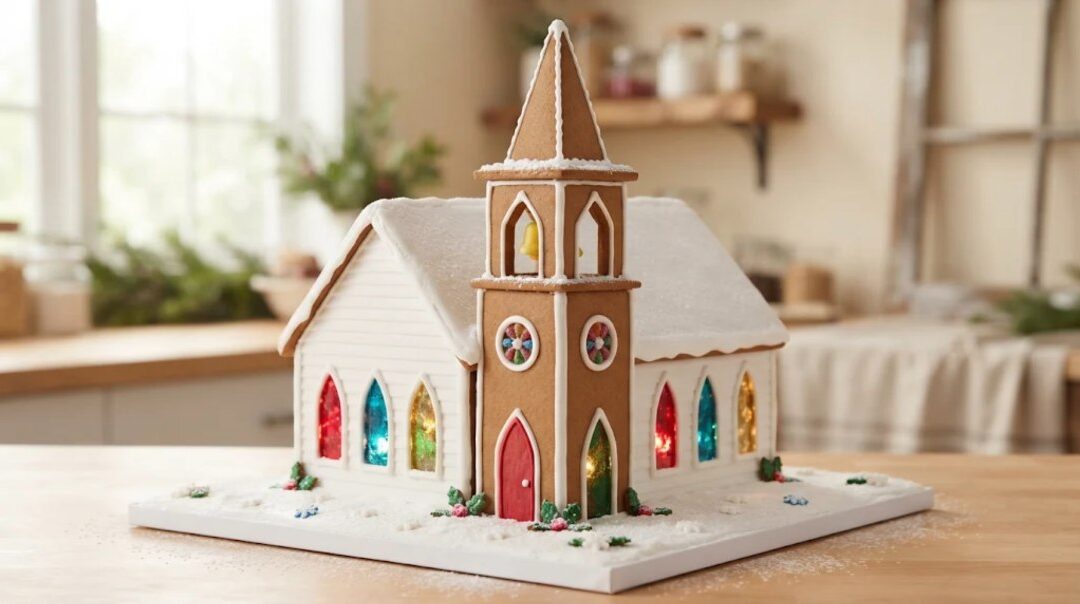
White country church. Flood the walls and tower with white icing so they look like painted clapboard, and leave the roof and steeple white. Pipe the door red, and use the jewel colors for the glass. This is the look in the photo at the top.
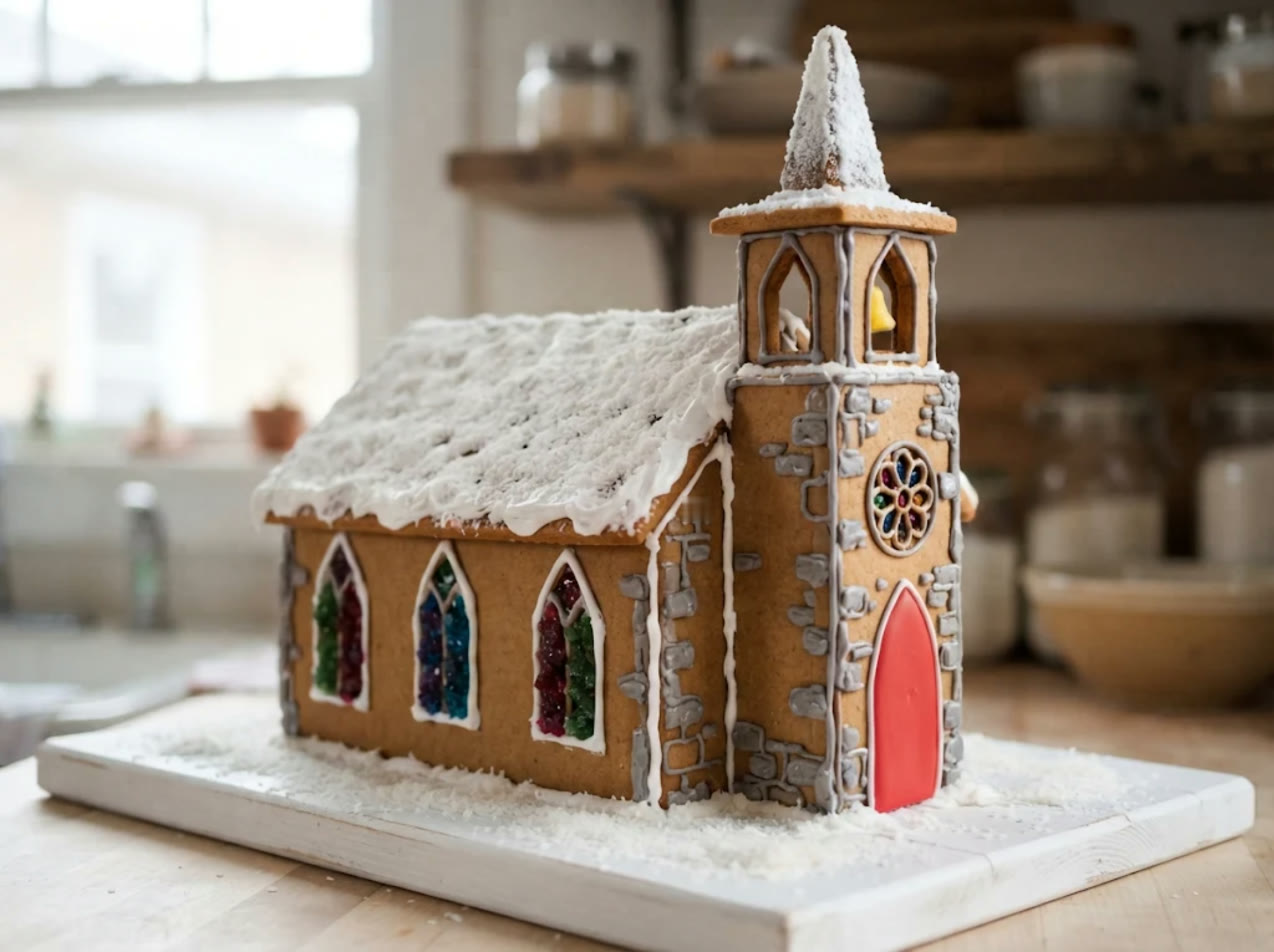
Old stone church. Leave the gingerbread bare and pipe grey stone outlines on the walls and tower while they lie flat. Mix the grey from white icing and a dot of black. Uneven blocks look older than neat ones. Frost the roof white like fresh snow and go deep with the glass: red, blue and green.
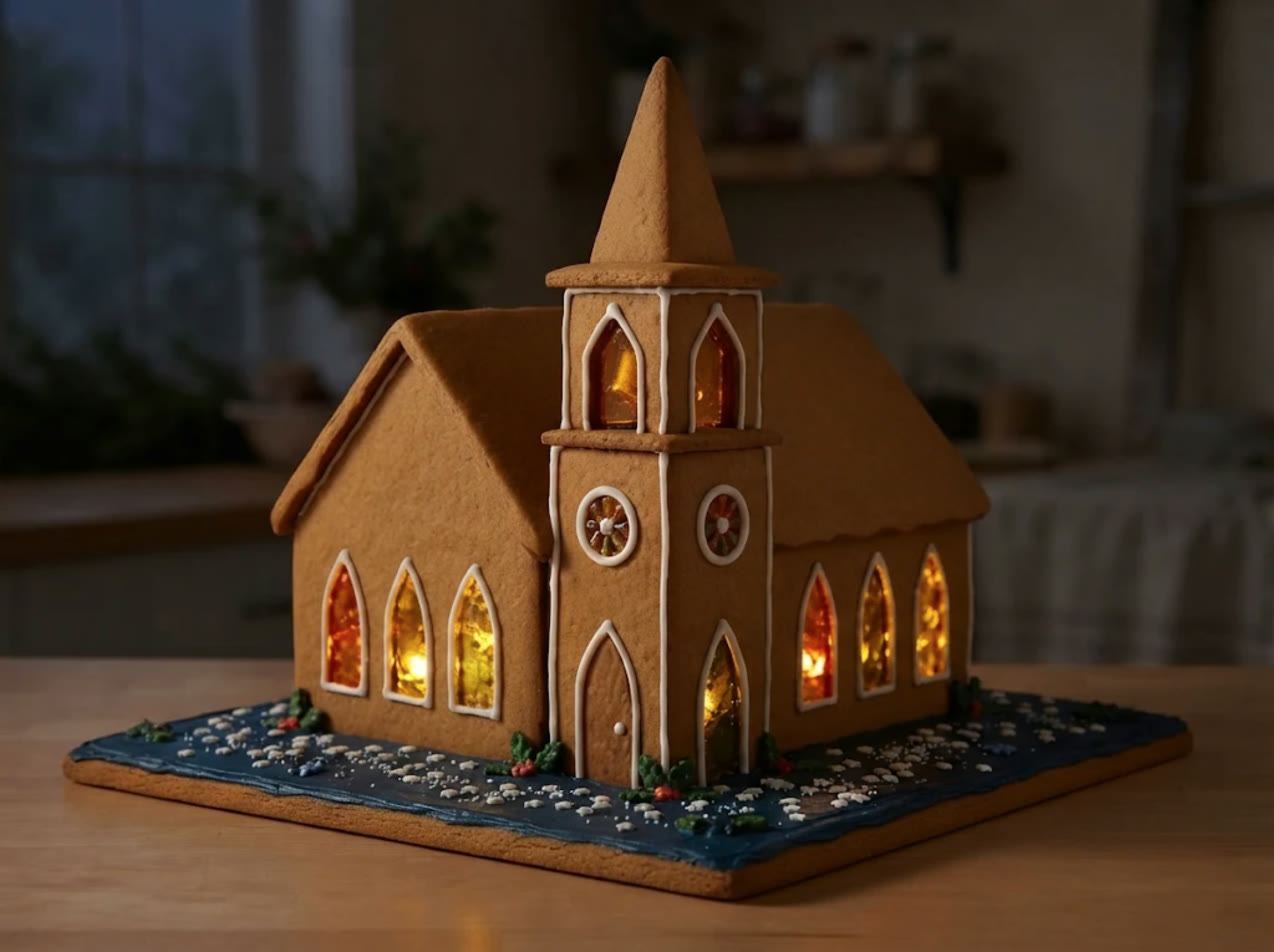
Candlelit midnight. Keep the walls bare, pipe only white window frames and edges, fill every window with amber, and coil a warm white LED string inside. On a dark blue board with white sprinkle stars, it looks like the church is lit for a late night service.
Gingerbread Churches Real Bakers Have Built
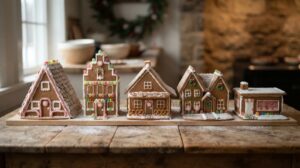
A reader’s church. These photographs came from a reader who built a church from a template that used to sit on our free gingerbread house templates page. Look at the second one: two of the baked pieces cracked on the tray. The finished church is standing anyway, which is the most useful thing a first-time church builder can see.


A bakery replica. In Estes Park, Colorado, Cru Shantz of Scratch Deli and Bakery spent three weeks on a gingerbread copy of the St. Malo church in nearby Allenspark, Denver7 reported. It uses Jolly Ranchers, pretzel rods and cinnamon sticks, with candy stained glass windows and icing icicles. If you want to copy your own church, print this template larger and swap the windows for your church’s shapes.
A blogger’s church. Sweetopia’s church is built the same way this one glows: crushed candy spooned into the openings near the end of baking. The difference is that you can print ours.
How Long It Takes, Day by Day
Plan on seven sessions over two days, about 6 1/2 hours of hands-on work. All the piping happens while the pieces lie flat on day 1, and the steeple sets overnight on its own. Pick your finish time and the planner counts back for you.
| When | What you do | Hands-on | Then wait |
|---|---|---|---|
| Day 1, morning | Print, make and chill the dough, cut, bake, melt the candy glass and trim. | About 3 1/4 hours | About 30 minutes |
| Day 1, afternoon | Pipe frames, stone and the door flat. Build the steeple on its cap. | 1 hour | Overnight, pieces flat |
| Day 2, early morning | Stand the nave walls and gables. | 30 minutes | 2 hours |
| Day 2, mid morning | Add the lights and set the roof. | 25 minutes | 2 hours |
| Day 2, midday | Hang the bell and build the tower. | 30 minutes | 2 hours |
| Day 2, afternoon | Set the steeple on the tower. | 15 minutes | 4 hours |
| Day 2, evening | Finish the look and the yard. | 40 minutes | Overnight before you move it |
Gingerbread Church Build Day Planner
Pick when you want the church finished. The planner counts back through every drying time and tells you when to start baking.
For planning only: icing sets faster or slower with the weather, so treat each wait as a minimum and check that joints feel firm before moving on. Not professional baking advice. Nothing you enter leaves your browser.
How to Make a Gingerbread Church Step by Step
1.Print the template and measure the test bar
Print all five pages at Actual Size or 100 percent, never Fit to Page, and check that the red bar reads exactly 1 inch.
Why this matters: a template printed small gives a tower that no longer clears the roof, and a steeple that no longer fits its cap.
2.Make the dough and chill it
Make one batch of house dough, split it in two, flatten each half into a thick disc, wrap and chill for at least an hour.
Why this matters: cold dough holds sharp window points. Warm dough slumps, and a slumped lancet turns into a blob.
3.Roll and cut the nave pieces
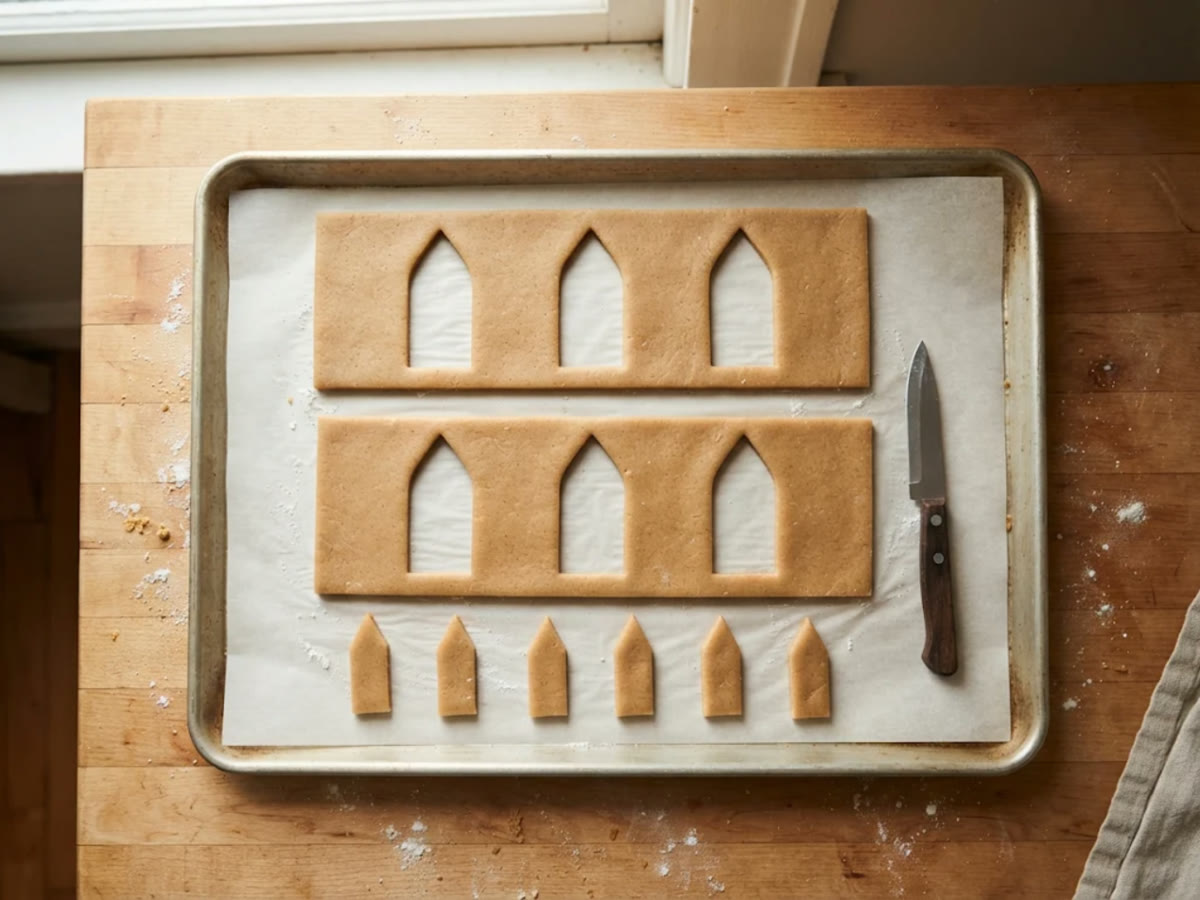
Roll a disc on parchment to an even 1/4 inch between guide strips. Cut the two side walls, the two gables and the two roof panels right on the parchment, so you never lift a piece with holes in it.
Why this matters: a side wall with three windows cut out bends if you move it raw. Slide the whole sheet of parchment onto the pan instead.
4.Cut the tower, cap and spire
From the second disc, cut the four tower walls, the cap and the four spire faces. The spire faces nest point up, point down to save dough.
Why this matters: the tower walls are tall and narrow. Cut them in one clean stroke along each long edge so they stay straight.
5.Cut out the windows and the belfry arches
With a small sharp knife, cut out the six side lancets, the back lancet and both rose windows, then the three belfry arches and the wire notch. Lift the cutouts away with the knife tip. Trace the door arch onto the tower front with a toothpick, but do not cut it.
Why this matters: windows cut after baking crack the wall. Cut raw, and keep the cutouts to bake as cookies for helpers.
6.Bake the pieces, then melt in the candy glass
Bake at 300 degrees F. Large pieces take 22 to 30 minutes, until matte with a firm edge. Pull the pans with windows about 5 minutes early, fill each opening with crushed candy about two pieces deep, and bake again until the candy has pooled flat and gone glassy.
Check as you go: hard crack, where candy flows, is 300 to 308 degrees F at sea level per Colorado State University Extension, so candy melts slowly at 300. If it is still lumpy after about 10 minutes, raise the oven to 325 degrees F and watch closely. At altitude that target drops by about 2 degrees F for every 1,000 feet, so check sooner.
7.Trim every piece while it is warm
Within two minutes of each pan coming out, lay the paper piece back on the baked one and trim any edge that spread. Leave every piece on its pan until fully cool. The candy is far hotter than the cookie.
Why this matters: moving a wall while the glass is soft lets the candy sag out of the frame.
8.Pipe the details while the pieces lie flat
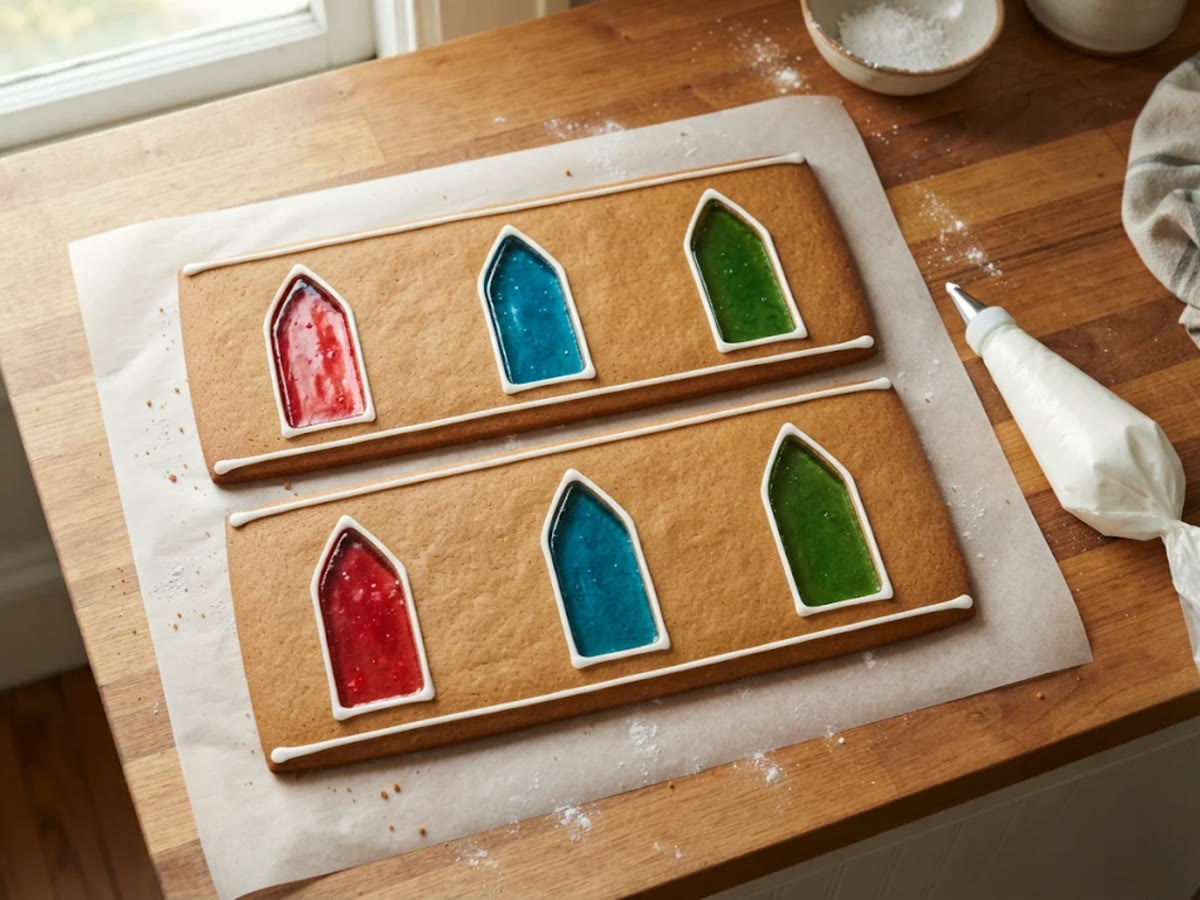
Pipe a frame around every window, the door on the tower front, and stone lines or clapboard if your look has them. Flood the door arch red or green.
Why this matters: lines piped on a standing wall slide downhill. Flat, they stay where you put them.
9.Build the steeple on its cap and leave it overnight
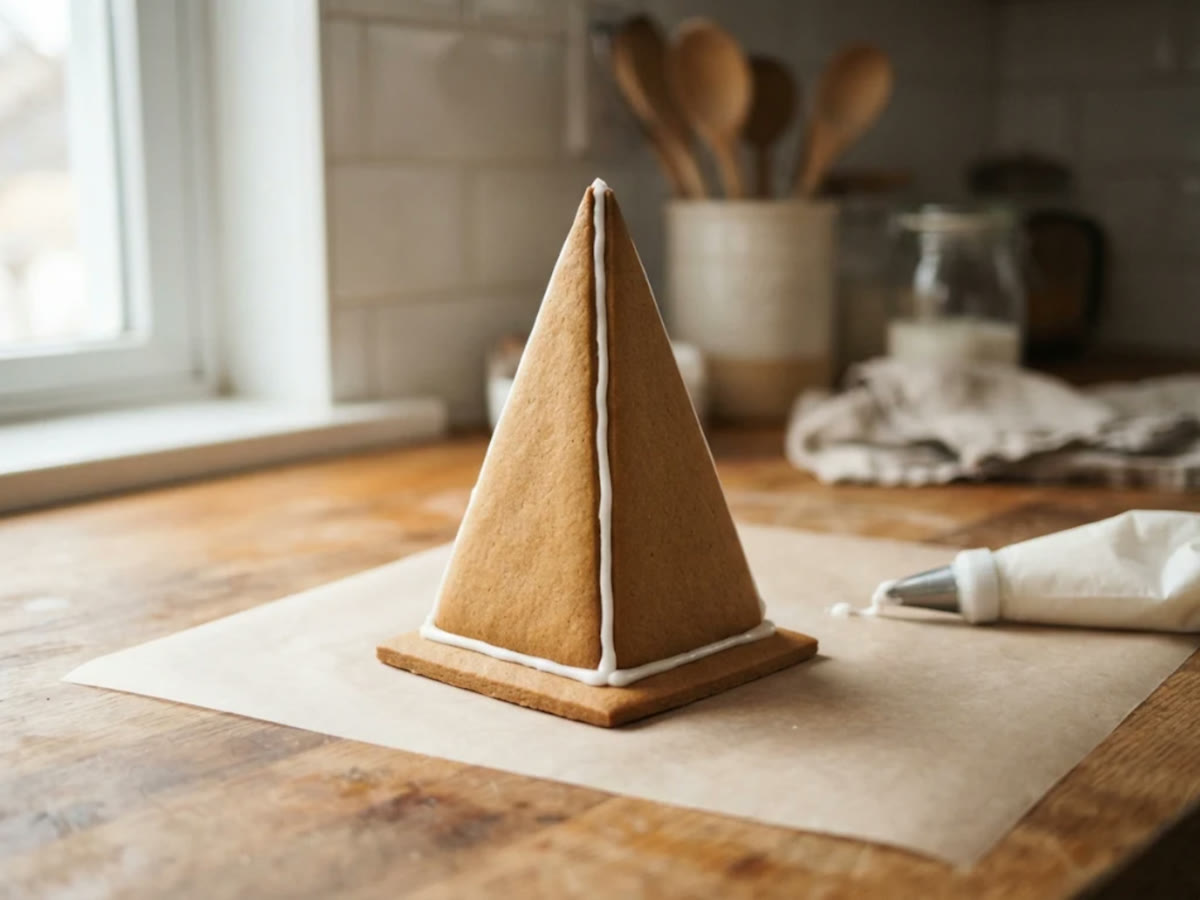
Pipe a line of stiff icing round the edge of the cap. Stand the four spire faces on it, leaning in so their points meet, and pipe icing down each of the four seams. Leave the steeple and every flat piece alone overnight.
Why this matters: four triangles hold each other up once their tips touch. Built a day early, the steeple goes on later as one solid piece.
10.Stand the nave walls and gables
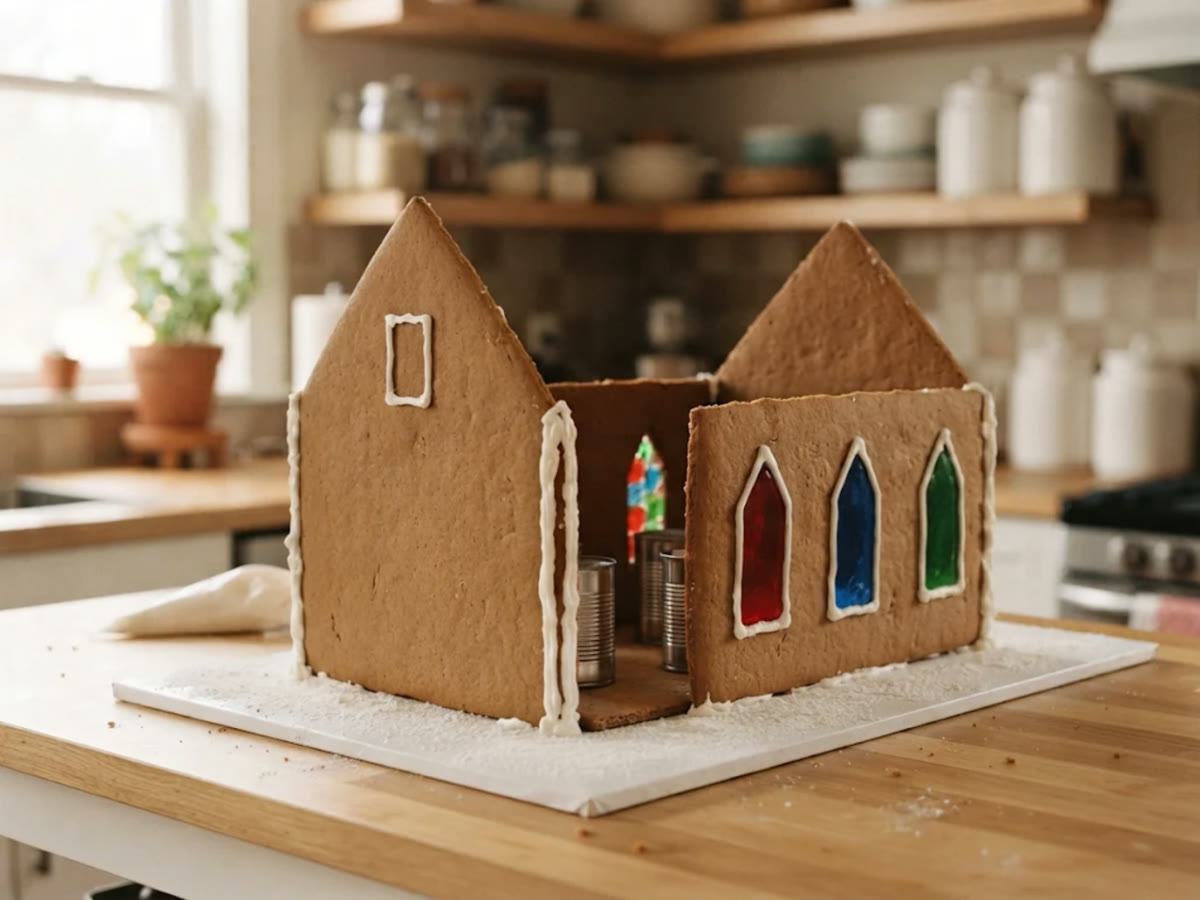
Pipe a rectangle of icing on the board where the nave will sit, about 2 inches back from where the tower goes. Stand a side wall, then a gable between the side walls at each end, wire notch at the back. Close the box with the second side wall, prop with cans and wait 2 hours.
Why this matters: the gables fit between the side walls. Set them outside and the roof will not match.
11.Add the lights and set the roof
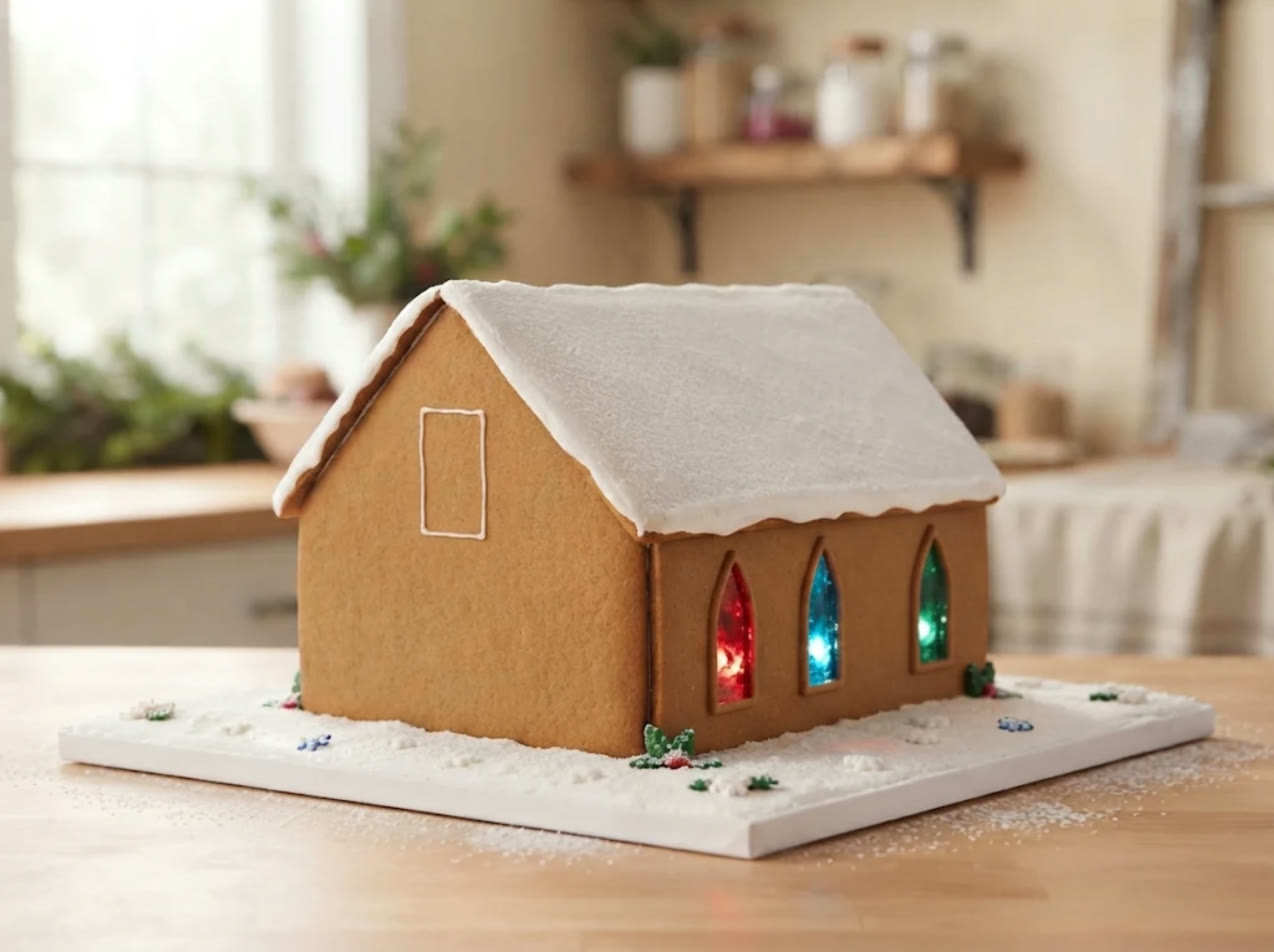
For a lit church, switch the LED string on to test it, coil it inside and feed the wire out through the notch. Pipe icing along the gable slopes and the wall tops. Set both roof panels with their flush ends at the front gable and the overhang at the back, then wait 2 hours.
Why this matters: once the roof is on you cannot reach inside. A roof that hangs over the front would also stop the tower from sitting tight against the gable.
12.Hang the candy bell
Press a small round yellow candy onto the end of a licorice lace with a dot of icing. Glue the other end inside the tower front, above the belfry arch, so the bell hangs in the opening.
Why this matters: once the tower is a box, you can’t reach in to hang it.
13.Build the tower against the front gable
Pipe a square of icing on the board tight against the front gable. Stand the tower back first, roof line toward the nave, then the two sides between front and back, then the front. Pipe the inside corners, prop and wait 2 hours.
Why this matters: a tower that stands on the board and leans on the gable is far stronger than one perched on the roof.
14.Lift the steeple onto the tower
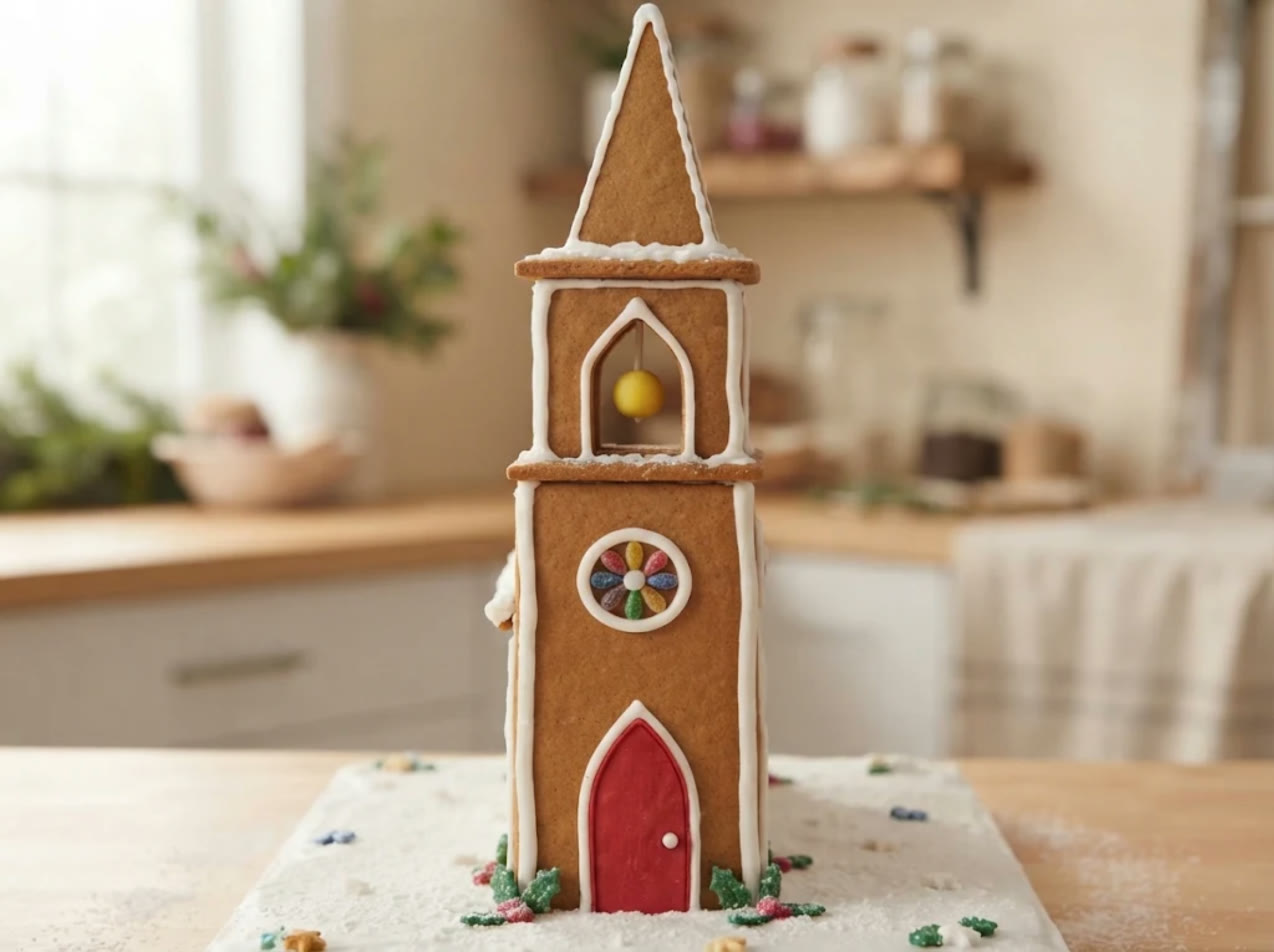
Pipe a line of stiff icing round the top edge of the tower walls. Lift the steeple by its cap and set it straight down, then wait 4 hours.
Why this matters: four hours lets the joint harden before any snow or decoration adds weight up top.
15.Finish the look and the yard
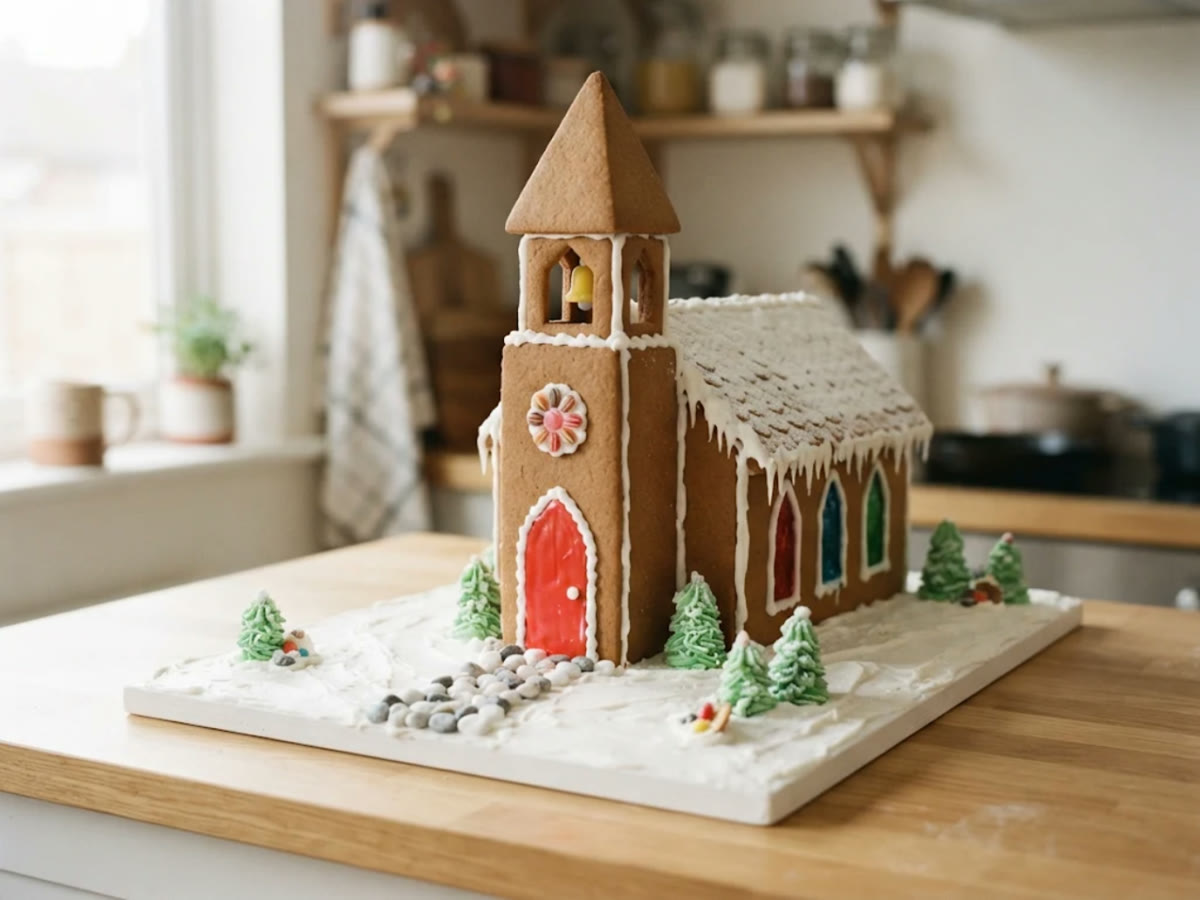
Spoon snow on the roof and let a little drip off the eaves. Pipe icicles if you like. Spread icing over the board for a snowy churchyard and add a path of candy stones to the door.
Why this matters: the yard hides the icing line at the base, so the church looks planted rather than glued.
16.Let it stand overnight
Leave the church where it is overnight before you move it, then lift it by the board, never by the tower.
Troubleshooting
| What you see | Why it happens | What to do |
|---|---|---|
| The candy windows are cloudy or bubbly | Too little heat, or too much | Lumpy: bake a few minutes more at 325 degrees F. Brown and bubbling: pull it sooner next time, especially at altitude. |
| Candy leaked under the wall | The parchment was wrinkled, or the window was overfilled | Snap the thin spill off once cool. Next time smooth the parchment and fill two pieces deep. |
| A wall cracked between windows | It was moved while hot or still soft | Glue it with icing from behind and pipe a frame over the crack. The reader church above stood with two cracked pieces. |
| The roof will not sit flat | The gables went outside the side walls | Shave the gable slopes, or fill the gap with a thick ridge line. |
| The tower leans away from the nave | Too little icing on the board, or it was not pressed to the gable | Push it back, pipe a thick seam down both front corners of the nave and prop it. |
| The steeple slips on the tower | It went on before the tower walls set | Lift it off, wait the full 2 hours, then set it again on fresh icing. |
| The spire tips will not meet | Pieces spread in the oven | Trim them against the template next time. For now, fill the gap at the tip with a star of icing. |
| The windows look dark | Candy glass needs light behind it | Add a battery light string through the notch, or shine a flashlight from the back for photos. |
Smaller and Quicker Versions
The chapel. For a one-afternoon church, our printable gingerbread chapel is 14 pieces and under 4 inches tall, with the tower on the board in front for the same reason as here.
A village church. Our gingerbread village with a church, a cottage and a shop puts a small church on one sheet beside two matching houses. For more shapes to compare, see the church with a steeple among our gingerbread house layouts.
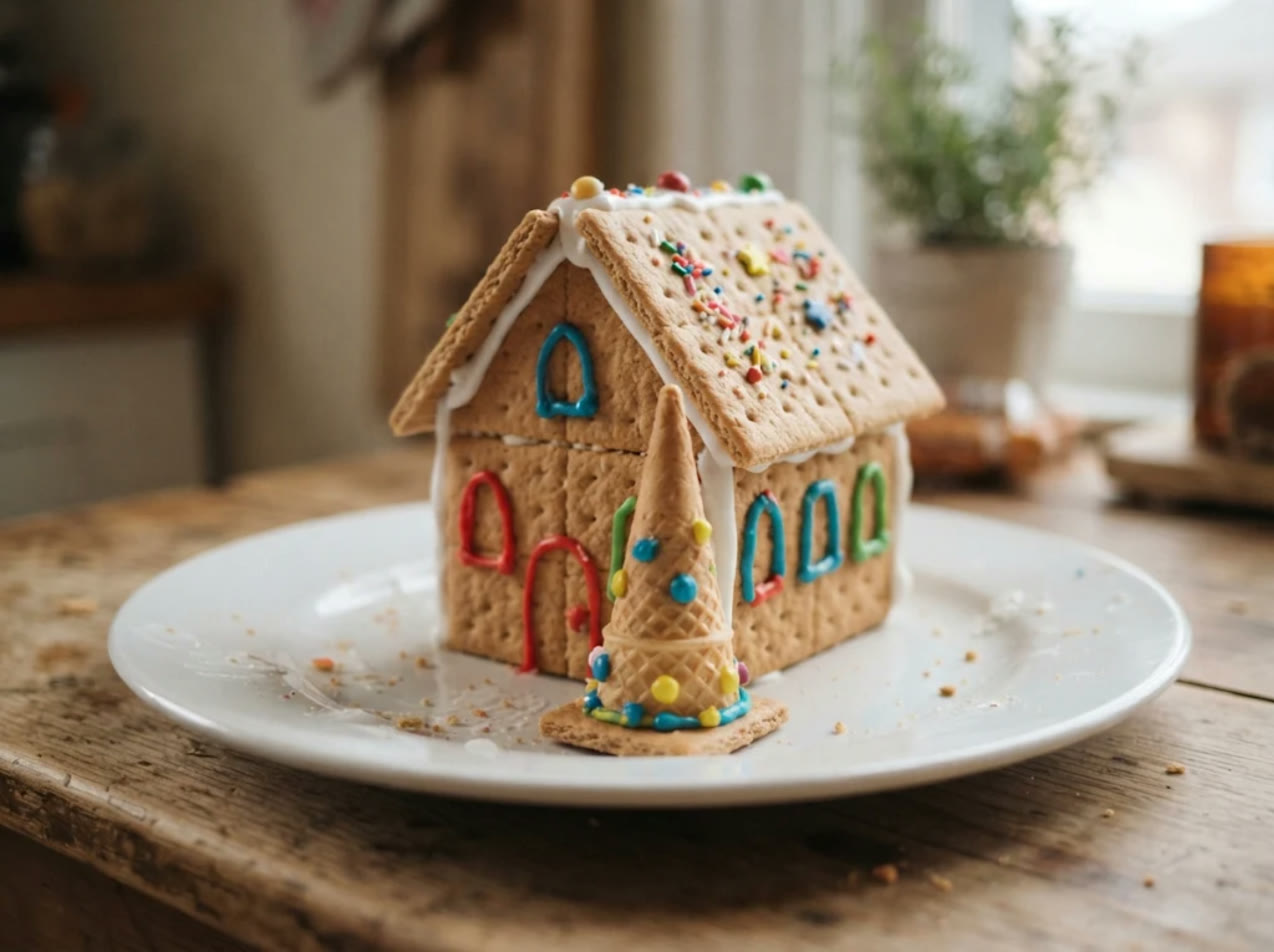
No-bake graham church. Stand four graham cracker halves into a box and lean two more into a roof. Stand a sugar cone upside down on a square of graham in front for a steeple. Pipe windows in colored icing instead of candy glass. It takes about 30 minutes, and kids can each make one. See our graham cracker gingerbread house for the icing that holds crackers.
Storage Instructions
Keep the church in a cool, dry room, away from the stove, a steamy kitchen and sunny windows. Damp air makes candy glass sticky and can soften it until it sags. Kept dry, it holds its shape through the season, and our guide to how long a gingerbread house lasts covers when to stop eating it and keep it for display.
FAQ
Can I put the steeple on the roof instead?
You can, but it is the weakest place on the house. If you want that look, keep the steeple short and light, and pipe a thick ridge line under it. The board-standing tower is why this one stays up.
Can I make it bigger?
Yes. Printed at 120 percent, the church stands about 12 1/2 inches tall and needs about 248 square inches of dough, so make one and a half batches and use a 12 by 14 inch board. The side walls and roof panels will no longer fit across Letter paper, so print those pages on 11 by 17 paper at a copy shop.
Is the candy glass safe to eat?
Yes, it is just melted hard candy, but it is hard on teeth. If the church will be eaten, use the meringue powder royal icing from our icing page.
Do I have to cut every window?
No. For a quicker build, cut only the side lancets and pipe the rose windows on as round frames. The church still glows down both sides.
More Gingerbread House Builds and Recipes
Browse more gingerbread house ideas for other themes, or try another tall build like our gingerbread castle with towers. Thinking of entering it somewhere? A church is a strong entry, and our guide to gingerbread house competitions covers how they are judged. When a wall will not stand straight, our tips for leaning gingerbread walls work on any house. When you want a head start, our ranked list of gingerbread house kits sorts the boxes that stay standing from the wobbly ones.