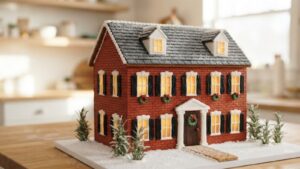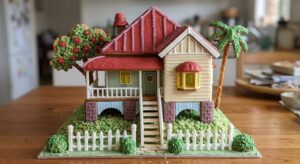
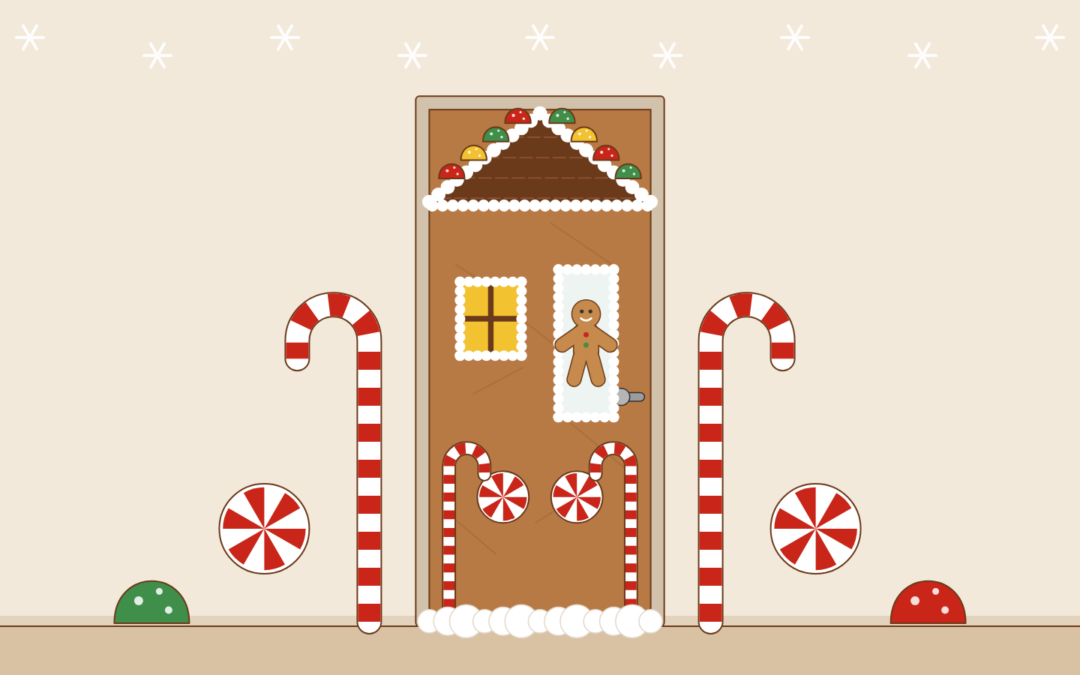
A gingerbread house door is a door dressed as the front of a gingerbread house: brown paper for the baked walls, white scallops for the piped icing, a roof across the top and oversized candy everywhere else. It is one of the most popular themes in December door decorating contests, at school and at work, because everyone knows what a gingerbread house looks like from the far end of a hallway.
We write about real gingerbread houses, the kind you bake, pipe and load with candy, so this guide borrows their proportions and their candy for the paper version. The build steps lean on people who have published their own doors, chiefly the kindergarten teacher behind Sharing Kindergarten, who turned her whole classroom front into a gingerbread house for her school’s gingerbread week. Where a tip comes from someone else’s door, we say whose it was.
This guide covers paper and craft doors only. No food goes on the door.
If you’re a teacher who has just heard the contest starts Monday, this gives you a plan you can finish after school. If your office team has been handed a door and a small budget, it tells you what to buy and how to make it read from the end of the corridor. And if your apartment or condo building is running its own contest, it starts with the rule that decides everything else.
By the end you’ll know what your building allows, how much paper and trim to buy for your exact door, and how to build it in an afternoon. It runs in four parts: the rules, the measurements, the build, and what wins.
Start with what the finished door actually is.
The Short Answer: A Gingerbread Door Is Four Layers of Paper
Every gingerbread house door, from a printed cover to a contest winner, is built from the same four layers, in this order:
- Walls: brown kraft or bulletin board paper over the whole door, or over the wall around it.
- Roof: a triangle or a shingled band across the top, in darker brown, white or a candy color.
- Icing: white scallops along the roofline, around the windows and down the edges, wherever a baker would pipe royal icing.
- Candy: gumdrops, peppermints, candy canes and lollipops, made big enough to read from across the hall.
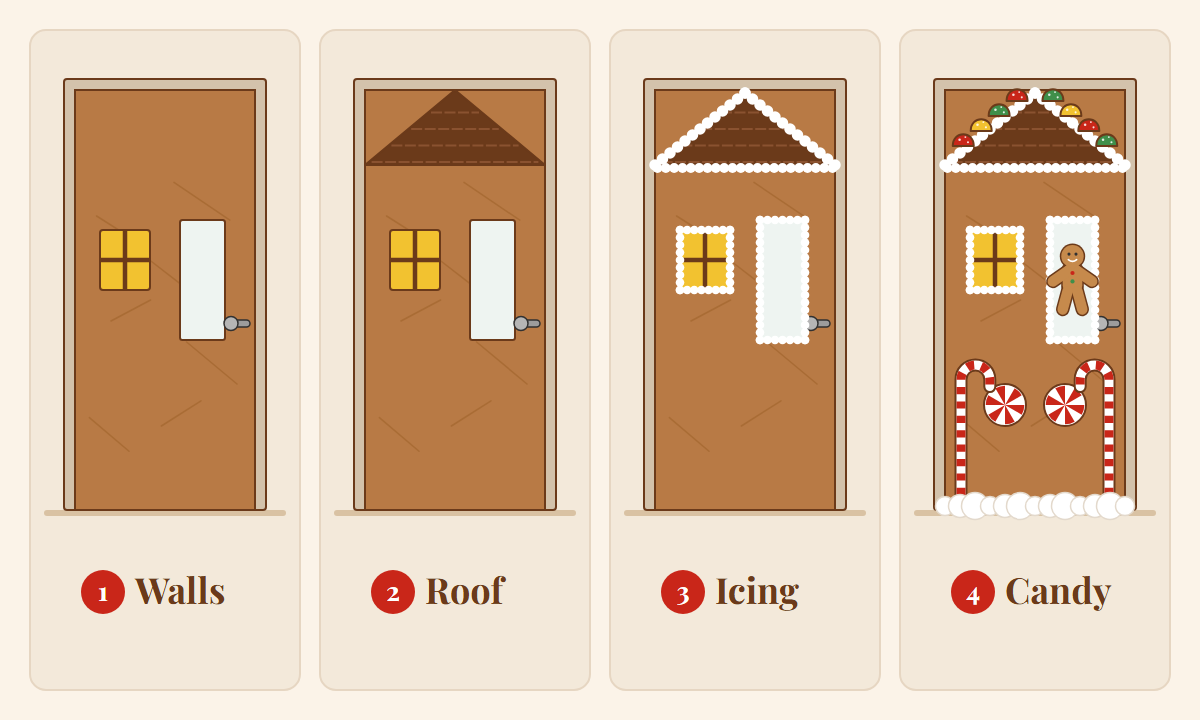
The order matters for the same reason it does on a baked house. The icing hides the joins, so it goes on after the walls and roof. The candy hides any icing that went wrong, so it goes on last.
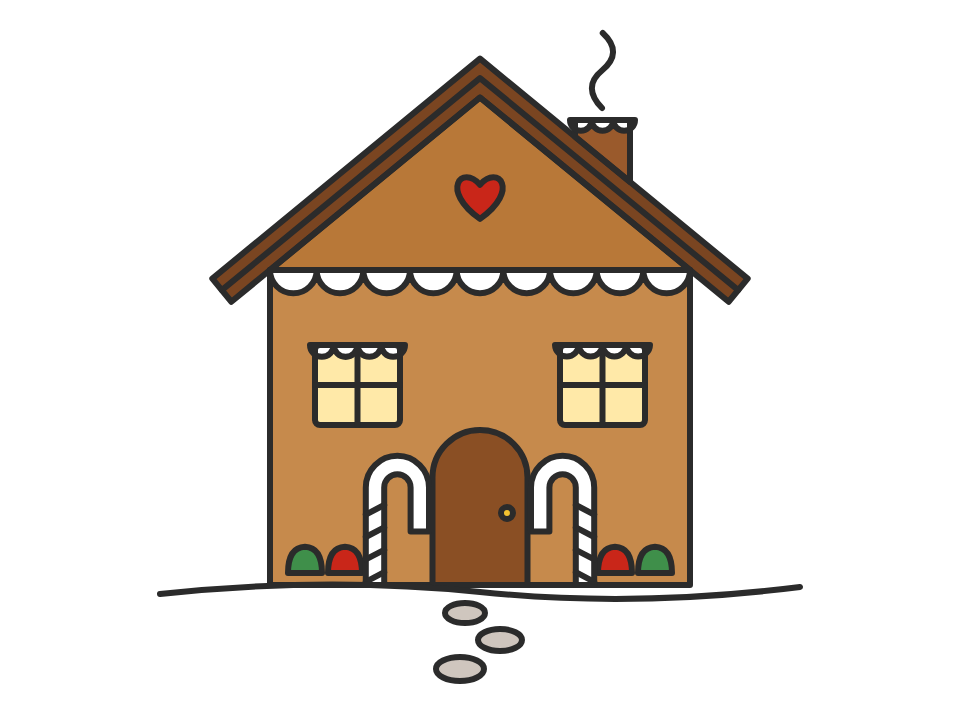
Think of the door as a flat drawing of a gingerbread house, blown up to full size. If you’d like to sketch the design on paper first, the same shapes work at both sizes.
Check What Your Building Allows Before You Buy Paper
The step most door roundups skip is the fire code. Paper burns, doors are how people get out, and schools are strict about both.
Here is what one set of written rules looks like. Washington County School District in Utah published its facility fire code standards in January 2026. They say classroom exit doors “cannot have paper, teaching aids, or decorations attached to either side of the door.” The same rules say glass panels in a classroom door must not be fully covered, and that dimensional artwork is not allowed in its schools at all.
That is one district, and plenty of others allow door decorations. The rulebook most U.S. fire officials start from is the International Fire Code, which limits paper on school corridor walls to 20 percent of the wall area, and on classroom walls to 50 percent. Each city and state adopts and amends it, so the local version is the one that counts.
Rules like these do get enforced. In a 2025 thread on r/Teachers, one teacher said their school stopped its door contest after a surprise fire marshal visit, when every door decoration had to come down.
So a gingerbread house can go in three places:
- On the door itself. The usual choice, and the one that is banned in the strictest buildings.
- On the wall around the door. Leaves the door bare, but counts toward the paper limit for that wall.
- On a freestanding panel beside the door. A trifold board or foam panel, out of the walkway. It keeps paper off the door and the wall.
Before you start, ask the office three things: whether doors may be decorated, whether the glass must stay clear, and whether they require flame-retardant paper. Flame-retardant bulletin board rolls do exist. Pacon sells one under the Flameless name, and retailers list it as meeting the NFPA 701 fire test.
Door Rules Check
Three questions about your door, and which of the three gingerbread layouts to plan for before you ask for sign-off.
Planning guidance, not a code ruling. Fire codes are adopted and amended locally, and the person who decides is your fire marshal, school district or building manager. Facts used here come from the International Fire Code’s limits on paper on school walls and from one school district’s published door rules; your own rules may be stricter or looser. Nothing you enter is stored or sent anywhere.
Measure Your Door, Then Plan the Paper
Most classroom and office doors are 36 inches wide. The most common commercial size is 36 by 84 inches, and 36 by 80 is the shorter standard. Measure yours anyway, and note three more things: where the glass panel sits, which edge has the hinges, and where the closer arm and latch are. Paper stays off all of them, so the door still closes and latches on its own.
Then pick one of two layouts.
- The door is the whole house. Cover the door in brown, put the roof across the top of the door, and the handle becomes part of the house front. Everything stays on the door, it comes down in minutes, and it is the only layout for a building that allows doors but not walls.
- The door is the front door. Build the house on the wall around the door, with the roof above the frame, so the real door becomes the gingerbread house’s front door. It looks bigger, but it needs wall space, ladders and permission. When the Sharing Kindergarten teacher built hers across the classroom front, it took two people on ladders to glue the roof to the walls and a third to make sure it was even.

Picture a standard 36 by 84 inch door wrapped as the whole house. With a 48 inch roll, one 86 inch strip covers it, with 2 inches to trim. The roof is a triangle 36 inches wide and 15 inches tall, starting 69 inches up the door. The roofline and the eave need about 7 feet of icing trim, which is 19 cut scallops at 4.5 inches, plus a couple of spares. Now build the same house on the wall, with a foot of brown on each side and a foot above the frame, and the roof peak climbs past 10 feet. That is at or above the ceiling in a lot of classrooms, so measure yours. It is also why the wall version usually ends up with a flatter roof or a narrower margin.
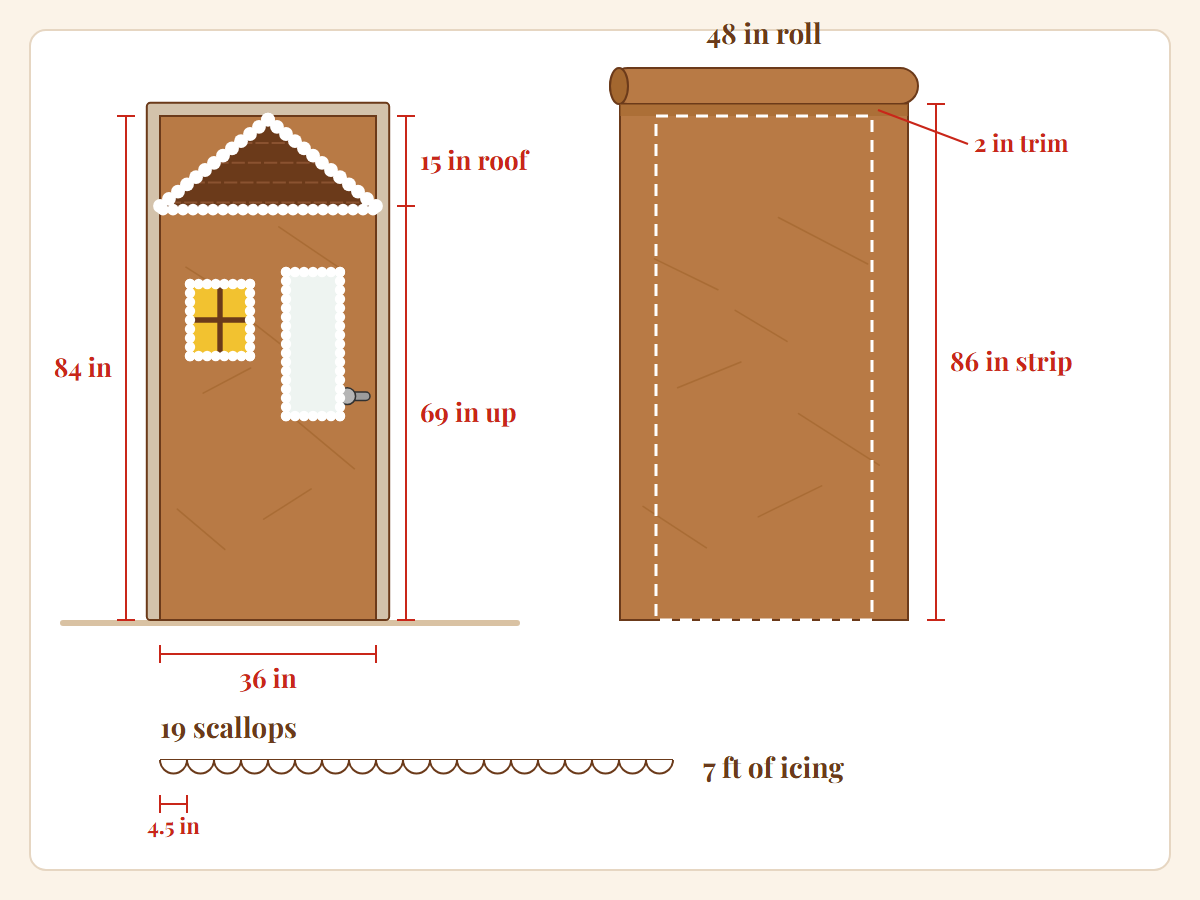
The roof in those numbers copies the classic template we use for baked houses, whose end wall rises 1.15 inches over a width of 2.8 inches. Scaled up to a 36 inch door, that same slope gives a 15 inch roof. Borrowing a real template’s proportions is the easiest way to make a paper door look like a gingerbread house instead of a brown rectangle with a hat on.
Gingerbread Door Cut List
Enter your door’s measurements and get the paper, roof, icing and candy counts for a door-sized gingerbread house.
Planning numbers for paper and craft supplies, not a building code check. The roof pitch copies our classic gingerbread house template, which rises 1.15 inches over a 2.8 inch wide wall. Paper lengths include 2 inches of trim per strip. Ask your school or building manager what may go on or around a door before you buy anything. Nothing you enter is stored or sent anywhere.
A note on store-bought covers: the classic printed plastic gingerbread door cover is listed at 5 feet by 30 inches. On a 36 by 84 inch door that leaves 6 inches of bare door across the width and 2 feet at the bottom, so plan to fill the gap with brown paper or a candy border.
Materials: The Paper Version of Every Gingerbread House Part
The trick to a door that reads as gingerbread is to copy a real house part by part. On a baked house, every candy has a job, and the candy that goes on each part of a real house tells you what each part of the door should look like. Here is how each job translates to paper.
| Part of the house | On a baked house | On a door |
|---|---|---|
| Walls | Gingerbread panels | Brown kraft or bulletin board paper |
| Piped icing | Royal icing lines and drips | White scalloped border, half paper plates, white puffy paint or chunky white yarn |
| Roof | Candy shingles or a gumdrop ridge | A darker brown or white triangle with rows of paper shingles |
| Windows | Cut-out windows, often filled with melted candy | Yellow paper rectangles with brown strips for panes, trimmed in white |
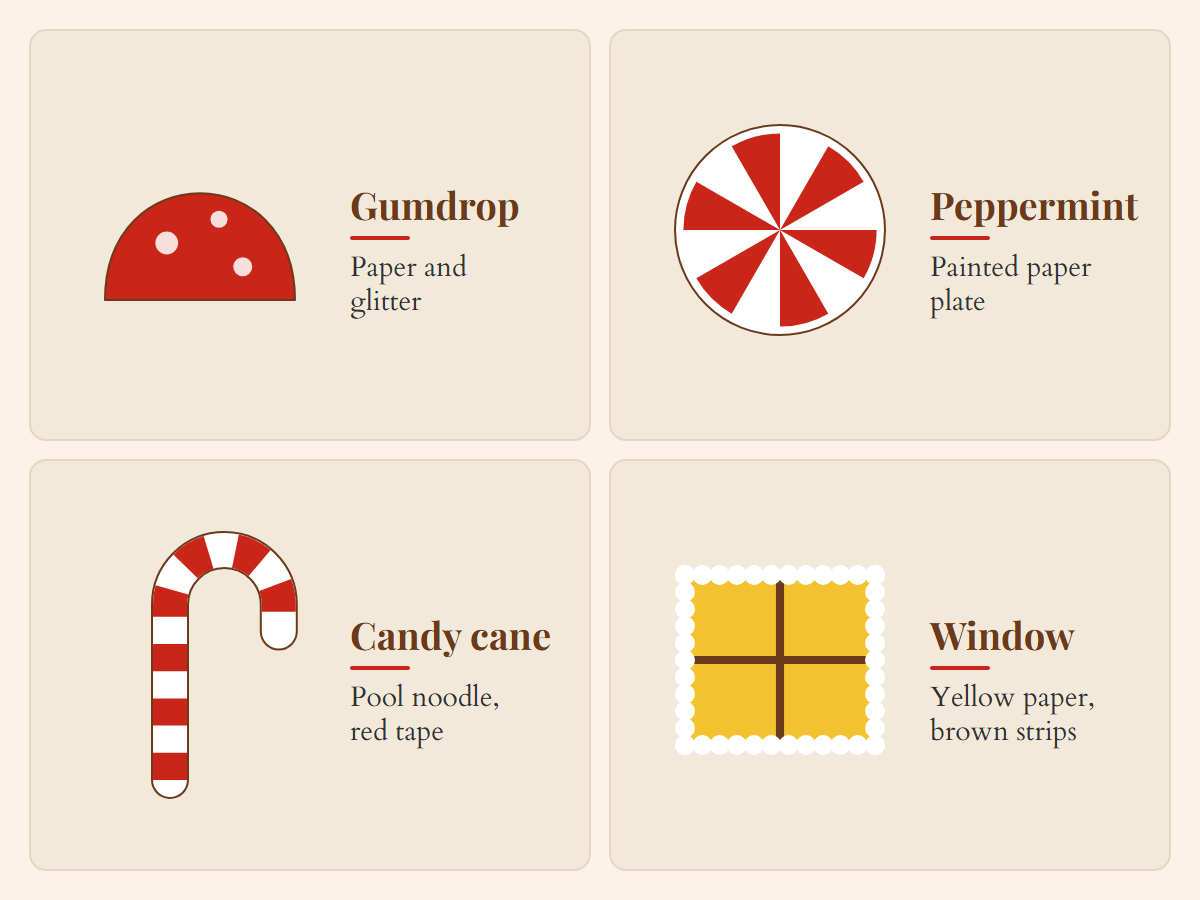
| Gumdrops | Gumdrops | Construction paper domes with glitter glue, or plastic cups cut in half |
| Peppermints | Peppermint swirls | Paper plates painted red and white, covered in plastic wrap for shine |
| Candy canes | Candy canes | Pool noodles wrapped in red tape, with wire inside to hold the hook |
| Snow | Powdered sugar or coconut | Crumpled white paper along the bottom |
| Gingerbread people | Cookie figures by the door | Printed or hand-cut figures peeking from the windows |
Most of the door column comes from builders who published theirs. The Sharing Kindergarten door used yellow paper windows with brown strips, die-cut circles for candy, pool noodle candy canes with wire inside and a taped stripe, construction paper gumdrops with glitter glue, and wrinkled paper snow. The painted paper plates under plastic wrap come from a classroom door shared on Pinterest. The cup gumdrops come from a Hometalk build for a home's front door.

These are the shapes to cut. Each one is simple enough to trace onto card, cut in a stack and repeat down a roofline.
The shopping list for one door: a roll of brown paper, a roll of white scalloped border or a pack of white paper plates, colored card or construction paper, a few plastic cups, painter's tape or masking tape, glue sticks and, if your building allows 3D pieces, a pool noodle or two.
The Build Plan: One Door in One Afternoon
Real gingerbread decorators pipe their panels flat on the table before the house goes up, because a straight line is far easier on a flat surface than on a wall. The same holds for a door. Make every piece on the floor or a table first, and use the door only for hanging them.
- Clear the door. Take everything off it, including old tape, and wipe it down so new tape sticks.
- Hang the brown paper. Tape the top edge first, smooth the sheet down, then tape the sides. Trim around the handle, the latch edge and the glass with a craft knife.
- Add the roof. The Sharing Kindergarten teacher's advice is to roll the paper out on the floor in front of the exact spot it will go, and work out how you will secure it before you cut.
- Add the windows. If your door has a glass panel, frame it in white so it becomes one of the house's windows rather than something you have to cover.
- Pipe the icing. Run white scallops along the roofline and under the eave, then around each window.
- Add the candy, biggest first. Candy canes on each side, gumdrops along the roof, peppermints on the walls. The Sharing Kindergarten teacher found that lining up the large candy circles took longer than anything else, so lay them out on the floor at the right spacing before any go up.
- Add the snow and the people. Crumpled white paper along the bottom, gingerbread people in the windows.
- Do the hallway check. Walk to the far end of the corridor and look back. Anything you cannot make out from there is too small. Make it bigger or take it off.
Say you have 90 minutes after the last bell. Spend about 20 on the paper and roof, 20 on the windows and icing, 40 on the candy and 10 on the hallway check. That split is our rough guide, not a rule, but it keeps the candy, which is the part people remember, from getting squeezed into the last five minutes.
On tape: painter's tape and masking tape come off a painted door more cleanly than clear tape. The Sharing Kindergarten teacher taped her candy circles up with masking tape and used hot glue for the roof circles on the walls. Ask before any glue touches a door or wall you don't own.
Making It Look Like Gingerbread, Not Brown Paper
A flat brown sheet looks like a parcel. Four small touches turn it into something that looks baked.
Texture. Crumple the brown paper into a ball, then flatten it before you hang it. The creases catch the light the way a baked surface does. A little darker brown paint dabbed on with a sponge around the edges gives it a toasted rim.
Raised icing. Real royal icing stands up off the gingerbread. Flat white paper reads thin, so layer two scalloped borders, the second offset by half a scallop, or outline the scallops in white puffy paint, which dries raised.
Shine. Candy is glossy and paper is not. Plastic wrap over painted paper plates, clear packing tape over colored circles, or a coat of glitter glue gives paper candy a sugar shine.
Faces at the windows. Gingerbread people peeking out of the windows make the house look lived in. Our free gingerbread clipart prints at any size, so you can run a whole family off in an afternoon. For plain figures the children can decorate themselves, print a blank gingerbread man outline.

One more habit borrowed from real decorators: repeat things. A row of eight identical gumdrops looks deliberate. Eight different candies in a row look like the craft table exploded.
What Wins a Gingerbread Door Contest
Door contests are judged from the hallway, usually in a few seconds a door. That changes what matters.
- One clear idea. The door should be a gingerbread house before it is anything else.
- A twist people remember. Gingerbread is popular enough that your neighbors may have the same idea. In one Facebook gingerbread group, a member shared a division office contest where two separate groups both made gingerbread house doors. A pun line helps, like "Oh Snap!" beside a broken gingerbread man, or "We Are Smart Cookies" with every student's name on a cookie.
- Something to do. A small mailbox for letters to Santa, or an order slot for a gingerbread bakery, gets people to stop.
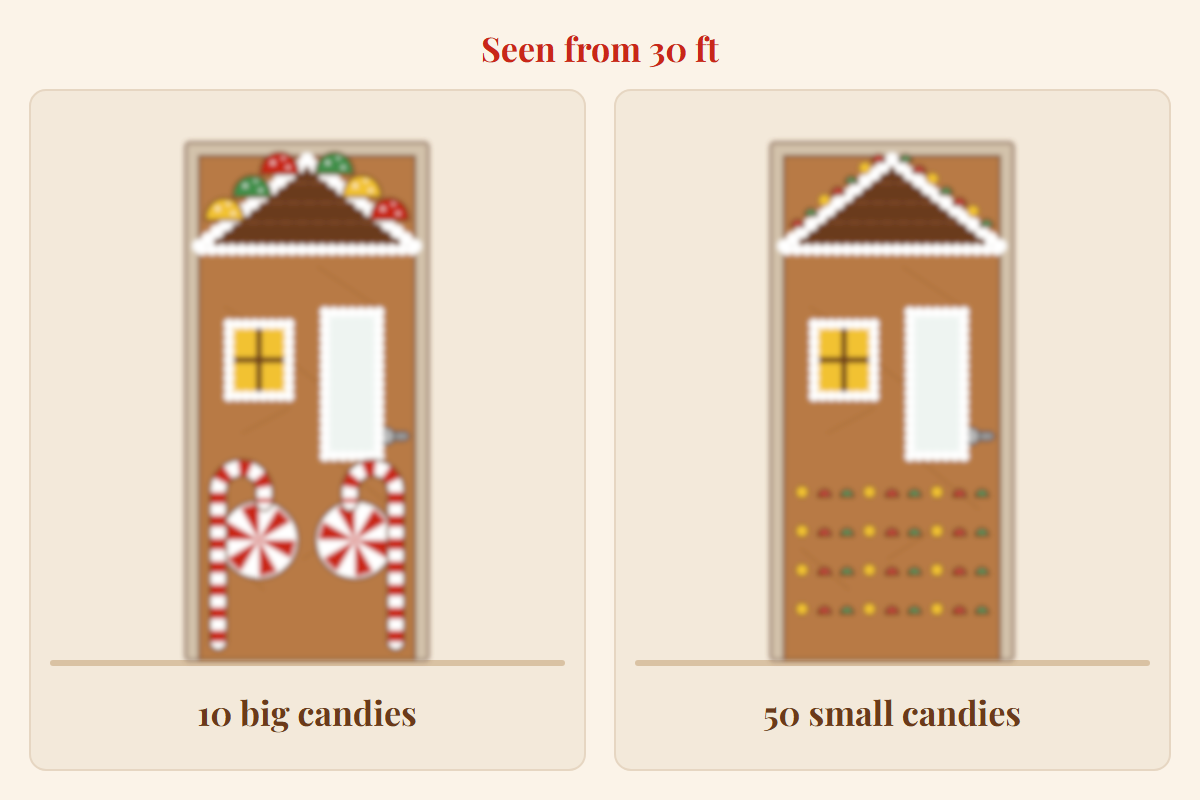
- Scale over quantity. Ten big candies beat fifty small ones from 30 feet away.
If your contest publishes criteria, read them the way a baker reads a competition rulebook. What gingerbread competition judges actually score comes down to originality, precision and difficulty, and the same trade applies on a door: one hard detail done cleanly beats three done roughly. In a small workplace field, originality carries the most weight, so the cheapest points come from building something that is not quite a house, like a gingerbread bakery front or a gingerbread chapel.
For more ways to theme a house, our house ideas that win contests translate to paper well. A candy roof, a pink house or a log cabin done in brown paper strips all read clearly from across a hallway.
Gingerbread House Door Decorations for Classrooms, Offices and Apartment Doors
The build is the same everywhere. Who builds it, how long it stays up and what the building allows are not.
For Teachers Decorating a Classroom Door
The Sharing Kindergarten door went up in the first week of December, during a gingerbread week when the class's reading, math and writing were all gingerbread themed, and it stayed up for the whole month. The children made their own small gingerbread houses together on the Friday. The door was the backdrop for a week of learning, not a separate project.
The hard question is who does the work. In a 2025 r/Teachers thread about a cancelled contest, one commenter guessed that the contest had been staff driven, with teachers making their own doors, and a special education teacher said it looks bad whether the children make it or not. A middle path works for most classes: the adult hangs the paper and the roof after school, and the children make the candy, the windows and the gingerbread people during the day. Every child can point to a piece of it.
For Office Teams in a Door Contest
An office door can win on one standout detail rather than a big budget. In December 2025, a member of r/GingerbreadHouses posted a monster gingerbread house they made for a Christmas door competition at work. A fellow member singled out its stained glass window, and in the replies the builder put the cost of the whole door at $25. Pick your one detail, put most of your time into it, and keep everything else simple.
Office doors bring their own rules. Ask the organizer what counts and when judging happens, keep paper off the latch, the closer and any room or exit signs, and leave stairwell doors and other labeled fire doors alone. A team of four can hang a whole-door house in a lunch hour if every piece is cut the day before.
For Apartment and Condo Doors
Some buildings run their own door contests, and an r/Apartmentliving post about one drew more than 70 comments. Others ban anything on the hallway side of a unit door. One high-rise condo resident wrote on Reddit that cardboard attached to an entry door would get an immediate warning from building management, and that residents could not even keep a welcome mat outside. Read your lease or house rules first. If the hallway side is off limits, build the house on the inside of your door instead.
For a house's own front door outdoors, Hometalk's version shows how far you can go: a foam board frame around the door, white expanding foam piped on as icing, cut plastic cups as gumdrops, and clear adhesive to hold it up. That build is for an outdoor door you own, not for a school or office.
Buy a Door Cover or Make One?
| Option | Best for | Watch for |
|---|---|---|
| Printed plastic door cover | A finished door in minutes, apartments, last-minute entries | Smaller than most commercial doors, and every other entrant can buy the same one |
| Multi-piece door and wall kit | Offices with wall space around the door | Needs permission for the wall as well as the door |
| Printable classroom kit | Teachers who want letters, labels and name tags | Printing and cutting time for a full door |
| Paper build from scratch | Contests, and anyone who wants a door nobody else has | An afternoon of work, plus planning |
A bought cover is fine for joining in. A door built to your own measurements is what wins, because it fills the door and nobody down the hall has the same one.
Taking It Down and Saving It for Next Year
- Photograph it first, straight on and from the end of the hallway. The photo is next year's plan.
- Peel tape slowly, pulling back low and flat along the door rather than straight out.
- Roll, don't fold, the big brown sheets and the roof, around a wrapping paper tube.
- Store candy pieces flat in a folder or a pizza box, and write the door's measurements on the lid.
Questions About Gingerbread House Door Decorations
How much paper do I need for a gingerbread house door?
If your roll is at least as wide as your door, one strip as tall as the door plus 2 inches. A 36 by 84 inch door takes about 7 feet of a 48 inch roll. With a 30 inch roll you need two strips, overlapped down the middle. The cut list above works it out for your exact door.
Can you put a gingerbread house on a classroom door?
Often, but not everywhere. Some districts ban paper and decorations on classroom exit doors entirely, and most want any glass panel left clear. Ask the office first. If doors are out, build the house on a freestanding board beside the door.
How do you make the icing on a paper gingerbread door?
White scalloped bulletin board border is the quickest. Half paper plates make bigger scallops, and white puffy paint or chunky white yarn gives a raised, piped look.
How do you make giant candy canes for a door?
Push a length of wire through a pool noodle so it holds a hook shape, then wrap it in red tape for the stripe. That is how the Sharing Kindergarten door's candy canes were made. Check that your building allows 3D pieces first.
How long does a gingerbread door take?
Our rough guide is about 90 minutes for a whole-door house with the pieces cut in advance, and most of a day for a team building a house on the wall around the door.
Can we use real candy on the door?
Keep food off the door. It melts, gets sticky, draws ants and gets eaten. Paper candy lasts the whole month and goes back in the box for next year.
Make the Real Thing Too, With Best Gingerbread Houses
A paper door gets the hallway talking. A real gingerbread house is the part people get to eat. If your contest comes with a staff room party, or you'd like a real house on the desk next to the door, we rate gingerbread house kits for the staff room table on how well they actually hold together. And if you'd rather make a house that comes out again every December, try a cardboard house that stands on a desk.