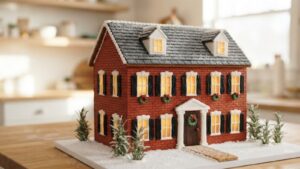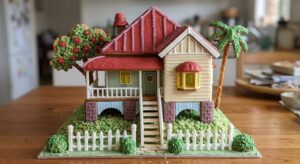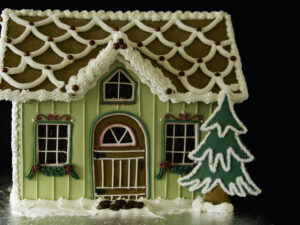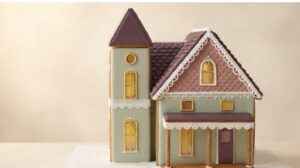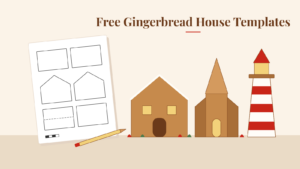
Search for a gingerbread house laser cut file and most results are files or kits for sale. Here are three houses you can cut for free, from the same true-size shapes we already use for our dough templates.
One honest note first. These files are for wood, cardboard or acrylic, not for cutting dough. The one laser cut gingerbread house we found, on Make: magazine, was cut from baked dough, and its builder reported a smell between burned cake and burned hair.
Each file is a retro diner, a schoolhouse or a chalet, redrawn as outlines and openings only, with no piping guides. We checked the shapes with a script when we drew each one as a dough house template. We have not cut these files on a laser ourselves, so cut one page on scrap first.
You will get three free downloads, a stock thickness adjuster, a file picker, 10 steps and a troubleshooting table. Start with the downloads.
Laser Cut Gingerbread House: At a Glance
- Difficulty: Easy for the retro diner, medium for the schoolhouse, hard for the chalet. The work is the gluing, not the cutting.
- Time: cutting time depends on your machine and your stock. We have not timed a cut or a build.
- Makes: one house. The diner is 6 in long and 2.8 in deep, the schoolhouse 4.6 in long and 3 in wide, the chalet 5 in wide and 6 in deep, all drawn for 1/4 inch stock.
- Files: three free zips of SVG pages, each page 8.5 x 11 inches at true size with a 1 inch check square.
- Not food: these houses are decorations. Do not eat them or set food on the wood.
Tools: a laser cutter with a bed at least 8.5 x 11 inches, or software that lets you move pieces around, calipers, fine sandpaper, a damp cloth, clamps or tape.
Materials
- Basswood or plywood sheets, 1/8 inch or 3 mm thick, or sturdy cardboard
- Wood glue, or a solvent cement made for acrylic if you cut acrylic
- Paint, wood stain or paint pens for the finish
- White paint or powdered sugar glue for snow
- For the night look, a battery micro LED string with a small battery box
Steps
- Download a zip and open page 1.
- Measure the blue square.
- Test one window on scrap.
- Cut every page.
- Clean the edges.
- Dry fit the box.
- Glue the walls.
- Set the roof.
- Paint and add details.
- Light it, if you like.
Notes: the files are drawn for butt joints with no tabs.
Free Gingerbread House Laser Cut Files
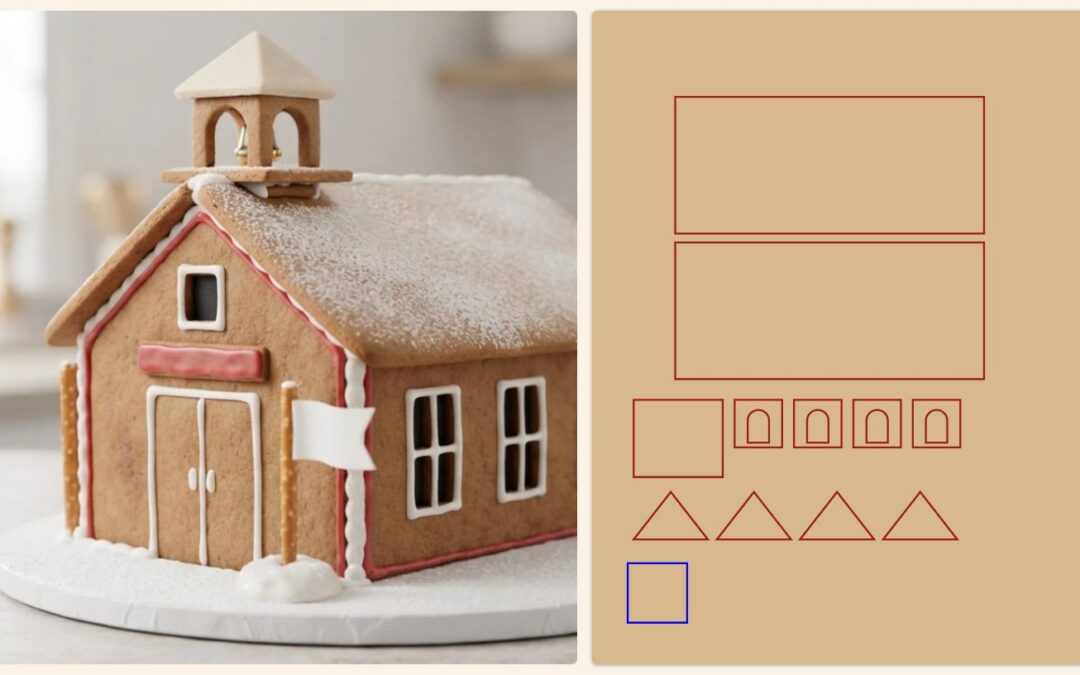
Each zip holds the SVG pages, a parts list and a short readme. Every page is 8.5 x 11 inches at true size. The red lines are cuts and the blue square is a 1 inch check square.
| File | Level | Pieces | Pages | Openings | Longest piece | Download |
|---|---|---|---|---|---|---|
| Retro diner | 1, easy | 11 | 3 | 8 | Roof, 6.7 x 3.5 in | Retro diner zip |
| Schoolhouse | 2, medium | 16 | 3 | 14 | Roof slab, 5.2 x 2.3 in | Schoolhouse zip |
| Chalet | 3, hard | 33 | 6 | 15 | Roof panel, 8 x 3.73 in | Chalet zip |
The piece count includes the door. Each door is an opening cut out of its wall, and the piece that falls out is the door. A laser leaves it loose, just as our dough templates do.
Retro Diner Laser Cut File: Start Here
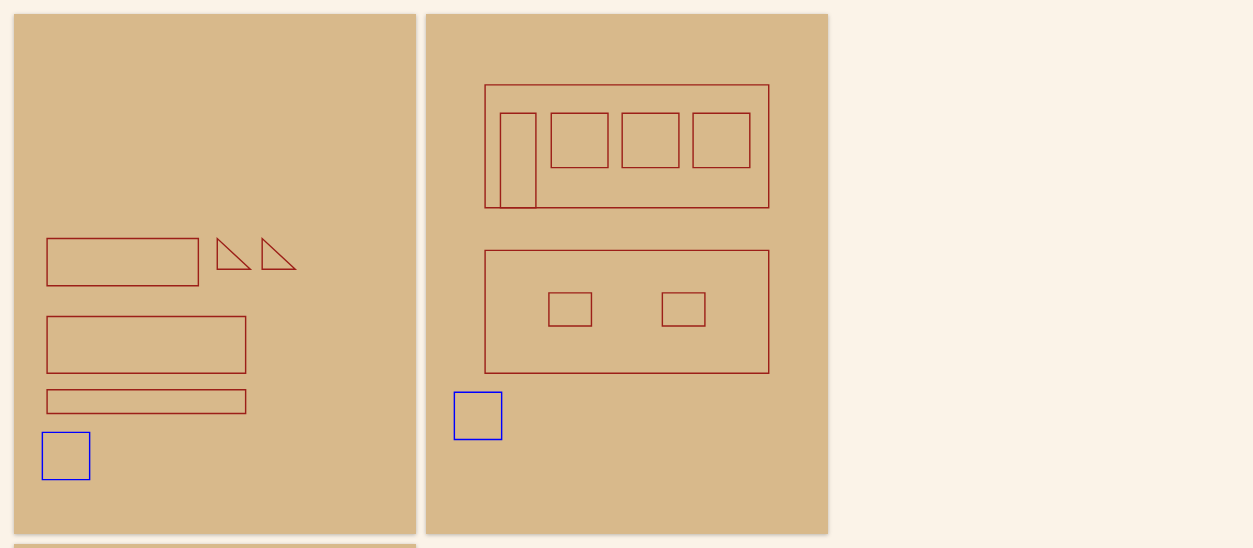
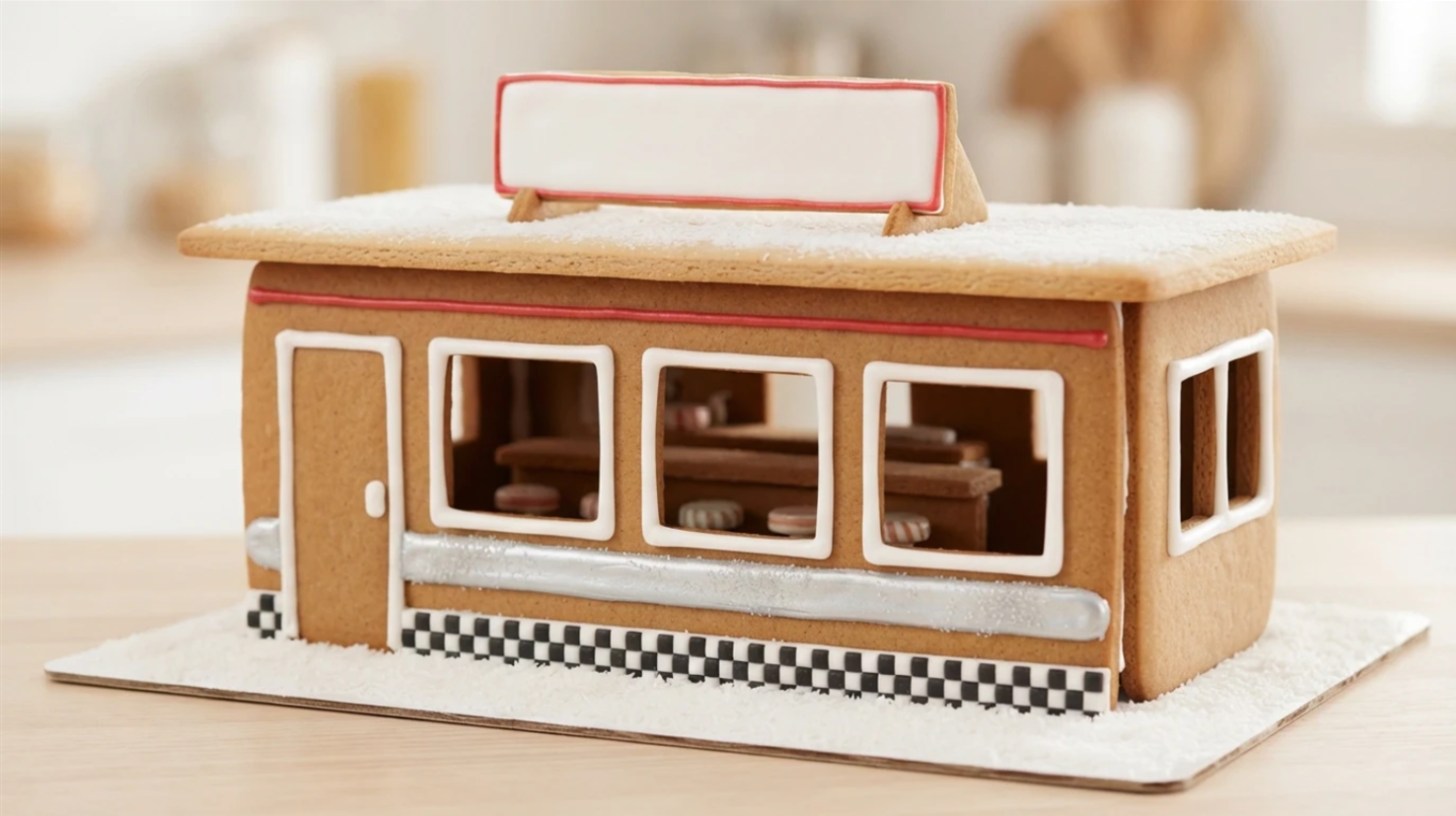
The diner is a long, low box with a flat roof. It is eleven pieces on three pages: a front wall with a door and three picture windows, a back wall with two windows, two end walls, a roof slab, a small rooftop sign with two braces, and an interior counter with its top. The smallest piece is a 0.7 x 0.65 inch brace.
It is the easiest file because nothing slopes. The roof is a flat slab, so you have no angled joint to sand. The end walls sit between the front and back walls, which keeps the box simple to square. See the retro diner gingerbread house for the gingerbread version with its stripe and checkerboard.
Schoolhouse Laser Cut File: The Middle Step
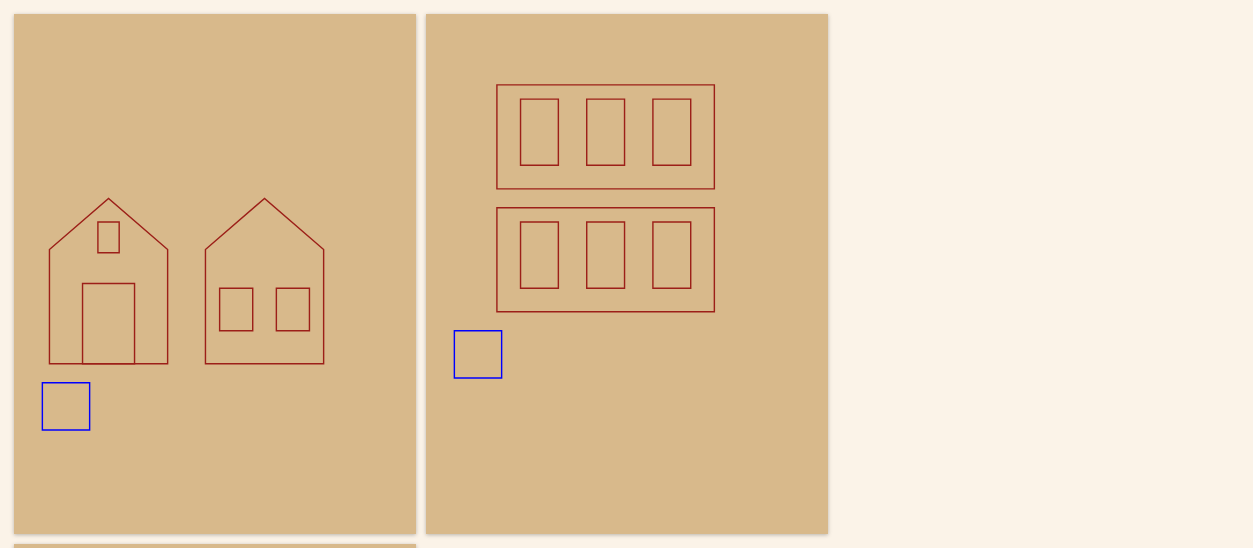
The schoolhouse adds a pitched roof and a bell tower. It is sixteen pieces on three pages: two gable walls, two side walls with three windows each, two roof slabs, and a tower of a platform, four faces with arches and four cap triangles. The arches in the tower faces are 0.36 x 0.55 inches.
The new problem is the ridge. The two roof slabs meet at the peak in a butt joint, and flat edges leave a thin gap along the top. Sand a small bevel on the top edge of each slab, or fill the line with glue. The schoolhouse gingerbread house shows the finished shape with its double door and sign band.
Chalet Laser Cut File: The Challenge
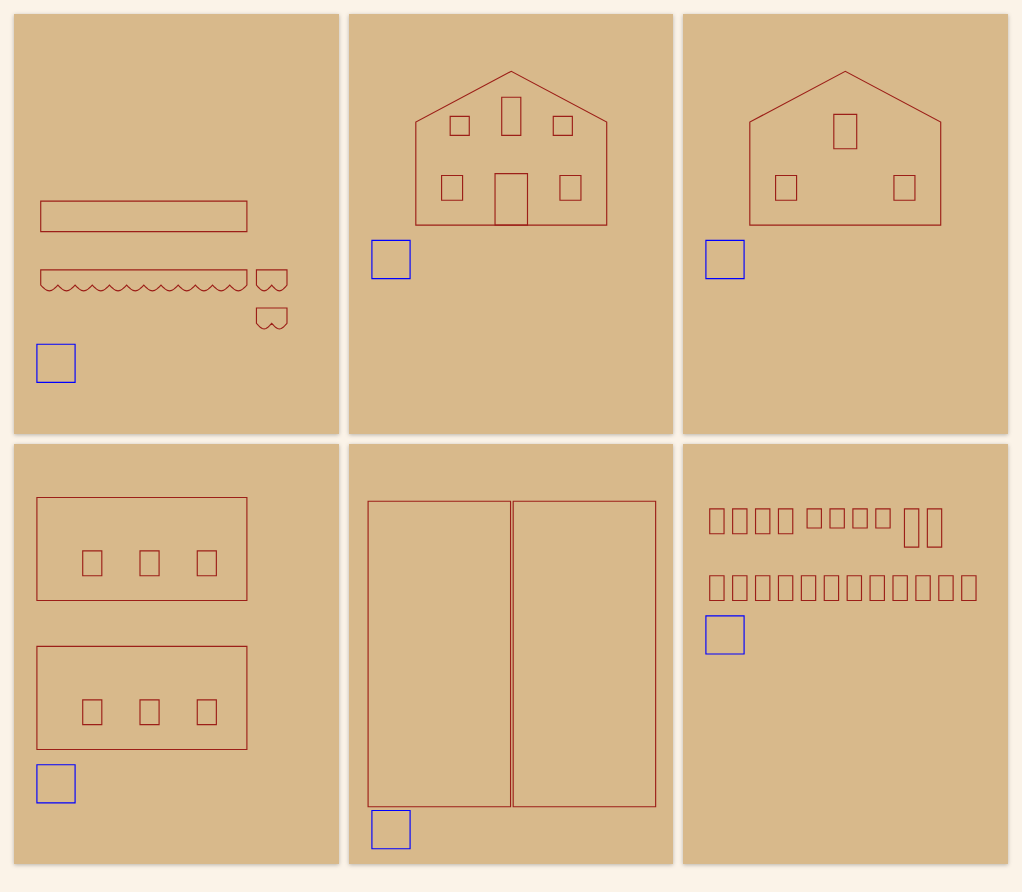
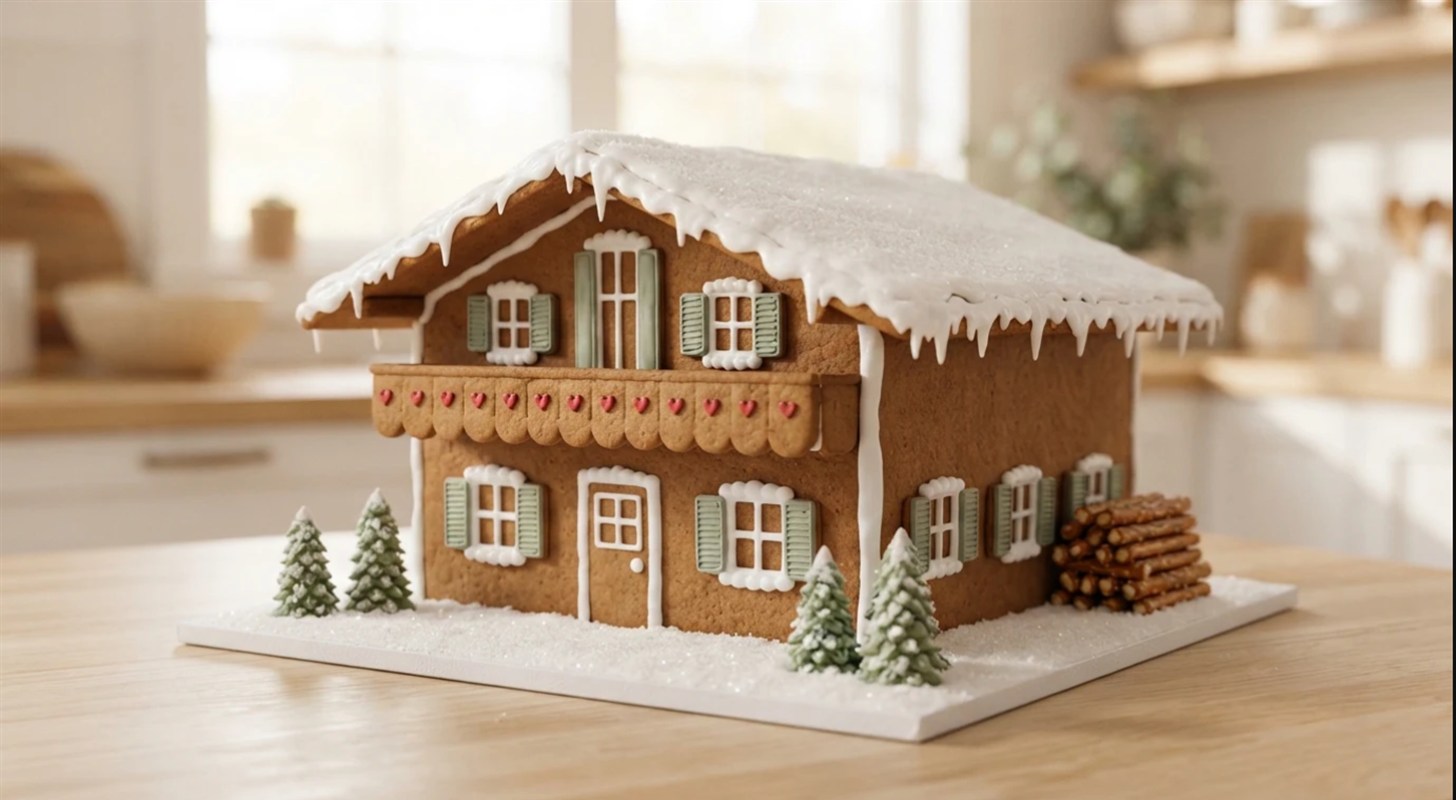
The chalet is thirty-three pieces on six pages, and most of that count is 22 shutters. It has a gable front with a door and five windows, a gable back with three, two side walls, two big roof panels, a deck slab and three scalloped aprons. The roof panels are 8 inches long, the longest piece in any of the files.
The shutters are the fiddly part. Each is 3/8 inch wide, and in thin wood or cardboard they can snap when you lift them off the bed. The deck and its aprons are what make the chalet look like a chalet. The gingerbread chalet shows how they sit.
What These Files Are, and What They Are Not
The files were drawn for dough, and dough houses are glued with icing at butt joints, with no tabs or slots. That choice carries over to wood. You glue the joints, and kerf does not change how anything fits.
Kerf is the width of material the laser burns away. One Fab Academy lab tested 3 mm plywood and found a slot of 2.8 mm fit best, which works out to a kerf of 0.1 mm, according to its week 3 notes. That is one machine and one sheet, so your number will differ. With no mating tabs, it only trims the outside of each piece by about a tenth of a millimeter.
The files are drawn for 1/4 inch stock, because that is how thick our dough is. Most laser stock is thinner. Walls that sit between two other walls then make the footprint a little smaller, and the roof hangs a little farther past the walls. The adjuster below tells you by how much.
Stock Thickness Adjuster
The files are drawn for 1/4 inch stock. Pick your house and your material, and see how the footprint and the roof overhang change.
For planning only. This is our arithmetic from each template’s own checks, not a measured build. Measure your stock with calipers, because plywood and cardboard run thick or thin.
Three more notes. The blue square is 1 inch, so measure it after you import, because a scale mistake is the most common problem. A page as drawn fits an 8.5 x 11 inch bed, and you can move the pieces around if your bed is smaller. We also have not tested these files on a Glowforge, an xTool or any other named machine.
How to Make a Laser Cut Gingerbread House Step by Step
1.Download a zip and open page 1
Pick a file from the table and open page 1 in your laser software. Import it at 100 percent. Keep the red lines as your cut layer.
2.Measure the blue square
The blue square is 1 x 1 inch. Measure it on screen after import. If it is wrong, fix your import scale before you cut anything.
3.Test one window on scrap
Cut one small opening in a scrap of your real stock first. It tells you whether your power and speed cut clean through, and whether the opening is the size you expected.
4.Cut every page
Cut each page and keep the pieces from one page together. The parts list in the zip gives the size of every piece, so you can count them against the table. Never leave a running laser unattended.
5.Clean the edges
Laser cut wood edges are usually dark and sooty. Wipe each piece with a damp cloth and sand the edges lightly. Make sure the wood is dry before you glue.
6.Dry fit the box
Stand the walls up without glue first. The end walls, gable walls or side walls sit between the other two, depending on the file, so check that they drop in without forcing.
7.Glue the walls
Run a thin line of wood glue along each joint and hold the box square with clamps or tape for the time your glue’s label gives. Wipe off any squeeze-out at once.
8.Set the roof
Glue the roof on last. On the schoolhouse and chalet, the two slabs meet at the ridge, so sand the bevel from the earlier note before you glue them.
9.Paint and add details
Paint or stain the house, then add the loose parts. The door goes back in its opening, the chalet shutters beside each window, and the diner sign on its two braces. White paint makes good snow on the roof.
10.Light it, if you like
A battery micro LED string tucked inside shines through the openings. Use battery lights only. Our guide to lights inside a gingerbread house explains why a candle is never the answer.
Finishing a Laser Cut House
Laser cut wood has no icing, so the finish does the work that piping does on a dough house. Paint or stain the walls first and let them dry. Then draw the window frames, the door trim and the roof line with white paint pens or puffy paint, the way our dough versions use white royal icing.
Stain gives the warm brown of baked gingerbread, and a coat of white across the roof reads as snow. Keep paint off the glue joints until they have set. A cake board under the house makes it easy to carry, and a row of these houses on one long board makes a village. Our gingerbread village guide shows how to make different houses look like one town.
Which File Should You Cut First?
Start with the diner if this is your first project, the schoolhouse if you have done a few, and the chalet if you want a challenge. Enter your stock and your bed size and the picker below checks that the longest piece fits.
Which File First
Tell us your experience, your stock and your bed size. We will rank the three files and check the longest piece fits.
The ranking is our judgment from piece count and fiddly parts, not a tested result. Piece sizes come from the files on this page. Check your own machine’s real working area.
If you cut cardboard, the chalet shutters are the part to skip. One Fab Academy lab tested 4 mm cardboard, so check what your own cardboard measures before you pick a file. For a house with no cutter at all, see our cardboard gingerbread house.
Prefer to Bake One Instead?
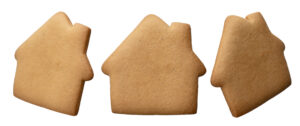
All three shapes also work as dough. The retro diner, schoolhouse and chalet pages each carry a printable template, a recipe card and a step by step build. Our gingerbread house dough that bakes hard and flat works for all of them. You can also browse our other free gingerbread house templates.
Troubleshooting
| What you see | Why it happens | What to do |
|---|---|---|
| The pieces come out the wrong size | The file imported at the wrong scale | Measure the blue 1 inch square. Reimport at 100 percent. |
| The roof slabs leave a gap at the ridge | Two flat edges meet at an angle | Sand a small bevel on each top edge, or fill the line with glue. |
| The house is shorter than the dough version | The files are drawn for 1/4 inch stock and yours is thinner | Check the adjuster above. The roof overhangs a little more and that is fine. |
| The door or a window falls out as a loose piece | Openings are cut all the way through | Keep the door and glue it back in. Discard the window pieces or save them for shutters or a sign. |
| A chalet shutter snaps | The strip is 3/8 inch wide and the stock is thin | Lift shutters with a spatula, or skip them and paint them on. |
| The edges are dark and sooty | Burning during the cut | Wipe with a damp cloth and sand lightly before gluing. |
FAQ
Can I cut gingerbread dough with a laser?
Someone has. The Make: house was cut from baked dough, and the builder reported heavy smoke and a smell between burned cake and burned hair, and the house was not edible. We would not recommend it. For an edible house, use the printable templates and a knife.
Do I need tabs or finger joints?
No. These files are drawn for butt joints that you glue. If you want tabs and slots, you would need to add them yourself and test the kerf on your own stock.
Can I sell houses cut from these files?
Our default is that the files are free for personal and classroom use, and we ask you not to resell the files themselves. If you plan to sell finished houses, ask us first.
Will these work on my machine?
They are plain SVG files with hairline cuts. We have not tested them on any named machine, so cut one page on scrap first.
More Gingerbread House Builds and Templates
Browse gingerbread house ideas for other themes or get decorating help. For a head start with no cutting at all, our ranked list of gingerbread house kits sorts the boxes that stay standing from the wobbly ones.