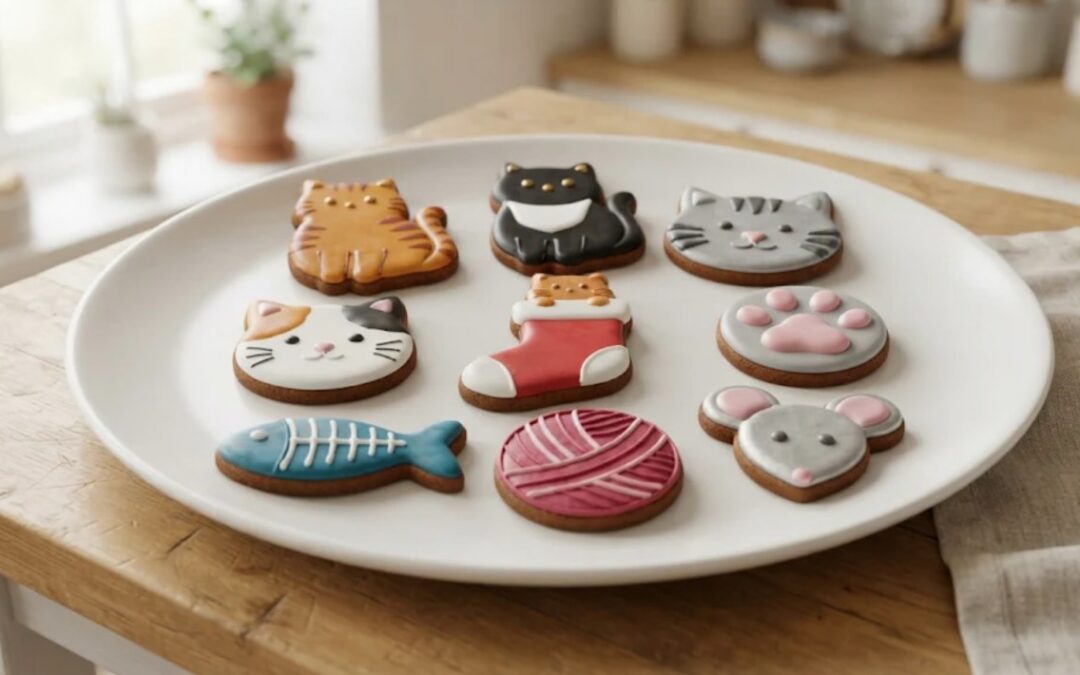
Cat gingerbread cookies come down to two pointed ears and a tail. Get those right in the dough and any cat lover at the table knows what it is before the icing goes on. The coat does the rest: stripes, a white bib or a patch of orange.
This set uses one free printable template with seven shapes, a cut-out dough that keeps ears and tails sharp and the royal icing cure times from our icing pages. It is written for parents planning a kitty birthday party and for anyone who wants a cat on the holiday cookie tray.
You get coat palettes for tabby, tuxedo, calico and ginger cats, nine designs with three steps each, a picker and a party planner. Start with the recipe card, then the shapes.
Cat Gingerbread Cookies
Makes about 18 cookies, a mix of 2 1/4 to 3 1/4 inch shapes · Prep 30 minutes · Bake 11 minutes · Chill and freeze 2 hours 30 minutes · Icing cure overnight, 8 hours
Total time about 11 hours, most of it hands off. The overnight cure is what lets you bag and stack them.
Equipment: Stand or hand mixer, Rolling pin with 1/4 inch guides, The free template and a small paring knife, Two light-colored half sheet pans, Parchment paper, Piping bags with small round tips.
Template: free 1-page PDF, US Letter, a sitting cat, a cat face, a cat in a stocking, a paw print round, a fish bone, a yarn ball and a mouse, with piping guides, dot-eye marks and a 1 inch test bar.
Ingredients
Dough
- 3 cups all-purpose flour, 360 g, spooned and levelled
- 1 teaspoon baking soda
- 1/2 teaspoon salt
- 1 tablespoon ground ginger
- 1 1/2 teaspoons ground cinnamon
- 1/2 teaspoon ground cloves
- 1/4 teaspoon ground nutmeg
- 3/4 cup unsalted butter, 170 g, softened but still cool
- 3/4 cup dark brown sugar, packed, 150 g
- 1/2 cup unsulphured molasses, 170 g
- 1 large egg
- 1 teaspoon vanilla extract
Royal icing, a double batch
- 1/4 cup meringue powder
- 1/2 cup cold water, plus a few drops more for flooding
- 1/2 teaspoon cream of tartar
- 4 cups confectioners sugar, unsifted, 454 g
- Gel food coloring in the shades from the palette charts, plus black gel for a tuxedo cat
Method
- Make the dough: whisk the flour, soda, salt and spices, cream the butter and brown sugar until lighter in color, beat in the molasses, egg and vanilla, then mix in the dry ingredients on low and stop the moment no dry flour remains.
- Chill the dough as two flat wrapped discs about an inch thick for 2 hours, until a pressed thumb leaves a clean dent rather than a smear.
- Roll each disc to 1/4 inch between two sheets of parchment, so the dough never picks up extra flour.
- Cut the cats round the template with a paring knife held upright, cutting the ears, tails and the yarn strand last.
- Freeze the cut shapes on the parchment-lined pan for 30 minutes, until the ears and tails feel hard and lift without bending.
- Bake at 350F for 9 to 11 minutes straight from the freezer, until the surface looks matte and the edges are set, then cool completely on the pan.
- Mix the icing to stiff peaks, keep a little white and a little black, and tint the rest into the colors your cats need from the palette charts.
- Flood the base colors, leave the cookies flat overnight until the flood does not dent under a fingertip, then pipe the stripes, toe beans, bones and dot eyes and give them about 2 hours before bagging.
Notes: times are worked out from the set times on our icing pages, not timed on a build, and ovens vary, so judge by the surface rather than the clock. The yield is an estimate from the template shape sizes, which run larger than the 3.5 inch cutter behind this dough, so bake one test tray before you shop for a big party. Dough adapted from King Arthur Baking gingerbread cut-outs. These cookies are for people, not pets.
What Makes a Cookie Read as a Cat
A shop cat cutter is often a blob with two bumps, so the decorator pipes whiskers to explain it. Each shape here is built round the one thing people check first, so the icing can stay simple.
| Shape | What gives it away | What the template does | What it leaves out |
|---|---|---|---|
| Sitting cat | Two pointed ears and a tail curled round the feet | Ears with blunt tips, a tail at least 0.3 inches thick that curls up beside the body | A free tail sticking out, which would snap |
| Cat face | Ears on a wide round head | Broad ears on a 2 1/2 inch face, an M guide for a tabby and a small nose triangle | A mouth and whiskers, which smudge and add nothing |
| Cat in a stocking | Ears peeking over a cuff | A kitten head joined to the cuff across its full width | Paws hooked over the cuff, too thin to survive |
| Paw print | Four toe beans over one big pad | A plain round with the print piped on | Cut-out toes, which break off |
| Fish bone, yarn ball, mouse | The things cats eat, play with and chase | A whole fish to pipe the bones on, a ball with a thick loose strand, a mouse with its tail curled close | A bare skeleton or a long thin tail |
The coats come with a fact your guests will enjoy. Calico cats are almost always female, and most ginger cats are male, because the gene for orange fur sits on the X chromosome. In 2025 two research teams traced orange fur to a small deletion next to one gene on that chromosome, as Science News reported. So when the birthday child picks a calico, you can tell the table it is a she.
The tabby has its own mark: most tabbies carry a dark M on the forehead. The face template has a dashed M guide for it.
One Template, 7 Cat Shapes
Every design starts as one of seven cookies on a single page, each 2 1/4 to 3 1/4 inches on its long side: a size a small hand can hold and a favor bag can take.
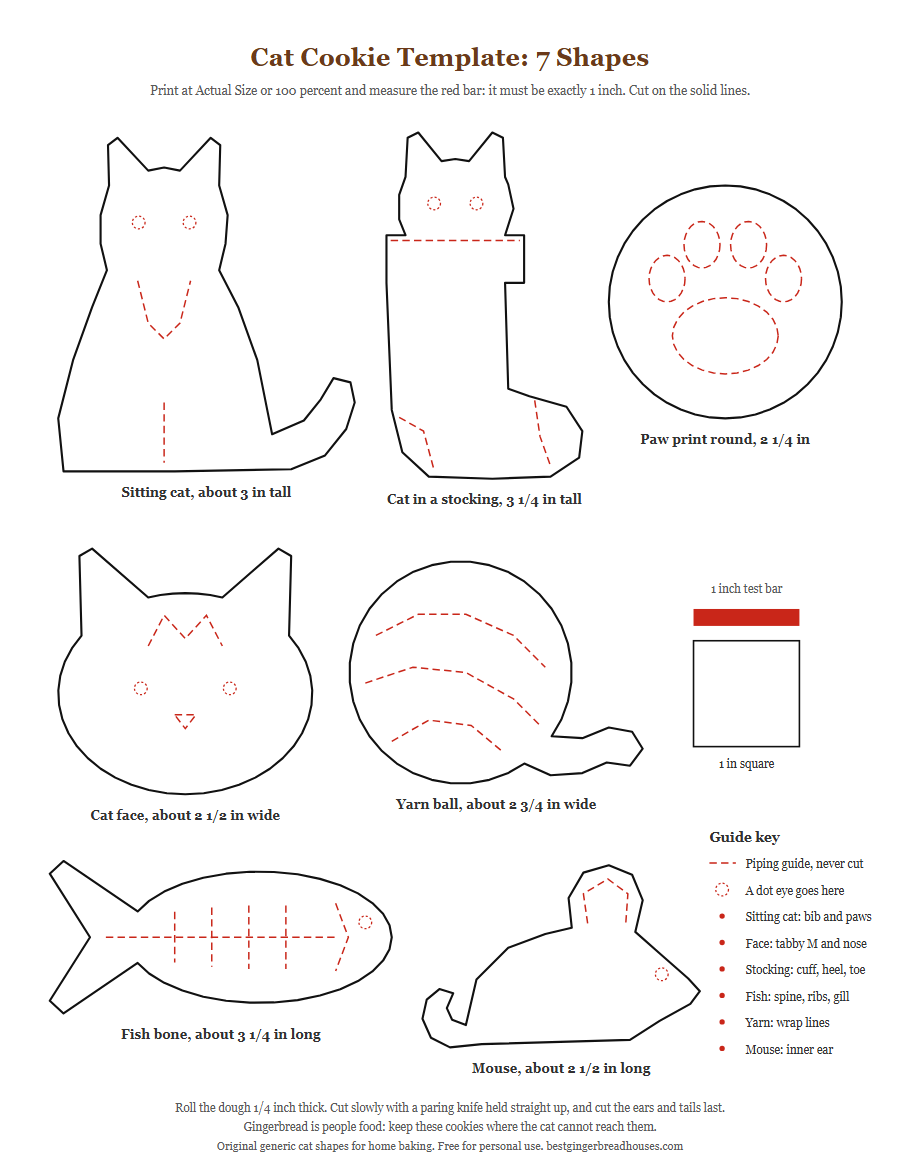
The free template prints on one US Letter page at 100 percent. Measure the red bar first: if it is not exactly 1 inch, your printer scaled the page.
The red dashed lines are piping guides, not cut lines. They mark the bib and paws, the tabby M and nose, the stocking cuff, the toe beans, the fish bones, the yarn wraps and the mouse ear. Small dotted circles mark the dot eyes.
A script checked every part that could snap: each ear is at least 0.23 inches across halfway up, the sitting cat’s tail is 0.3 inches thick at its tip, the mouse tail stays at least 0.25 inches thick through its curl, and the yarn strand is 0.33 inches thick. If you own a cat cutter, use it, but pick one with broad ears.
Coat Palettes for Tabby, Tuxedo, Calico and Ginger Cats
These four coats work on any cat shape: the sitting cat, the face or the kitten in the stocking. Match a guest’s own cat, or mix all four on one plate.
| Coat | What it looks like | Colors | Tip |
|---|---|---|---|
| Tabby | Striped coat, with an M on the forehead | silver gray for the base; charcoal for the stripes and M | Pipe the stripes after the base cures, so they stay sharp. |
| Tuxedo | Black with a white chest and white paws | black for the base; white for the bib and paws; golden yellow for the dot eyes | Flood the white first, then the black, so the black never shadows the white. |
| Calico | White with patches of orange and black | white for the base; marmalade orange for the patch; black for the patch | Drop the patches into the wet white so they dry flat. |
| Ginger | Orange with darker orange stripes | marmalade orange for the base; rust orange for the stripes | A touch of brown gel deepens orange into rust for the stripes. |
The tuxedo is easier than it looks. On a brown cookie, black is the easy color and white is the hard one, so flood the white bib first and thick enough that no brown shows through, then the black round it.
Icing Palette for All 9 Designs
Each row lists the colors one design needs and what each covers, so you mix only the bowls you need. The colors are original choices based on real coats, and gel brands vary, so test a spoonful on a scrap cookie first.
| Design | Shape | Colors and what they cover | Difficulty |
|---|---|---|---|
| The Ginger Tabby Sitting Cat | Sitting cat template | marmalade orange for the body; rust orange for the stripes; black for the dot eyes | Easy |
| The Tuxedo Sitting Cat | Sitting cat template | black for the body; white for the bib and front paws; golden yellow for the dot eyes | Medium |
| The Gray Tabby Cat Face | Cat face template | silver gray for the face; charcoal for the M and cheek stripes; rose pink for the nose; black for the dot eyes | Medium |
| The Calico Cat Face | Cat face template | white for the base flood; marmalade orange for the patch over one ear; black for the patch over the other ear and dot eyes; rose pink for the nose | Hard |
| The Ginger Kitten in a Stocking | Cat in a stocking template | stocking red for the stocking; white for the cuff, heel and toe; marmalade orange for the kitten head; black for the dot eyes | Medium |
| The Pink Toe Bean Paw Print | Paw print round template | soft gray for the round; rose pink for the toe beans and pad | Easy |
| The Fish Bone Treat | Fish bone template | ocean blue for the fish; white for the spine, ribs and gill; black for the dot eye | Easy |
| The Pink Yarn Ball | Yarn ball template | raspberry pink for the ball and loose strand; light pink for the wrap lines | Medium |
| The Little Gray Mouse | Mouse template | silver gray for the body and tail; rose pink for the inner ear and nose; black for the dot eye | Easy |
Black, white, marmalade orange, rose pink and silver gray each serve several designs, so a four-design plate usually needs 7 to 9 bowls. The picker shows each design’s swatches and steps, or matches the cat at home.
Which Cat Cookie Should You Make?
Pick a design to see its icing colors, its three steps and how hard it is. Or match the cat at home, ask the birthday child, filter by skill, or let the button choose.
For ideas only: these palettes are original color choices and gel brands vary in shade, so tint a little and test on a scrap cookie. Nothing you pick leaves your browser.
Difficulty follows one rule. Easy means a flood and one detail, plus the dot eyes. Medium means two details or a two-stage flood where one color has to crust before the next goes on. Hard means patches dropped into wet icing in three colors on one cookie.
Ingredient Notes
The dough is a cut-out dough on purpose. It holds a sharp edge and bakes flat. A soft cookie dough puffs, and pointed ears melt into round bumps.
Meringue powder, not raw egg whites. Royal icing is never cooked and party cookies sit out for hours, so use meringue powder, dried egg white sold as a pasteurized product. For the 10 second test and the full cure table, see how runny flood icing should be.
Make the black first. Tint it dark charcoal, cover it and let it deepen for a few hours. A tuxedo cat needs a good bowl of it; a set without one needs only a tablespoon for eyes.
Rust orange is marmalade orange plus brown. Pull a spoonful of the orange out before you add the brown gel, and one bowl becomes the base and stripe colors for the ginger cat.
How to Make Cat Gingerbread Cookies Step by Step
1.Make the dough
Whisk the flour, soda, salt and spices, cream the butter and brown sugar until lighter in color, then beat in the molasses, egg and vanilla. Mix in the dry ingredients on low and stop the moment no dry flour remains, so the dough stays tender.
2.Chill the dough
Chill the dough as two flat wrapped discs about an inch thick for 2 hours. It is ready when a pressed thumb leaves a clean dent rather than a smear.
3.Roll the dough
Roll each disc to 1/4 inch between two sheets of parchment. Keep it even: a thin spot under an ear or a tail is where the cookie breaks.
4.Cut the cats
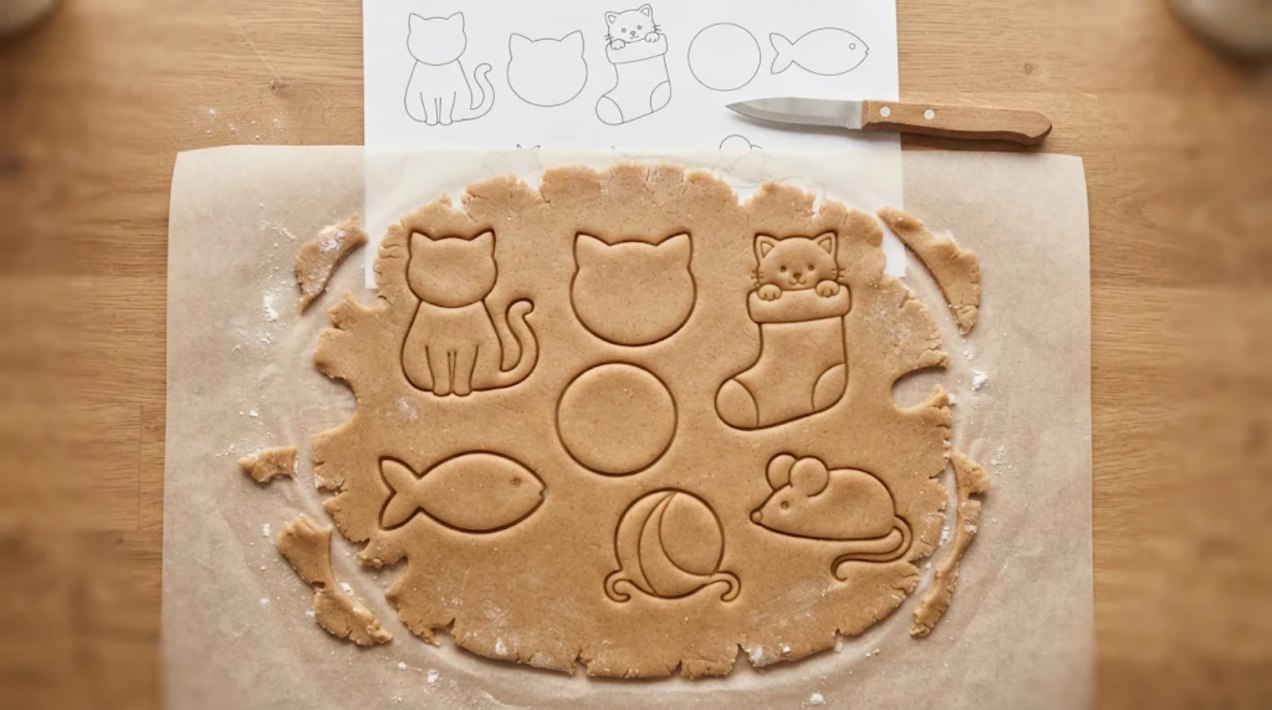
Lay the paper shapes on the dough and cut round them with a paring knife held straight up, with the ears, tails and the yarn strand last. Peel the scraps away rather than lifting the cookies.
5.Freeze the shapes
Slide the parchment onto a pan and freeze the cut shapes for 30 minutes. They are ready when the ears and tails feel hard, which keeps the ear tips pointed in the oven.
6.Bake at 350F
Bake for 9 to 11 minutes straight from the freezer. The paw rounds and faces have no thin parts, so they often need the full time while the mouse is ready a little sooner; judge by the surface rather than the clock: matte all over, with edges that are set. Let everything cool completely on the pan, because a warm ear bends.
7.Mix and color the icing
Beat the icing to stiff peaks, keep a little white and a little black, and tint the rest from the palette charts. Thin a spoonful of each base color to flood consistency and keep the rest stiff for details.
8.Flood and pipe the details
Outline and flood the base colors, then leave the cookies flat overnight until the flood does not dent under a fingertip. Pipe the stripes, toe beans, fish bones, wrap lines and eyes the next day, and give the details about 2 hours before anything touches them.
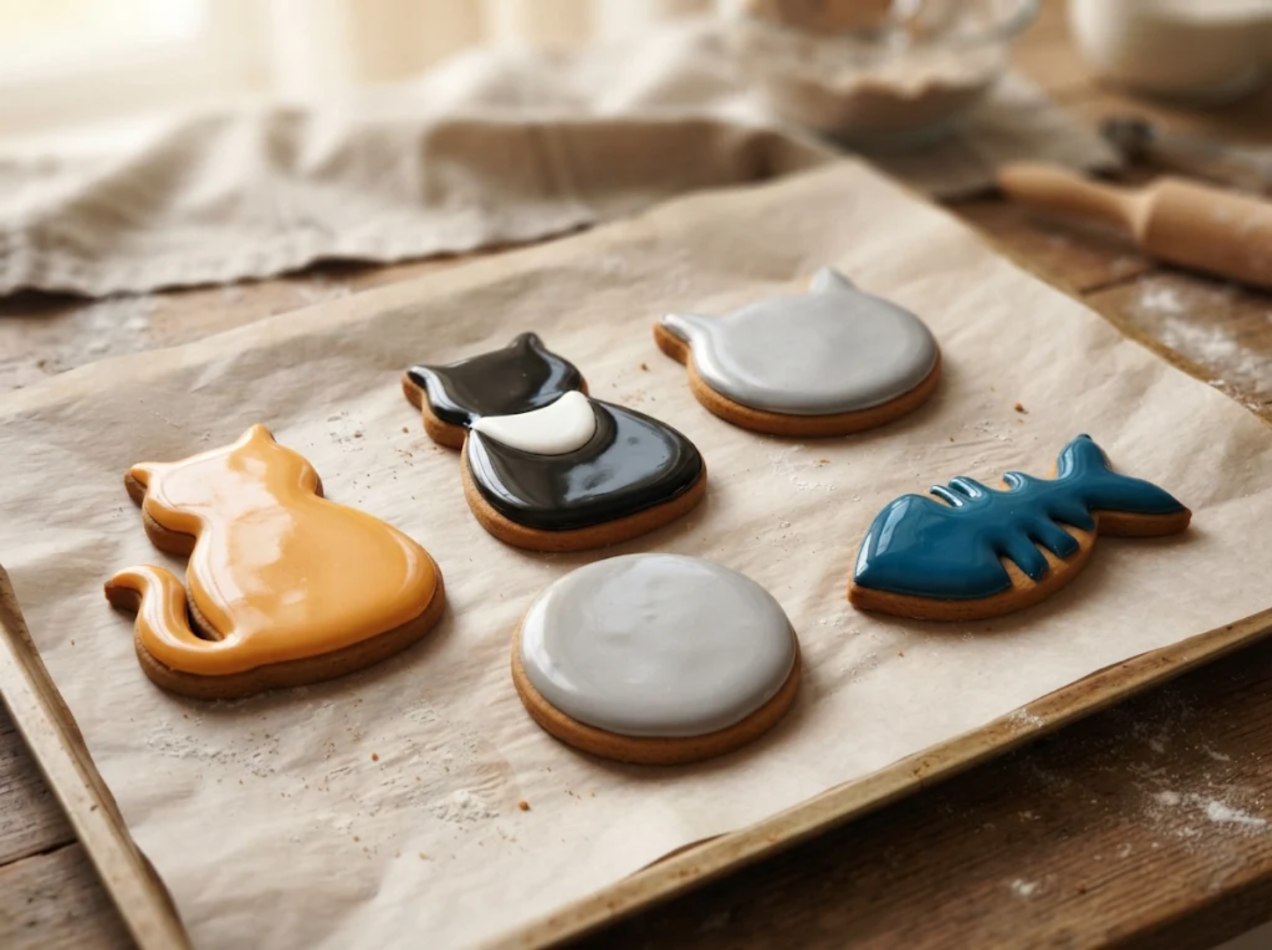
Say you are decorating with a six-year-old who has a gray cat at home. Flood two faces silver gray the night before, then hand over bags of charcoal, pink and black. The M and the cheek stripes are short lines a small child can manage, and they will want to do the eyes.
9 Cat Cookie Designs
Each design lists its colors, difficulty and three short steps. Every cat gets simple dot eyes, and the faces add a small pink nose. No mouths and no whiskers.
1.The Ginger Tabby Sitting Cat
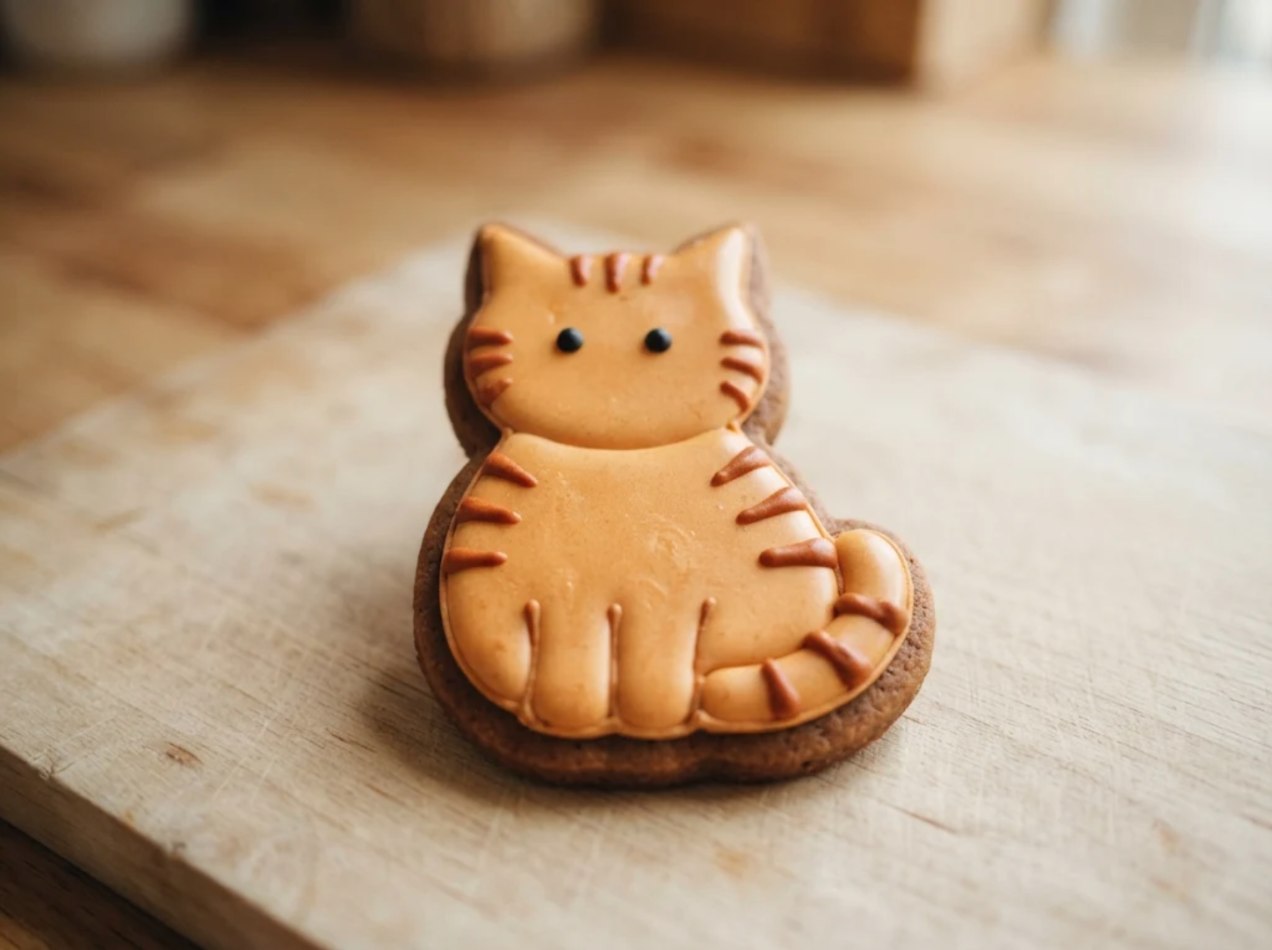
Colors: marmalade orange, rust orange, black. Difficulty: Easy.
The best first cookie: one flood color, and stripes that can go anywhere.
- Flood the whole cat marmalade orange and leave it flat overnight.
- Pipe short rust orange stripes across the sides and around the tail, leaving the face plain.
- Pipe two black dot eyes on the dotted circles.
2.The Tuxedo Sitting Cat
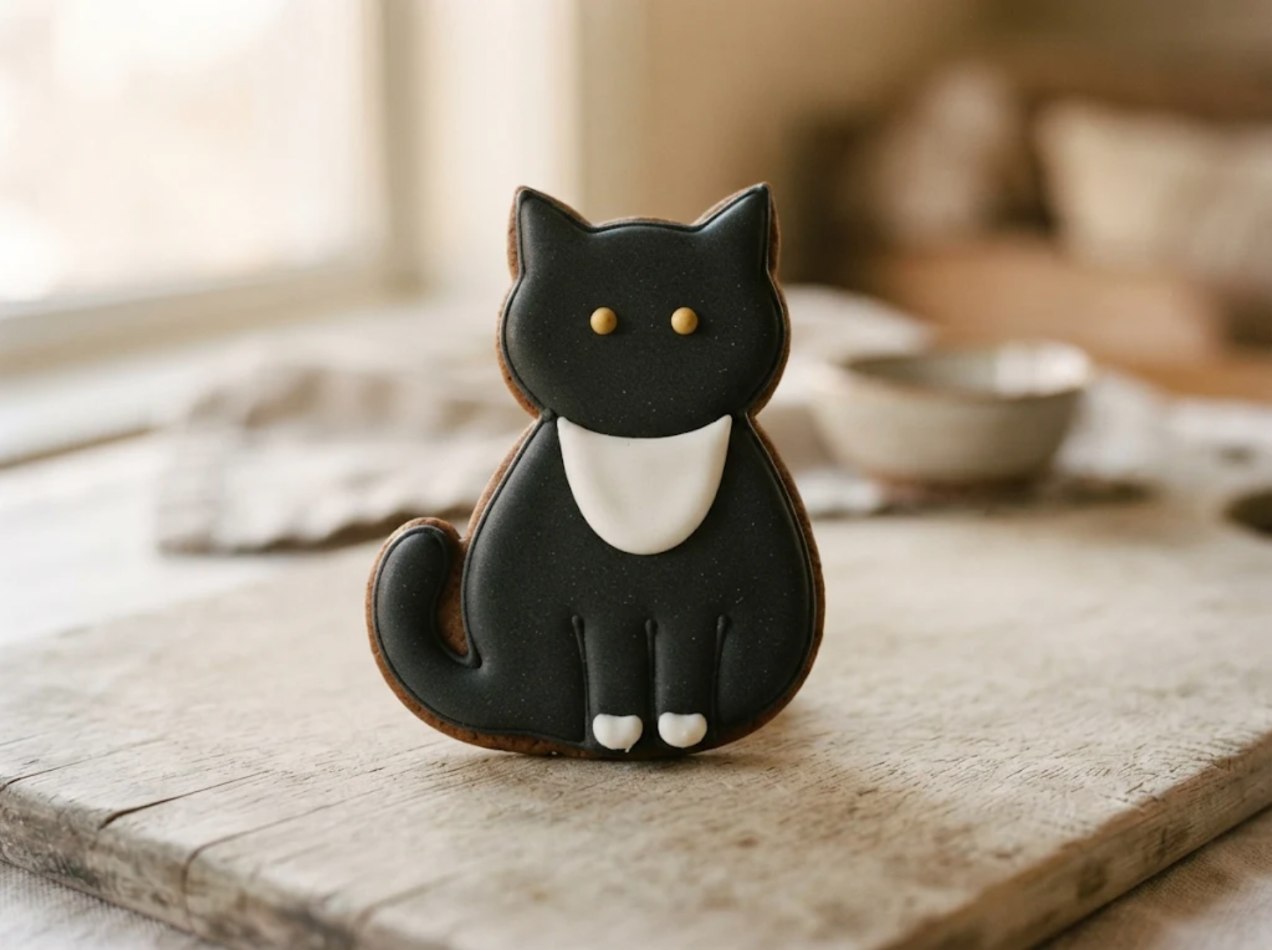
Colors: black, white, golden yellow. Difficulty: Medium.
Black and white with yellow eyes. The white goes on first so it stays bright, and the yellow eyes show up on the black where black eyes would vanish.
- Flood the bib and the bottom of the paw line white and let them crust for an hour.
- Flood the rest of the cat black, right up to the white, and leave it flat overnight.
- Pipe two golden yellow dot eyes on the dotted circles and a thin black line up the paw guide.
3.The Gray Tabby Cat Face

Colors: silver gray, charcoal, rose pink, black. Difficulty: Medium.
The M does the work. Pipe it along the guide and the face reads as a tabby straight away.
- Flood the whole face silver gray and leave it flat overnight.
- Pipe the charcoal M along the dashed forehead guide, then two short stripes on each cheek.
- Fill the small nose triangle rose pink and pipe two black dot eyes.
4.The Calico Cat Face

Colors: white, marmalade orange, black, rose pink. Difficulty: Hard.
The hardest cookie in the set, because the patches have to go into the white while it is still wet so they dry flat. Work on one cookie at a time.
- Flood the whole face white and, while it is still wet, drop a marmalade orange patch over one ear and a black patch over the other, keeping both above the eye line.
- Leave the cookie flat overnight without touching it.
- Fill the nose triangle rose pink and pipe two black dot eyes on the white.
5.The Ginger Kitten in a Stocking
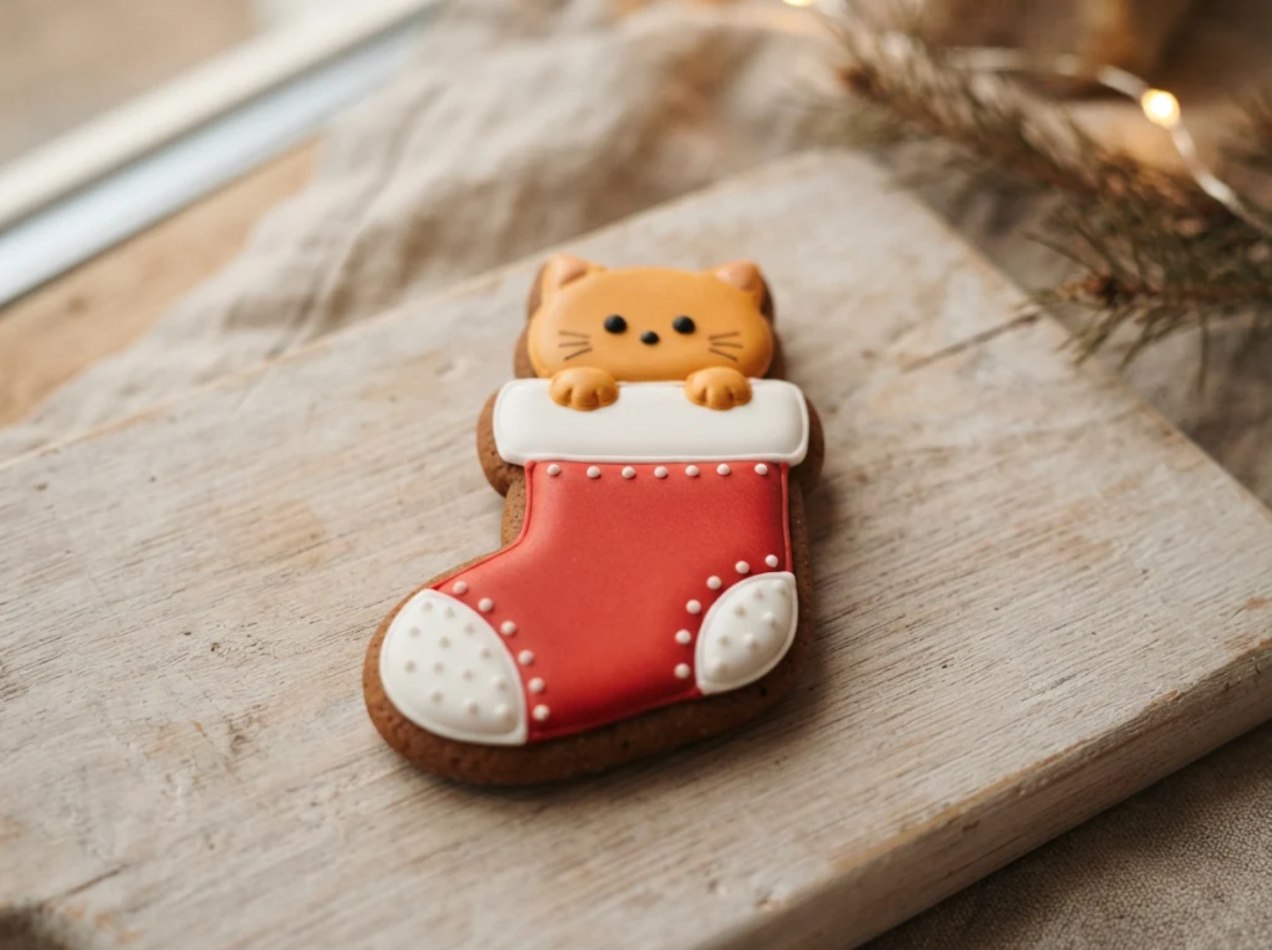
Colors: stocking red, white, marmalade orange, black. Difficulty: Medium.
The Christmas cookie of the set. Swap the orange head for any coat above.
- Flood the kitten head marmalade orange and the stocking red, leaving the cuff, heel and toe bare, and let them crust for an hour.
- Flood the cuff, heel and toe white and leave the cookie flat overnight.
- Pipe two black dot eyes on the kitten and a few white dots on the red if you like.
6.The Pink Toe Bean Paw Print
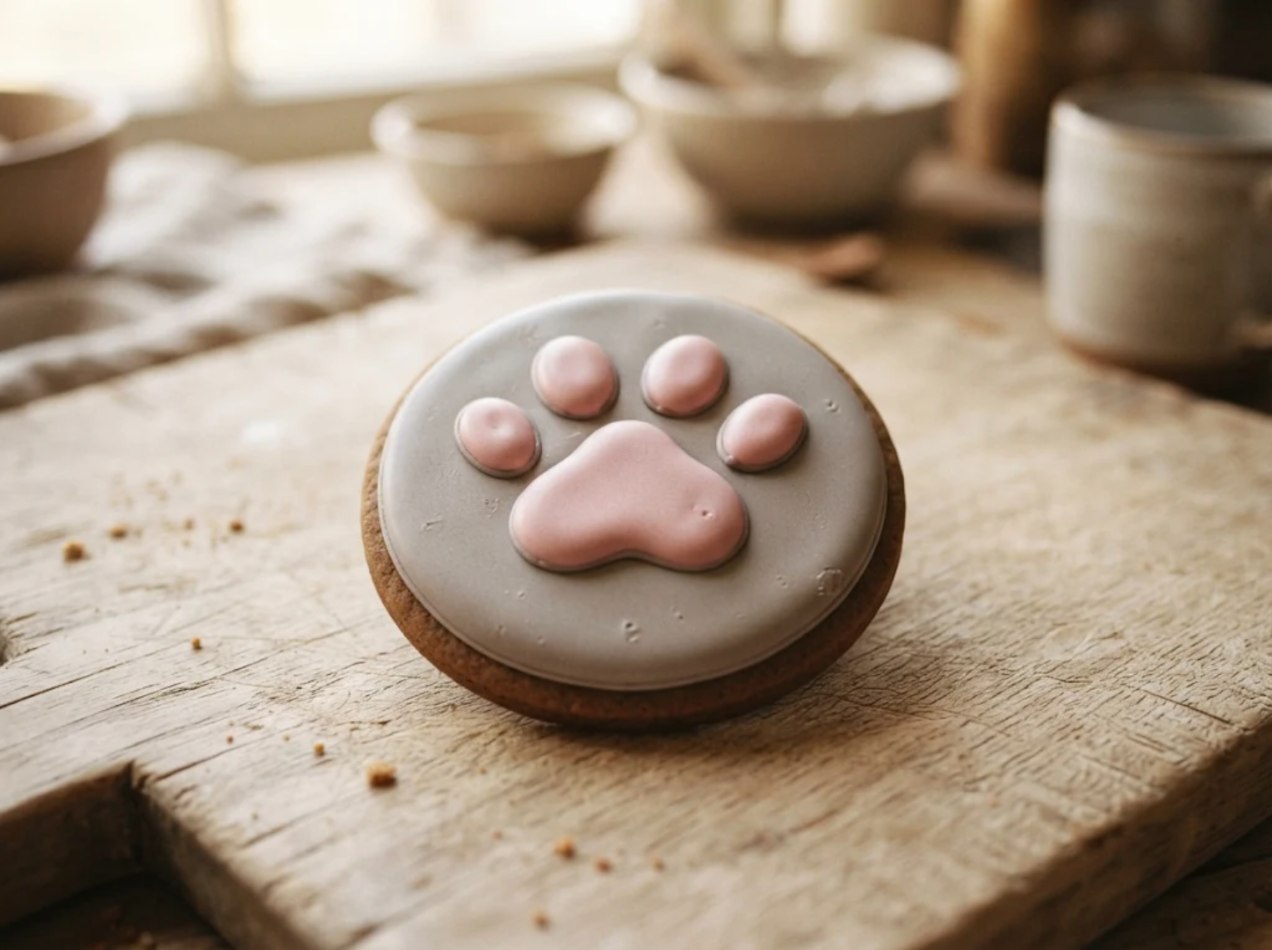
Colors: soft gray, rose pink. Difficulty: Easy.
The easiest round to hand a child: pink beans on gray, with gaps between them.
- Flood the round soft gray and leave it flat overnight.
- Outline and fill the big pad rose pink on its dashed guide.
- Fill the four small toe beans rose pink, keeping a gap of gray between each one.
7.The Fish Bone Treat
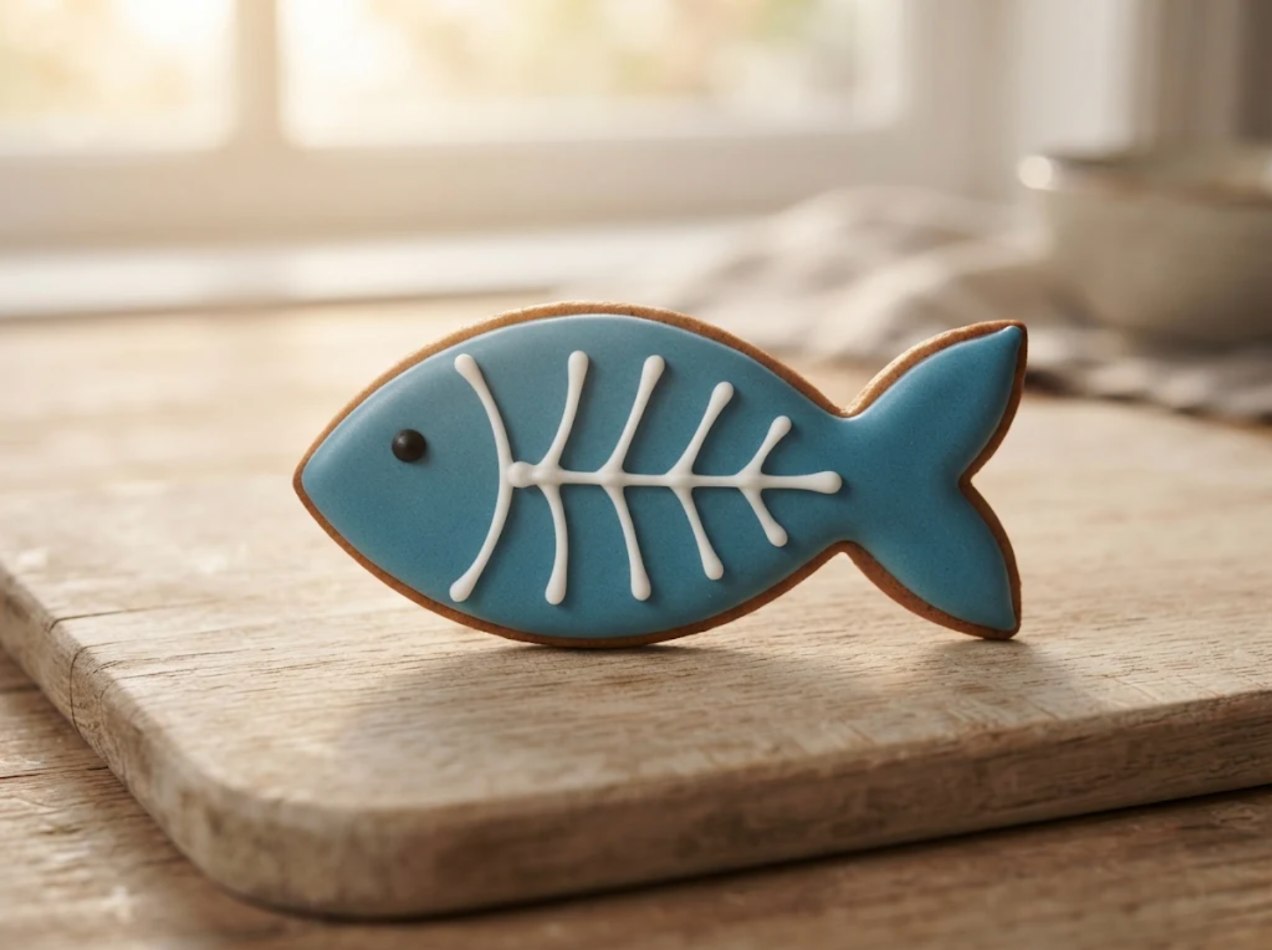
Colors: ocean blue, white, black. Difficulty: Easy.
A whole fish to cut, with the bones piped on in white. It holds up far better in a bag than a cut-out skeleton would.
- Flood the whole fish ocean blue and leave it flat overnight.
- Pipe the white spine along the dashed line, then the four ribs and the curved gill.
- Pipe one black dot eye on the dotted circle.
8.The Pink Yarn Ball
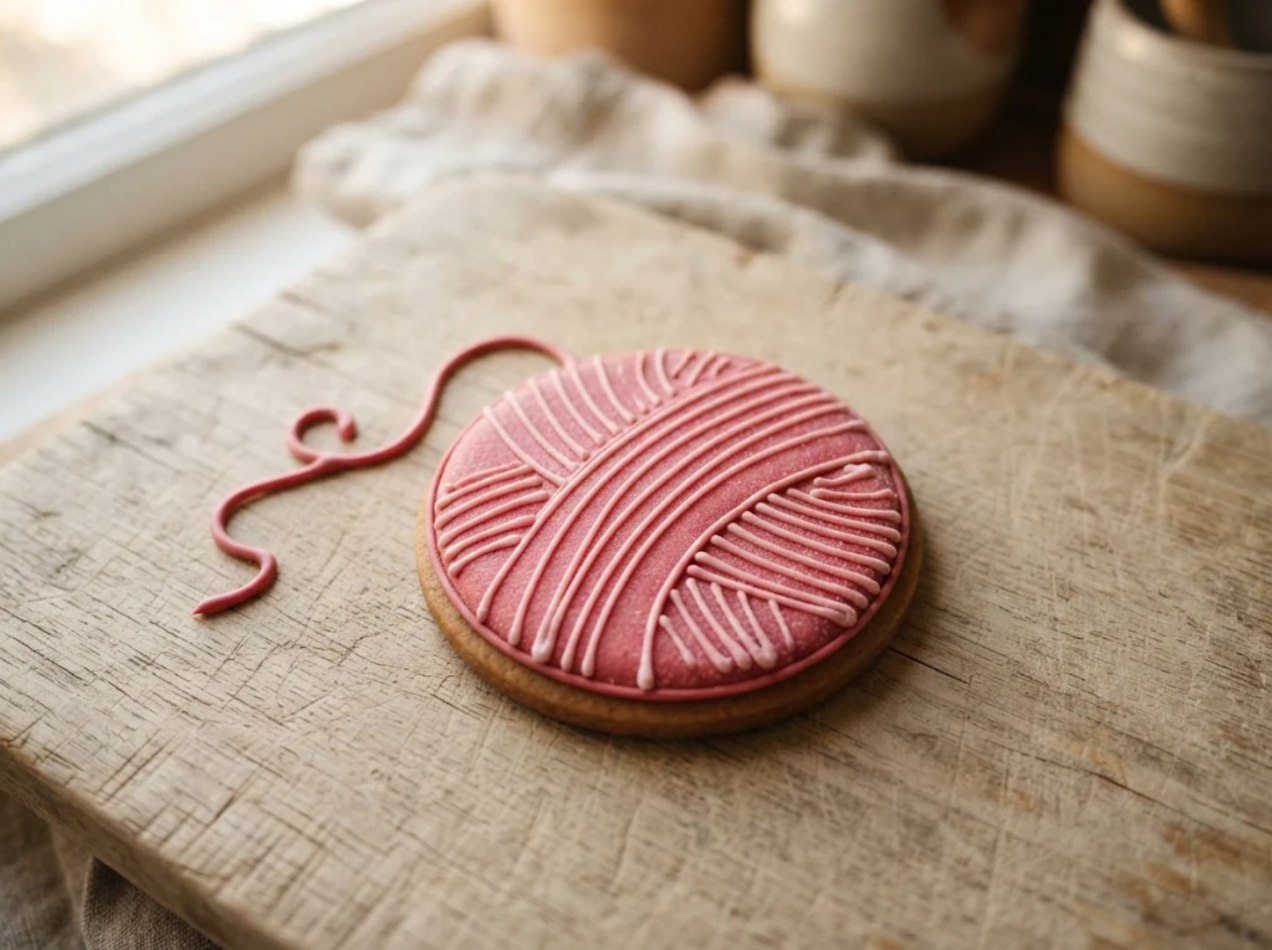
Colors: raspberry pink, light pink. Difficulty: Medium.
Run every wrap line the same way and it reads as wound yarn; criss-cross them and it turns into a beach ball.
- Flood the ball and the loose strand raspberry pink and leave them flat overnight.
- Pipe light pink lines along the three dashed curves.
- Add two or three more curves between them, all running the same way, so it reads as wound yarn.
9.The Little Gray Mouse
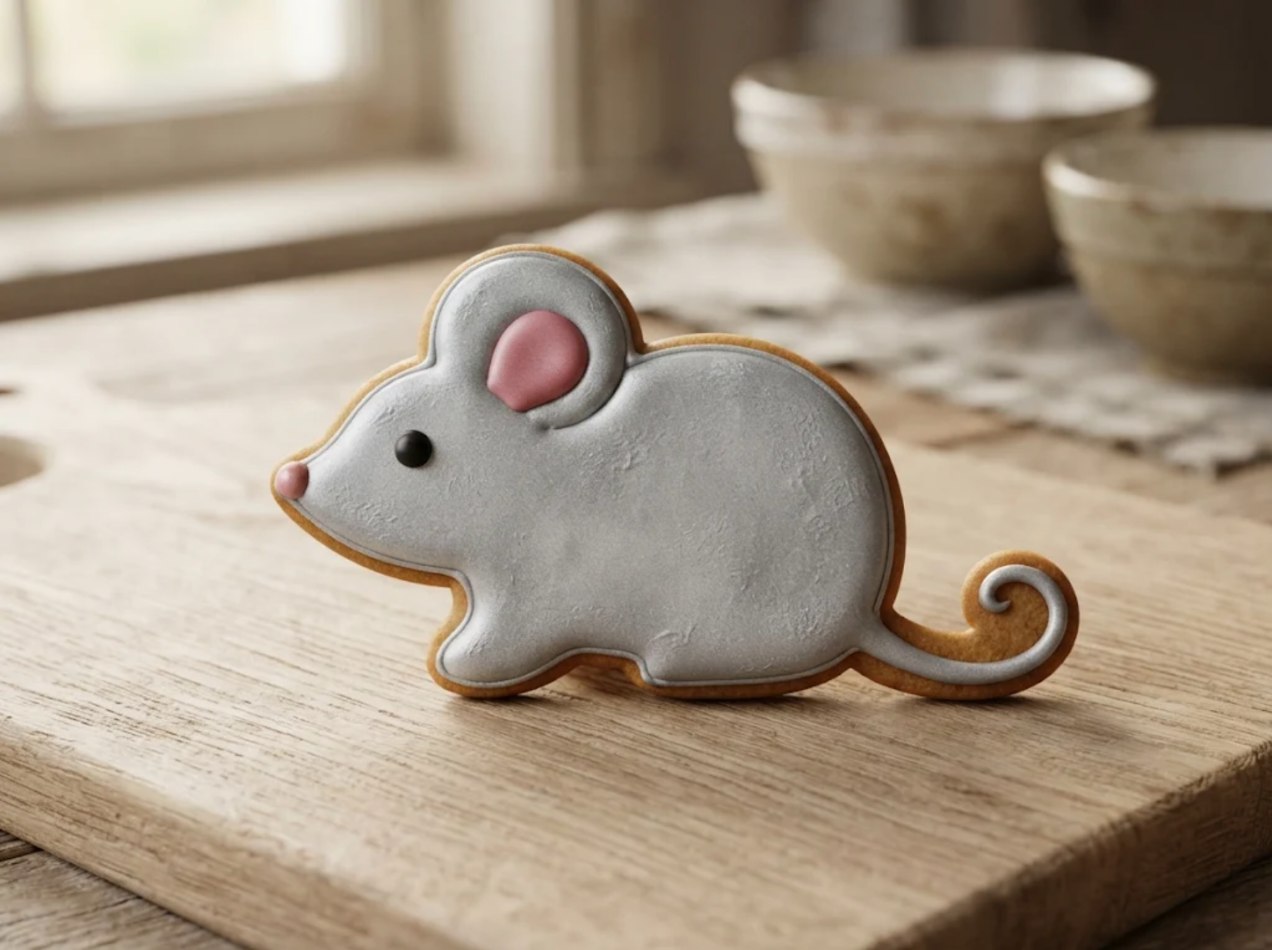
Colors: silver gray, rose pink, black. Difficulty: Easy.
The quickest cookie on the template, and a fun one to tuck beside a sitting cat on the plate.
- Flood the whole mouse silver gray and leave it flat overnight.
- Fill the inner ear rose pink on its dashed guide and pipe a pink dot on the tip of the nose.
- Pipe one black dot eye on the dotted circle.
Cat Gingerbread Cookies for a Kitty Birthday Party
A kitty party suits cookies because each guest takes one home. Plan by how they will be used.
- If they are favors, bake one per guest plus a few spare, lean on the Easy designs, and bag them once the icing has cured.
- If they are a decorating table, flood sitting cats and faces the night before in plain coat colors and let the guests add stripes, toe beans and eyes.
- If they are a holiday tray, make kittens in stockings and paw prints and set them beside plain gingerbread people cut from a printable gingerbread man template.
The planner below does the math for cookies, shapes, batches, colors and days.
Kitty Party Cookie Planner
Enter the guests, the cookies each and the party date, then tick the designs. It works out the batches, how many of each shape to cut, the icing colors and which day each job falls on.
For planning only: the cookies per batch figure is an estimate and dough rolls out differently in every kitchen, so bake one test tray before you shop for a big party. Nothing you enter leaves your browser.
Picture a party for 10 seven-year-olds on a Saturday, with the ginger cat, the tuxedo, the paw print and the fish bone ticked. The planner calls for 11 cookies, one batch of dough and one double batch of icing in 8 colors, with 3 each of the first three and 2 fish. Bake and flood on Wednesday, pipe on Thursday, and Friday stays free in case an ear snaps.
Keep the Cookies Away from the Cat
A cat party often happens in a house with a real cat. Gingerbread is people food. A veterinarian-reviewed guide says cats should not eat gingerbread: the ginger is fine, but nutmeg and cloves are not safe for cats and the sugar does them no good. Keep favor bags off counters a cat can jump onto, and if one gets into a cookie, call your vet. The same thinking applies to dogs, covered in what to do when a dog eats gingerbread.
Troubleshooting
| Symptom | Cause | Fix |
|---|---|---|
| Ears snap off | Dough rolled thin under the ears, or the cookie lifted by the head | Roll an even 1/4 inch, freeze before baking, and lift every cat by the body |
| Ears bake into round bumps | Warm dough went into the oven | Freeze the cut shapes 30 minutes and bake straight from the freezer |
| Brown shows through the white bib | The white flood was too thin | Flood white a little thicker, or give it a second coat once the first has crusted |
| Black bleeds into the white | The black went on before the white crusted | Give the white an hour to crust, or flood the black the next day |
| Calico patches sit in lumps | The white had started to set before the patches went in | Flood and patch one cookie at a time, and tap the cookie gently so the patches level |
| Cookies go soft in the favor bags | Bagged before the icing cured | Wait the full overnight cure and seal the bags only when the flood no longer dents |
Make-Ahead and Timeline
Plan on three days: bake and flood on day one, pipe details on day two, bag on day three. For a big party, bake ahead, freeze the plain cookies flat in an airtight container and thaw them in the container so condensation forms on the outside. For how long decorated cookies stay good to eat, see how long iced gingerbread cookies keep.
Storage Instructions
Once the icing has cured, store the cookies in layers with parchment between them, in an airtight tin at room temperature and out of sunlight, which fades colors. Slide each cat into a cello bag head first so the ears do not catch. The royal icing drying times are the schedule to hold to before anything goes in a bag.
Frequently Asked Questions
Why do the cats have no mouths or whiskers?
Fine lines smudge in a bag and add little. Two dot eyes, the ears and the coat are enough to read as a cat.
Can my cat eat these cookies?
No. Gingerbread contains nutmeg and cloves, which are not safe for cats. Keep the cookies for the people at the party.
How far ahead can I make cat party cookies?
Baked, undecorated shapes freeze for up to about 3 months. Decorated cookies keep about two weeks in an airtight tin once the icing has cured, so decorating three days before the party leaves plenty of margin.
More Gingerbread Cookie Recipes
- a cookie set for older kids with the same batch planner, for another birthday
- soft pumpkin gingerbread cookies for the grown-ups' plate
- printable gingerbread house templates, when the party wants a build too
Pair the Cookies with a Best Gingerbread Houses Kit Pick
When the party wants something to build too, skip baking walls and start from a gingerbread house kit for the party table and let the kids sit a cookie cat on the roof.