
A two story gingerbread house is not a tall box. The walls are nearly twice as high as a one-story house’s, and tall walls bow, lean and crack in ways short ones never do. That is why this house has one extra piece that most templates leave out.
The template is free, true to size and checked by a script. The dough, icing and set times come from our own recipe pages, and the tall-wall tips follow a home baker’s two story build and our own mansion and big house pages. It is written for bakers who have made one house and want a taller one.
Start with the template, then pick the build that fits your week.
Two Story Gingerbread House: At a Glance
- Difficulty: Intermediate. There are 7 pieces and nothing is cut out, but the walls are tall.
- Total time: about 2 days, in six sessions. Most of it is icing setting.
- Active time: about 6 hours, counting the dough chill and the bake.
- Makes: one house 4 3/8 inches wide and 4 inches deep, about 6 5/8 inches tall to the ridge, on a 10 by 9 inch board.
- Template: free 5-page PDF, US Letter, true size with a 1 inch test bar on every page.
Tools: printer, ruler, scissors, a small sharp knife, rolling pin, parchment, 2 half sheet pans, piping bags with a small round tip, an offset spatula, cans for propping, a 10 by 9 inch cake board or tray.
Materials
- 1 batch of gingerbread dough that holds a wall, of which this house uses a little over half
- 3 batches of royal icing for the walls and the roof snow
- 1/2 cup of stiff sage green royal icing for the shutters
- 2 tablespoons of red royal icing for the door
- 3 sugar cones and green icing for the pine trees
- 1/2 cup of shredded coconut or sanding sugar for snow
Steps
- Print the template at Actual Size and measure the test bar.
- Make the dough and chill it for at least an hour.
- Roll the dough 1/4 inch thick and cut the two gables, the two side walls and the floor plate.
- Cut the two roof panels.
- Bake at 300 degrees F and trim every piece while it is warm.
- Pipe the door, the windows, the shutters and the white floor band while the pieces lie flat. Wait 2 hours.
- Stand the back gable and the two side walls on the board, then wait 2 hours.
- Pipe an icing bead inside at the floor line, slide the floor plate in and close the box with the front gable. Wait until the next day.
- Set the roof panels, then wait 4 hours.
- Load the roof with snow and pipe the icicles.
- Plant the pines, snow the board and let it stand overnight.
Notes: times come from the set times on our icing page, not a timed build, and nobody has baked this house yet. Ovens vary, so check the first pan early.
Free Printable Two Story Gingerbread House Template
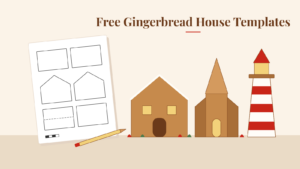
The template is five US Letter pages with every piece at true size. Download the PDF, print it at Actual Size, and check that the red bar measures 1 inch before you cut anything.
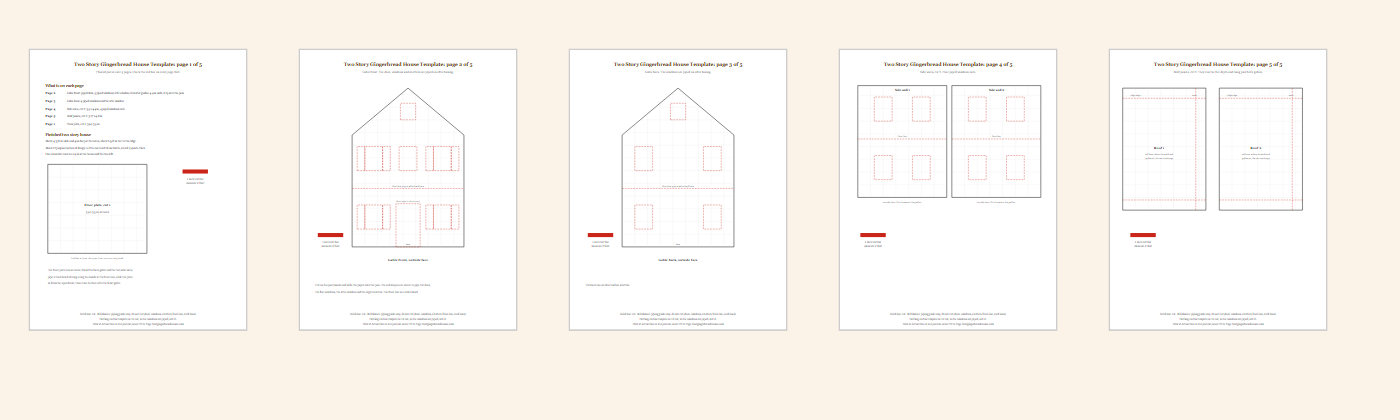
| Piece | Cut | Size |
|---|---|---|
| Front gable | 1 | 4.4 in wide, 6.25 in to the peak, door, 5 windows, attic window and 8 shutters marked to pipe |
| Back gable | 1 | 4.4 in wide, 6.25 in to the peak, 4 windows and the attic window marked to pipe |
| Side walls | 2 | 3.5 x 4.4 in, 4 windows marked to pipe on each |
| Roof panels | 2 | 3.27 x 4.8 in, with 0.4 in eaves and 0.4 in hanging past each gable |
| Floor plate | 1 | 3.9 x 3.5 in, no holes |
One batch of house dough covers all 7 pieces, about 123 square inches, with the rest for spares and cookies.

Why a Two Story Gingerbread House Needs a Floor Plate
Our small gingerbread house has walls 2 1/2 inches tall. These walls are 4 3/8 inches tall, as high as the house is wide, and a dough wall that tall wants to bow outward at the middle.
The plate. A baked floor plate, 3 7/8 by 3 1/2 inches, slides in at the second-floor line, 2.3 inches up from the base. It sits on a bead of icing against all four walls and ties them together at about their halfway point, the way the brace wall does in our big gingerbread house that stays standing.
The dough. Our mansion page calls for a firm house dough for two story walls. Use the dough on our recipe page, roll it a full 1/4 inch and let the pieces cool flat.
This is our design reasoning from the checked geometry, not a load test. If your first wall bows anyway, the troubleshooting table below says what to do.
Two Story House Size Planner
Pick a size to see every piece, the paper, the dough and the board.
For planning only. Sizes come from the free template and scale evenly; keep the dough 1/4 inch thick at every size. Nothing you choose leaves your browser.
Which House Should You Build First?
Answer two questions and get the build that fits.
A suggestion, not a rule. Nothing you choose leaves your browser.
Two Story Gingerbread House Builds, by How Easy They Are
Here are the routes, easiest first.
Level 1, build one story. Our simple gingerbread house is six pieces with nothing cut out, and it teaches the dough, the piping and the roof.
Level 2, build it small. Our small gingerbread house is 10 pieces and 5 1/4 inches tall, and its template works the same way as this one.
Level 3, stack graham crackers. A home baker’s page for a two story graham cracker house says the project takes 3 to 4 days. Our graham cracker gingerbread house guide covers the one-story method it grows from.
Level 4, bake this house. Print the template and make it from dough. It is the only route that gives you your own colors and size.
Level 5, go bigger. Our gingerbread mansion and Victorian gingerbread house are the showpiece versions.
Two Story Looks
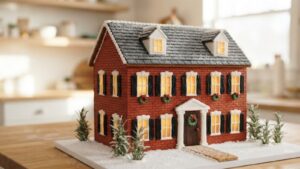
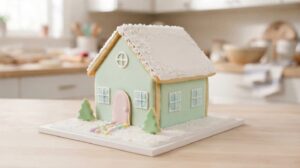
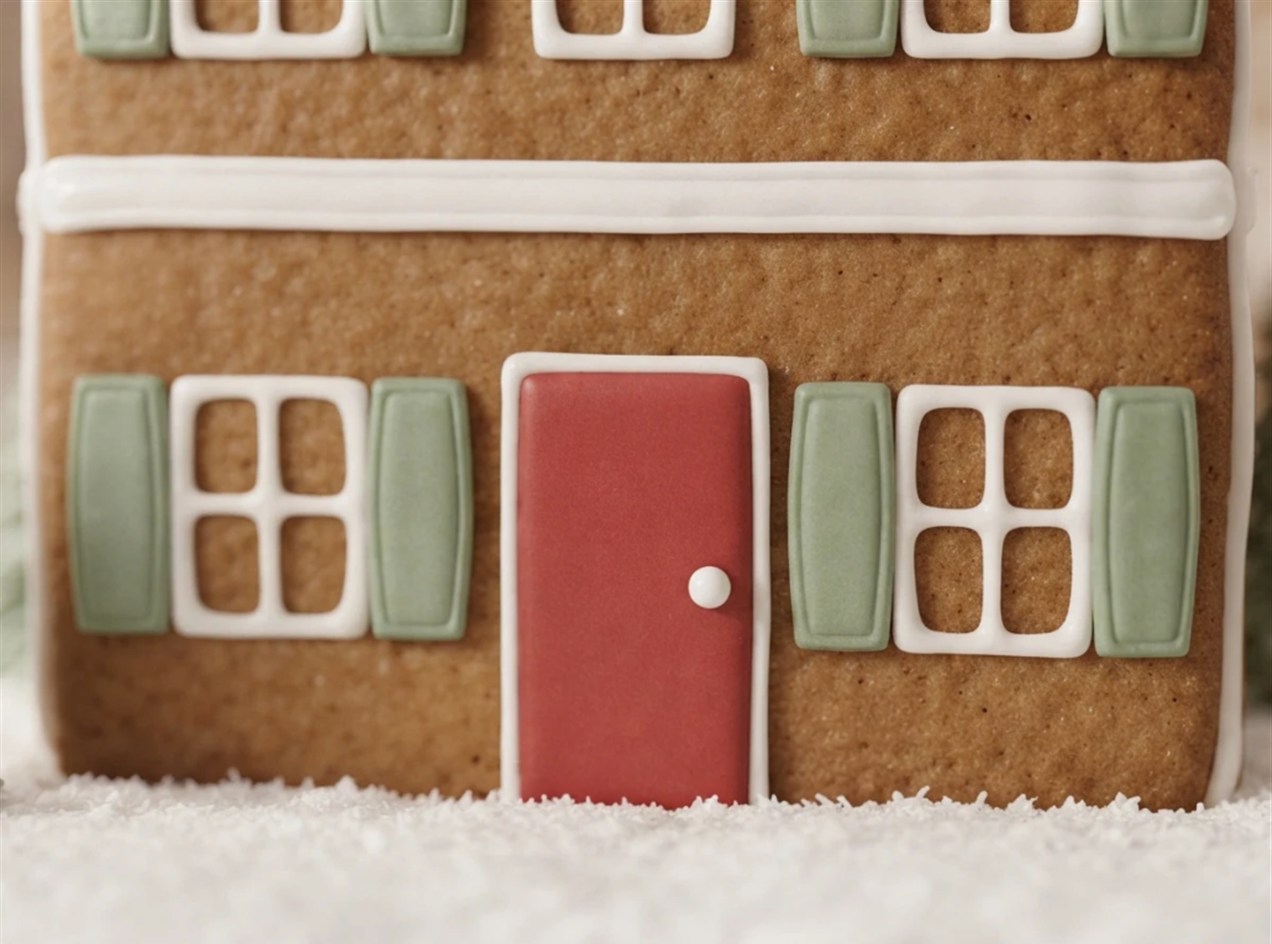
Classic snow house. Natural baked walls, a white floor band, sage green shutters, a red door and an even blanket of snow, as at the top.
Pastel row house. Flood the walls and shutters in soft pink, mint and cream, pipe the floor band in white, and skip the heavy snow.

Candy cane trim house. Pipe red and white stripes up each corner, press red and white mints under the eaves and leave the roof without snow.

Two Story Gingerbread House Builds for Hands-On Bakers and Showpiece Fans
Two kinds of baker ask about a two story house, and published builds answer each of them.
For a baker who found decorating a finished house awkward
The graham cracker baker above built her house first and decorated it after, laying it on its back for the front and flipping it for the back and sides. She says she wondered whether decorating the pieces flat first would be easier. This template is built that way: every window, shutter and band is piped while the wall lies flat, and the walls stand only when the piping has set.
Say a baker has one evening for the decorating. Flat pieces on the counter let them pipe two windows, wait, and pipe two more.
For a baker choosing between this house and the mansion
Our mansion page lists 33 baked pieces and about 7 1/2 to 8 hours of hands-on work, and the Victorian lists 15 pieces and about 8 hours. This house is 7 pieces and about 6 hours, with no wings, tower or portico.
Picture a family that wants a taller house this year and a bigger one next year. They bake this one now, and the mansion is the next template on the shelf.
How Long It Takes, Day by Day
Six sessions, about 6 hours of hands-on work.
| When | What you do | Hands-on | Then wait |
|---|---|---|---|
| Day 1, morning | Print, make and chill the dough, cut, bake and trim. | About 2 hours 45 minutes | About 30 minutes |
| Day 1, early afternoon | Pipe the door, windows, shutters and floor band. | 1 hour | 2 hours |
| Day 1, late afternoon | Stand the back gable and the side walls. | 20 minutes | 2 hours |
| Day 1, evening | Floor plate and front gable. | 25 minutes | Overnight |
| Day 2, morning | Set the roof panels. | 20 minutes | 4 hours |
| Day 2, afternoon | Snow, icicles, pines and board. | 55 minutes | Overnight before you move it |
How to Make a Two Story Gingerbread House Step by Step
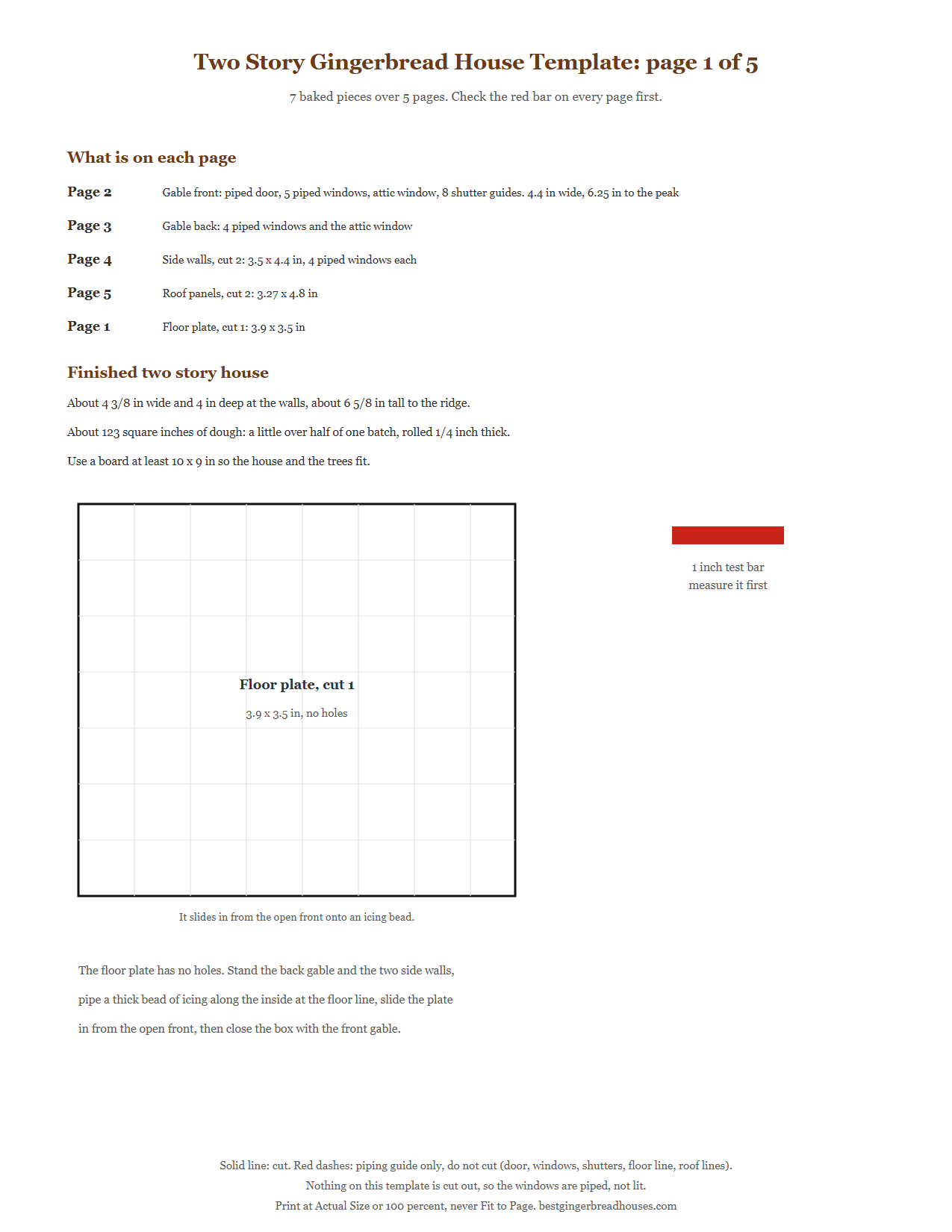
1.Print the template and measure the test bar
Print all five pages at Actual Size, never Fit to Page, and check that the red bar reads exactly 1 inch.
2.Make the dough and chill it
Make one batch of house dough, split it in two, flatten each half into a disc, wrap and chill for at least an hour so it holds sharp corners. This house uses a little over half of it, so bake a few cookies from the rest.
3.Roll and cut the gables, side walls and floor plate
Roll a disc on parchment to an even 1/4 inch. Cut the two gables from pages 2 and 3, the two side walls from page 4 and the floor plate from page 1, right on the parchment. Tall walls bow when they are thin, so keep the dough at a full 1/4 inch.
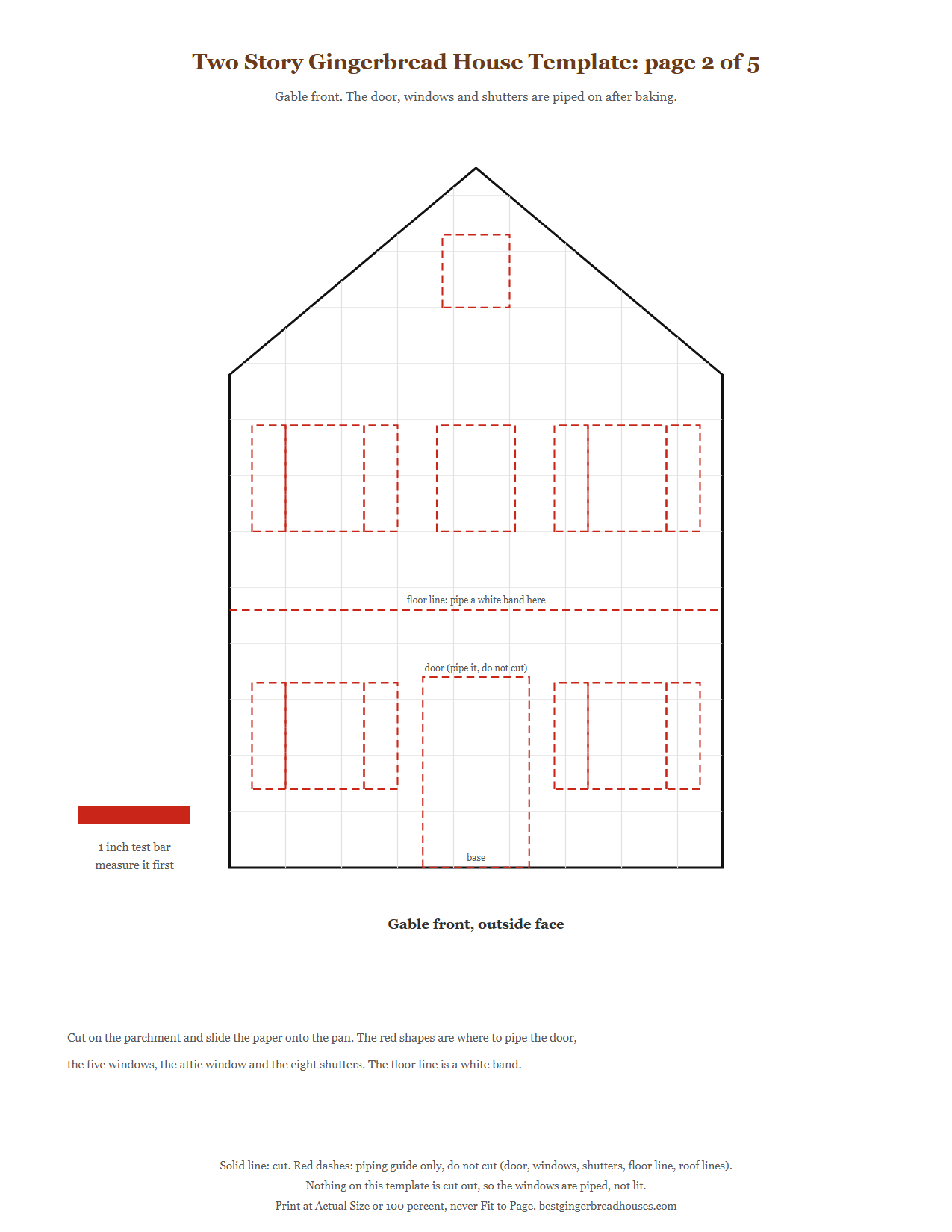
4.Cut the roof panels
From the second disc, cut the two roof panels from page 5. Cut one spare side wall from any scrap, since the tall pieces are the ones that break.
5.Check the pieces before baking
Nothing on this template is cut out. The door and the windows are piped on after baking, so every wall goes into the oven whole. A wall with no holes bakes flat and stays strong.
Why this matters: openings in a tall wall leave thin strips, and thin strips snap.

6.Bake and trim every piece while it is warm
Bake at 300 degrees F for 22 to 30 minutes depending on panel size, the range on our dough page, until the surface is matte and the edge is firm. The tall walls take the long end, so check the first pan early. Within two minutes of each pan coming out, lay the paper piece back on and trim any edge that spread, and trim the floor plate to its paper lines so it slides in. Then leave every piece flat on the rack until it is cold.
7.Pipe the door, windows, shutters and floor band while the pieces lie flat
With white royal icing, pipe a frame and four panes in every red window shape, a frame around the attic window and a band along the floor line. Pipe the door on the front gable in red. Flood the eight shutter shapes with sage green icing and pipe their slat lines. Wait 2 hours.
Why this matters: lines piped on a standing wall slide downhill, and the front is where everyone looks.

8.Stand the back gable and the side walls on the board
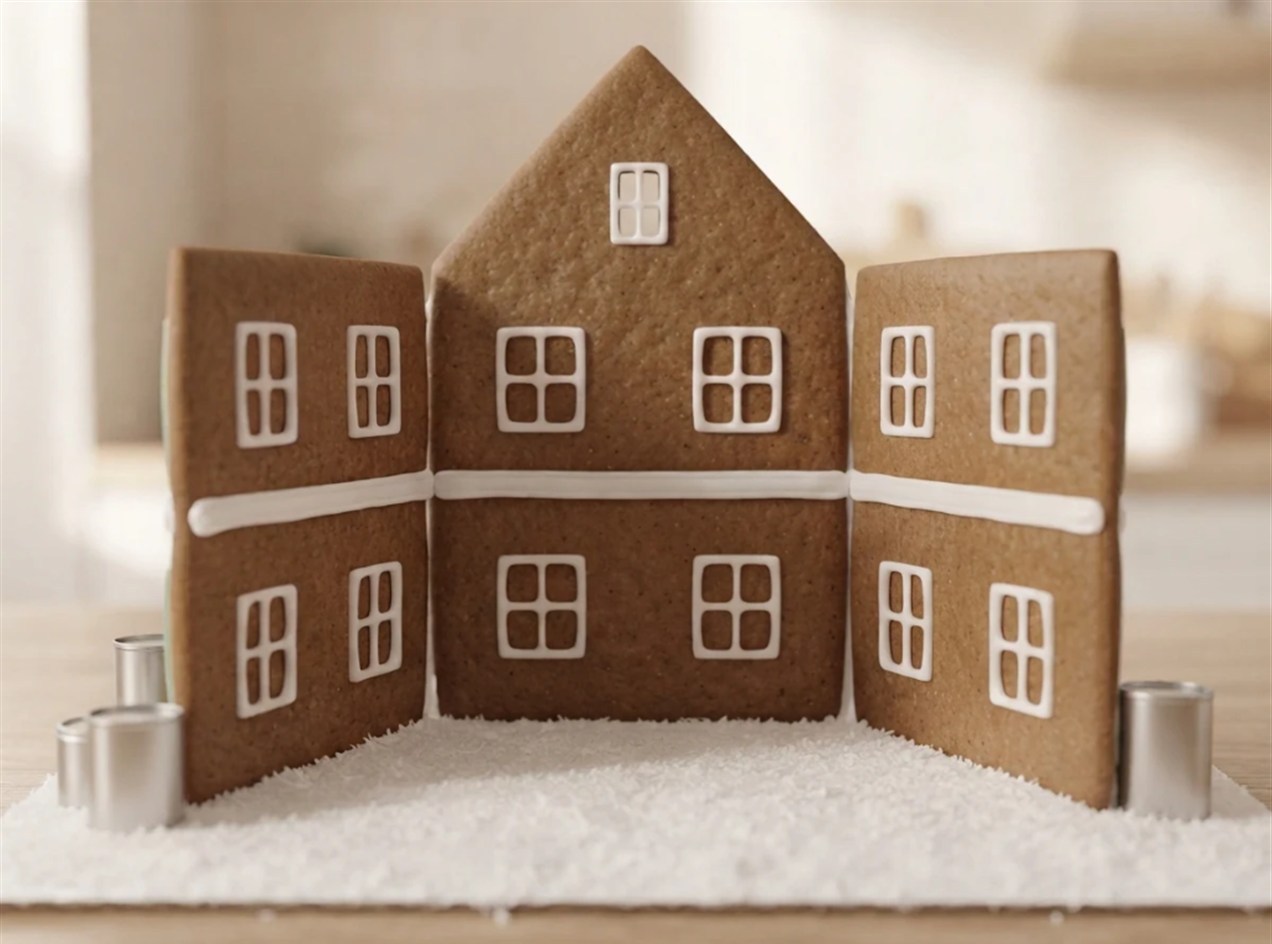
Pipe thick icing on the board, stand the back gable, then glue the two side walls to its edges. Prop each wall with cans, pipe the inside corners and wait 2 hours.
9.Slide in the floor plate and close the box with the front gable
Pipe a thick bead of icing along the inside of all three walls at the floor line, then slide the floor plate in from the open front and press it onto the bead. Pipe icing on the plate’s front edge, the wall edges and the board, set the front gable and prop it with cans. Wait until the next day.
Why this matters: the plate holds the tall walls square, so give it the night to set before the roof goes on.

10.Set the roof panels
Pipe icing on the wall tops and gable slopes, set the first panel with its ridge edge at the peak, hold it two full minutes and prop the eave. Set the second panel, pipe the ridge and wait 4 hours.
Why this matters: a roof slides before the icing grabs. Our tips for keeping a roof panel in place come down to the same hold and prop.
11.Load the roof with snow and pipe the icicles
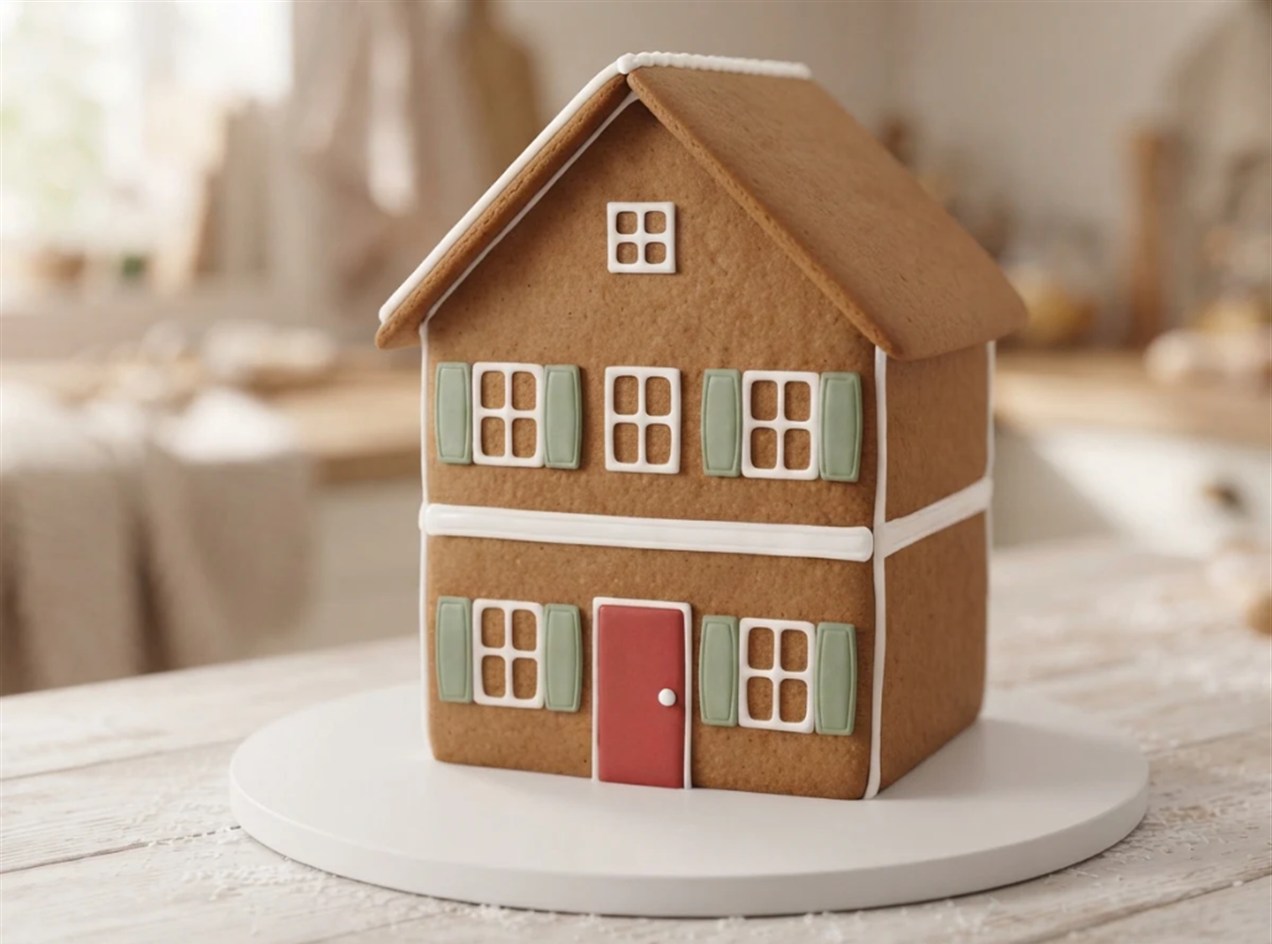
Spread a thin coat of stiff icing over both panels and let it crust for a few minutes. Pile snow thicker near the ridge and thinner toward the eaves, then pipe short icicles off the eave edges last. Our keeping snow on a roof rules apply at this height too.

12.Plant the pines, snow the board and let it stand overnight
Plant the trees as in the next section. Leave the house overnight before you move it, then lift it by the board, never by the walls.
Building the Pine Trees and Snowy Board
The trees. Stand three sugar cones upside down and pipe green icing up each cone in short pulled strokes, then dust them with powdered sugar snow.
The snow. Spread a thin coat of icing over the whole board and press coconut into it, leaving the front door clear.

Troubleshooting
| What you see | Why it happens | What to do |
|---|---|---|
| A wall bows outward at the middle | The dough was thin, or the piece cooled standing up | Keep the floor plate in, prop the wall with a can until it sets, and bake a replacement if it will not close. |
| A tall wall snaps when you lift it | It was lifted warm, or by one end | Glue the break with thick icing and hide it under the floor band, or use the spare wall. |
| The floor plate will not slide in | The plate spread in the oven, or the bead is too thick | Trim 1/8 inch off the plate with a serrated knife, and pipe the bead thinner. |
| The front gable leans out | It went on before the plate had a bead to rest on | Prop it with cans and pipe the inside corners again. |
| A roof panel creeps down the slope | The walls were not set, or it was not held long enough | Push it back, prop the eave, and wait the full 4 hours before snow. |
Storage Instructions
Keep the house in a cool, dry room, away from the stove, vents and sunny windows. See how many weeks a display house keeps before it goes stale.
FAQ
Can I make it bigger?
Yes, up to 125 percent on 11 by 17 inch paper. The size planner above gives every dimension and says how tight one batch gets.
Can I add a third story or a chimney?
We have not planned either. A third story would need a second floor plate and a thicker base, and a chimney needs a cutout. For cutout windows and a chimney, follow our from scratch gingerbread house guide.
More Gingerbread House Builds and Recipes
See more house designs in our gingerbread house pictures, or print free gingerbread house template pages.